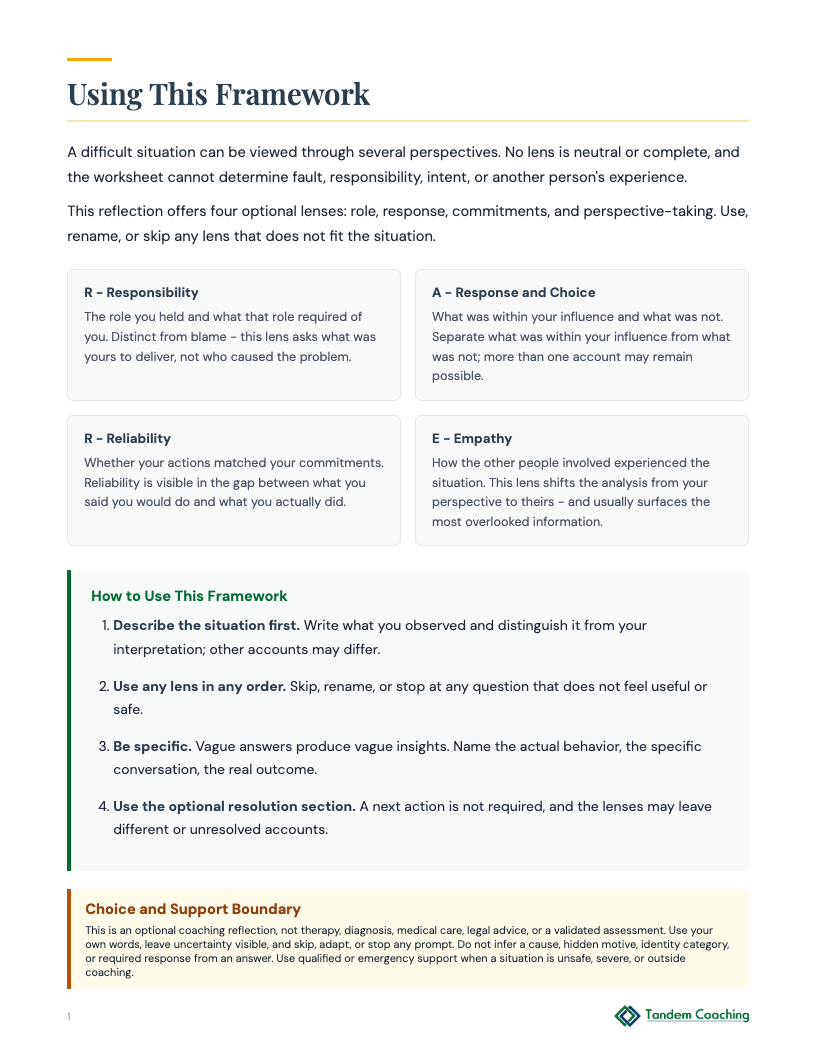
R.A.R.E. Reflection Framework

A structured, coach-tested method to spot where you’re owning your part vs deflecting, and choose a clearer next step.

Framework · 30 min · Print-ready PDF · Free download

Get This Tool

Free PDF - professionally formatted, ready to print or fill digitally

Preview Framework · 30 min
R.A.R.E. Reflection Framework - preview
When to Use This Tool
I want to reflect on my behavior and understand where I'm owning my part and where I'm deflecting
I'm working on being more accountable and I want a structured way to examine that
I talk about empathy and reliability as values but I'm not sure I'm living them consistently
How to Introduce This Tool Plus

Some clients find it useful to reflect on a specific situation using a framework that examines responsibility, accountability, reliability, and empathy as distinct lenses - would that kind of structured reflection be useful for something you're working through?

Browse All Pages
Interactive Preview Framework · 30 min
Tool Classification
Domain
Life Coaching
Type
Framework
Phase
Discovery Reflection
Details
30 min Mid session As-needed
Topics
Accountability Mindset Values

For the Coaching Practitioner

Plus
Coaching Scenarios Plus
1 Director who missed a key delivery and is handling feedback defensively
Context

A director missed a significant project deadline and has spent two sessions explaining why the failure was structural, organizational, or attributable to teammates. They can articulate responsibility in theory but deflect when it's applied to their specific situation. The unresolved dynamic is starting to affect their relationships with peers.

How to Introduce

Position this as a situation analysis, not accountability enforcement. 'There's a framework that looks at four separate dimensions - what you were responsible for, what you're accountable for, whether you were reliable, and how others experienced it. It's designed to give you more precision than just asking whether something was your fault.' Clients in defensive mode often resist because they read this as blame assignment. Name it upfront: 'These four lenses aren't a verdict. They're a map of the full picture, including your own.'

What to Watch For

The Accountability section is diagnostic. If the client fills the Responsibility section fully and the Accountability section with explanations rather than ownership statements, they're distinguishing between what they were supposed to do and what they're willing to own. Watch for the Empathy section specifically - clients who fill every other section but write minimally here have often not genuinely considered how others experienced the situation. The Resolution section is equally telling: a vague 'next action' ('have a conversation,' 'follow up') suggests the client knows what needs to happen but isn't ready to commit.

Debrief

Start with the Resolution section. Ask them to read their next action aloud. If it's vague, stay there: 'Who is the conversation with, and what specifically are you going to say?' Then move backward through the four lenses, spending the most time on Accountability. 'You wrote that you owned the outcome - what does that look like in practice with the people who were affected?' The question that tends to open this is: 'If you were fully accountable, what's the conversation you'd be having that you haven't had yet?'

Flags

If the Empathy section is blank or minimal after one round of the exercise, and the client is unwilling to consider how others experienced the situation even when prompted, this may indicate a pattern beyond this specific situation. Severity: moderate. Note whether the empathy gap appears consistently. Coaching can continue but may need to explicitly address perspective-taking capacity before accountability conversations become productive.

2 Manager whose direct report feels let down after a promised promotion didn't materialize
Context

A manager told a high-performing direct report that they would advocate for their promotion. The advocacy didn't happen - not through malice, but through competing priorities and lack of follow-through. The direct report now feels misled, trust is damaged, and the manager is struggling to know what to own versus what to attribute to organizational constraints.

How to Introduce

Frame this as preparation for a repair conversation, not just reflection. 'Before you have the conversation with your direct report, it might be useful to work through what you're actually accountable for here - separately from what you were constrained by. The framework separates those things explicitly.' The Reliability section is often the most uncomfortable for this scenario: did the client do what they said they would do? Position that question as something to examine before the conversation, not after.

What to Watch For

Watch the Reliability section. Clients who answer 'Did I do what I said I would do?' with context ('I tried, but the timeline changed / my manager wasn't supportive') are not fully engaging with the reliability question. The answer to whether they did what they said is factual. Watch also for the Empathy section - clients who describe the direct report's experience in terms of what they probably felt ('disappointed, I assume') rather than what they know from a conversation have a gap in their information that needs to be named.

Debrief

Start with Reliability: read what they wrote and ask, 'Is that a yes or a no?' Once that question has been answered plainly, the rest of the framework has more traction. Then move to Accountability: what does owning this outcome look like? 'Your direct report needs to understand what happened. What are you going to tell them about your part in it - not the organizational story, your part?' Close with the Resolution section: what's the first conversation, and what are you committed to saying in it?

Flags

If the client describes the situation primarily through organizational framing - process failure, leadership support gap, timing - across all four lenses without once using first-person ownership language, the coaching may need to address their relationship to accountability more broadly before this situation can be resolved. Severity: low to moderate. This is common and coachable. If it persists across multiple sessions and multiple situations, it becomes a higher priority pattern.

3 Team lead whose inconsistency is eroding peer trust in a cross-functional project
Context

A team lead on a high-visibility cross-functional initiative has committed to deliverables in three separate meetings and delivered inconsistently. Peers have stopped counting on them. The client attributes it to competing demands and unclear prioritization from above, but the pattern has repeated across contexts. They want to be seen as reliable but haven't examined what reliability actually requires of them.

How to Introduce

Introduce this between sessions as preparation for an honest self-assessment. 'The R.A.R.E. framework is useful for a situation where you can see the impact but aren't sure what to own. Work through a recent instance - one where you made a commitment and didn't deliver - using all four lenses.' The Reliability section is the anchor for this scenario. Frame it as a precision exercise: 'Not whether you intended to do it, but whether you did it.'

What to Watch For

In the Reliability section, watch for answers that explain rather than assess. 'I wasn't able to complete it because...' is an explanation. 'No - I did not do what I said I would do' is an assessment. The distinction matters because explanations, even accurate ones, don't produce change. Also watch the Responsibility section - clients who define their responsibility narrowly ('I was responsible for the output, not for managing around the constraints') are setting themselves up for the same outcome next time.

Debrief

Start with the Situation description. Ask them to read it to you as if they were describing someone else's situation. Then ask: 'Now stay with the Reliability section. What's the honest answer to whether you did what you said?' Once that's established plainly, move to Resolution. 'What would it take to be reliable in this specific situation going forward - not in general, but for this project with these people?' The Empathy section often surfaces the real cost: asking the client to name how peers have experienced the inconsistency is often more motivating than the self-assessment.

Flags

If the client consistently places all four lens answers in external contexts - organizational constraints, competing demands, others' failures - without once writing something that is entirely within their own control, the coaching needs to address the attribution pattern directly before this exercise will have impact. Severity: low. Reframe the lenses as a calibration tool: 'Of the four, which one is most fully yours - regardless of what else is true?'

4 Executive whose lack of follow-through on team commitments is becoming a cultural signal
Context

A senior executive makes commitments in town halls and team meetings that they do not follow through on. The pattern has been named by their HR business partner and is visible in engagement survey comments. The executive is not dismissive - they take it seriously - but they haven't yet connected the pattern to specific behaviors they can change. They see it as a capacity problem, not an accountability one.

How to Introduce

Position this as a leadership calibration exercise. 'There's a framework that separates four things that often get blurred - what you were responsible for, what you're accountable for, whether your team experienced you as reliable, and how they experienced the situation emotionally. Let's apply it to one specific instance from the last quarter.' The Empathy section is especially important for this scenario because the cultural signal is about how the team experienced the pattern, not just what happened.

What to Watch For

Watch whether the executive can name a specific instance rather than describing the pattern in the abstract. 'I tend to over-commit' is a pattern statement. 'In the March all-hands I said I would have the new comp structure decision out by April 15th and it's now June' is an instance. Specificity is the diagnostic - executives who remain abstract may be managing discomfort by staying at altitude. Also watch the Accountability section: does the client distinguish between what they're accountable for and what is genuinely outside their control, or do they collapse everything into organizational complexity?

Debrief

Start with the Resolution section. Ask them to read their next action. Then ask: 'What are you going to say to your team - not about the situation, but about your part in it?' The direct acknowledgment to the team is often the high-leverage move that executives avoid. Work backward through the lenses, ending with Empathy: 'If you had experienced this pattern from your own leader, what would it have told you about their priorities?' The question puts them on the receiving end without making it therapeutic.

Flags

If the executive describes the commitment gap as a system failure or a process gap without including their own decision-making as a factor, the exercise won't produce useful output. Severity: low. The coaching move is to ask: 'Of everything you've written in the four sections, what's the part that only you can change?' Keeping the focus on the one thing in their control often breaks the pattern of distributed attribution.

Tool Flow Plus
Requires
  • specific recent situation to examine
Produces
  • four-lens situation analysis completed
  • named accountability gaps and reliability shortfalls
  • concrete next action with deadline

Pairs Well With

Life

Yes / No / Maybe Assessment

Client knows what they should do but hasn't fully committed to it

5 min Assessment
Life

Life Setting

Client is approaching a new goal but hasn't grounded it in their genuine motivations

15 min Worksheet
Career

Empower Yourself at Work

Client knows they're unhappy at work but hasn't named what specifically energizes them versus drains them

15 min Worksheet

Related Articles

How to Find an Executive Coach: 8 Steps That Work

How to Find an Executive Coach: 8 Steps That Work

Read article →
ICF Core Competencies: Empathy, Neutrality, and Vulnerability

ICF Core Competencies: Empathy, Neutrality, and Vulnerability

Read article →
Getting to 85 - Agile Metrics with ActionableAgile Part 1

Getting to 85 - Agile Metrics with ActionableAgile Part 1

Read article →
Getting to 85 - Agile Metrics with ActionableAgile Part 2

Getting to 85 - Agile Metrics with ActionableAgile Part 2

Read article →
Getting to 85 - Agile Metrics with ActionableAgile Part 3

Getting to 85 - Agile Metrics with ActionableAgile Part 3

Read article →
Definition of Done – More Than a Checklist

Definition of Done – More Than a Checklist

Read article →