See who’s truly in your corner by mapping your current support network, so you feel less alone and know who to reach out to.
Free, print-ready PDF.
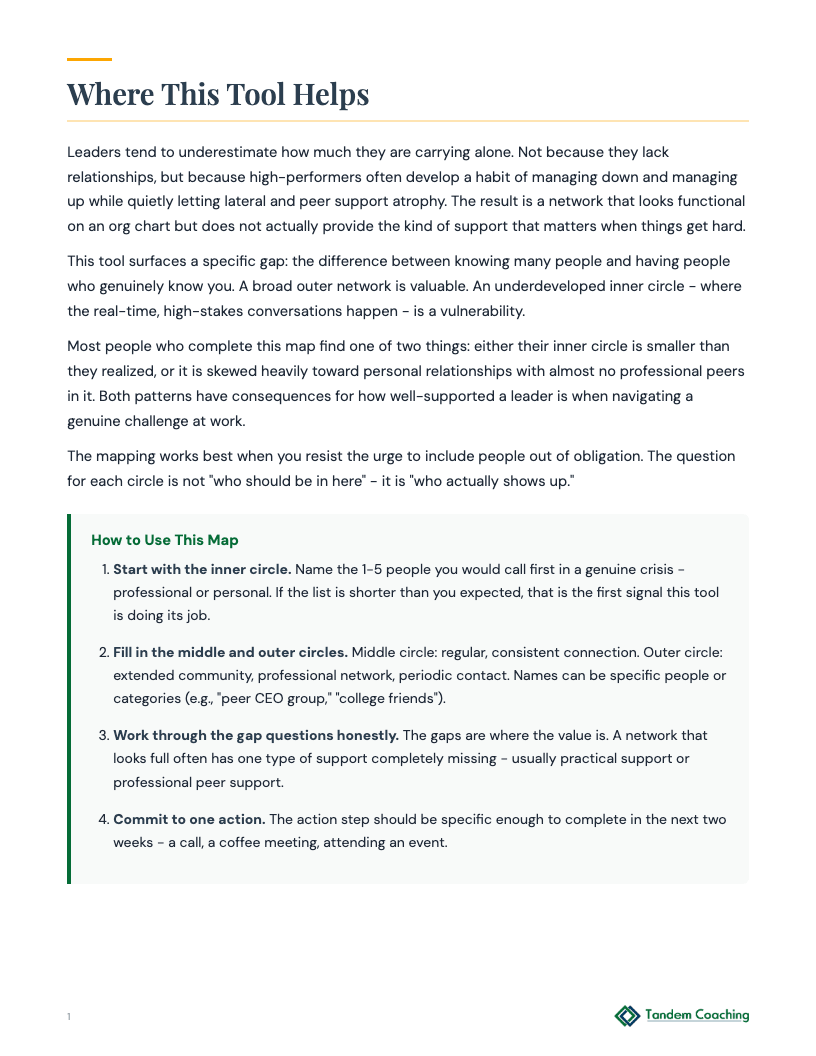
When things get difficult, who in your life do you actually turn to — and are there kinds of support you're not getting that you genuinely need?
Your client is navigating a significant transition - a job change, a divorce, a relocation - and is doing it with a vague sense that they are on their own. When you ask who is in their corner, they give you a list of people who care about them but cannot describe what any particular person provides. They have not thought about their network structurally. They experience support as something that either appears or does not, not as something that can be mapped, understood, and strengthened. The circles exercise is the right first move before any action planning.
Frame this as creating visibility, not measuring adequacy. 'The map does not tell you whether you have enough support - it shows you what you have and where the specific gaps are. Most people are surprised by what they find, in both directions.' The resistance pattern: clients in the middle of hard transitions sometimes resist mapping their network because they are afraid the map will confirm they are more alone than they thought. Name that directly: 'You might find the map is more populated than you expected. Or it might show a specific gap we can address. Either outcome is more useful than the vague sense of being on your own.'
Watch whether the inner circle ends up empty or with only one name. A single-name inner circle is not necessarily a problem - some people have one person they deeply trust - but it is a structural vulnerability. If that one person is not available, the client has no inner circle fallback. Also watch the five support type grid. A network that is rich in Emotional support but has no Challenge support tells a different story than one that is all Professional support with no Social. The specific pattern of gaps tells you where the action step should point.
After the map is complete, ask: 'Where on this map do you feel most solid, and where do you feel most thin?' That question lets your client interpret their own data rather than receiving your interpretation. Then move to the five support types: 'Which of these five types is most missing right now - not in general, but given specifically what you are navigating?' The one-action-step section should name one person, one type of support, and one specific next contact. If it is abstract, work through making it concrete together.
If the map reveals that a client's inner circle is genuinely very small - one person or none - and they are in a high-stress period, the gap is not just an observation but a risk. Severity: low to moderate. Response: the action step is the right intervention, but name directly that building inner circle depth is a medium-term goal worth explicit attention, not just a box to check.
Your client is well-networked by professional standards. They have mentors, industry contacts, and peers across multiple organizations. When they complete the circles, the outer ring is full and the middle ring is moderately populated. The inner circle has one or two names. The five support types show a clear pattern: Professional and Social support are plentiful; Challenge and Emotional support are nearly absent. They have built a network that is excellent for career advancement and terrible for the moments when they are actually struggling.
Frame this as a portfolio audit, not a verdict on their relationships. 'You have built a specific kind of network - one that serves some functions very well and underserves others. The map helps you see which functions you have covered and which ones are structurally absent.' The resistance pattern: professionally successful clients sometimes read a sparse inner circle as normal or even as a sign of self-sufficiency. Name that the absence of Challenge support specifically - someone who will tell you when you are wrong - is a professional risk, not just a personal one.
Watch the Challenge support row in the five support types. Clients with wide networks but thin inner circles often write names in Challenge support that they would actually not call when they need to be challenged - they write names of people they respect rather than people who actually push back. Ask directly: 'When you wrote that name in Challenge, have they actually told you something you did not want to hear in the last year?' Also watch whether Emotional support has any names at all. A complete absence of emotional support in a high-achieving leader's network is a specific finding worth naming.
Ask your client to look at the outer ring and the inner circle side by side: 'What do you notice about the ratio?' That observation often opens a real conversation about how the network was built and what it was built for. Then ask: 'If you were navigating something genuinely hard - not a professional problem but a personal one - who would you actually call?' The answer to that question usually surfaces who the real inner circle is, which is often different from what was written.
If your client's network imbalance means they have no one providing Challenge support - no one who will tell them they are wrong - and if they are in a senior role where that kind of input matters for decision quality, the gap has professional consequences. Severity: moderate. Response: name the professional risk directly alongside the personal gap.
Your client went through a period - a demanding job, a health crisis, a difficult relationship - during which they withdrew from most of their relationships. The people who were in their middle and outer circles are now distant. Some relationships have recovered; many have not. Your client can see clearly what they lost. What they cannot do is take action on rebuilding because the gap feels so large that starting anywhere feels inadequate. The map gives the situation structure and surfaces where the most viable rebuilding actions are.
Frame the map as a damage assessment with a forward application. 'The map shows you what you have right now - not what you had three years ago, not what you want to have. It also tells you where the most viable next move is. You are not rebuilding everything at once; you are identifying the one relationship that is closest to reactivation.' The resistance pattern: clients who have withdrawn from their network sometimes experience the mapping exercise as confronting a loss they have not yet grieved. Name that completing the map may feel harder than expected, and that is relevant information.
Watch whether your client writes people in the inner or middle circle who are actually no longer available to them - people whose relationships have genuinely ended or cooled beyond reactivation. If the map contains names that represent who the client wishes were close rather than who actually is, the data is not accurate. Ask directly: 'When you write this person's name in the middle ring - when did you last speak?' Also watch the one-action-step section. Clients rebuilding from a withdrawn period often name an action that is too large (reaching out to everyone) or too vague (reconnecting with people I've lost touch with).
After the map is complete, ask: 'Which relationship on this map feels most worth investing in right now - not the hardest to rebuild, but the one where something is still alive?' That question identifies the highest-probability action. Then ask: 'What specifically would reaching out to that person look like - what would you say, and what would you be asking for?' Getting to a specific sentence is the difference between a plan and an intention.
If the withdrawal period was caused by a mental health episode, a substance use period, or another significant personal crisis, the network map is appropriate but the rebuilding work may be more complex than a single action step. Severity: moderate. Response: continue with the tool, but note whether the client needs support structures beyond relationship rebuilding - and whether any referral conversations are warranted.
I know which relationship situations I struggle with but I haven't figured out what to do differently
RelationshipsA client needs to have a hard conversation and wants to prepare before going in
RelationshipsMy client is going through something hard and seems to be handling it completely alone