Burnout Risk Assessment
Identify whether your constant fatigue is temporary stress or burnout risk using a research-based assessment and clear, actionable results.
Get This Tool
Free, print-ready PDF.
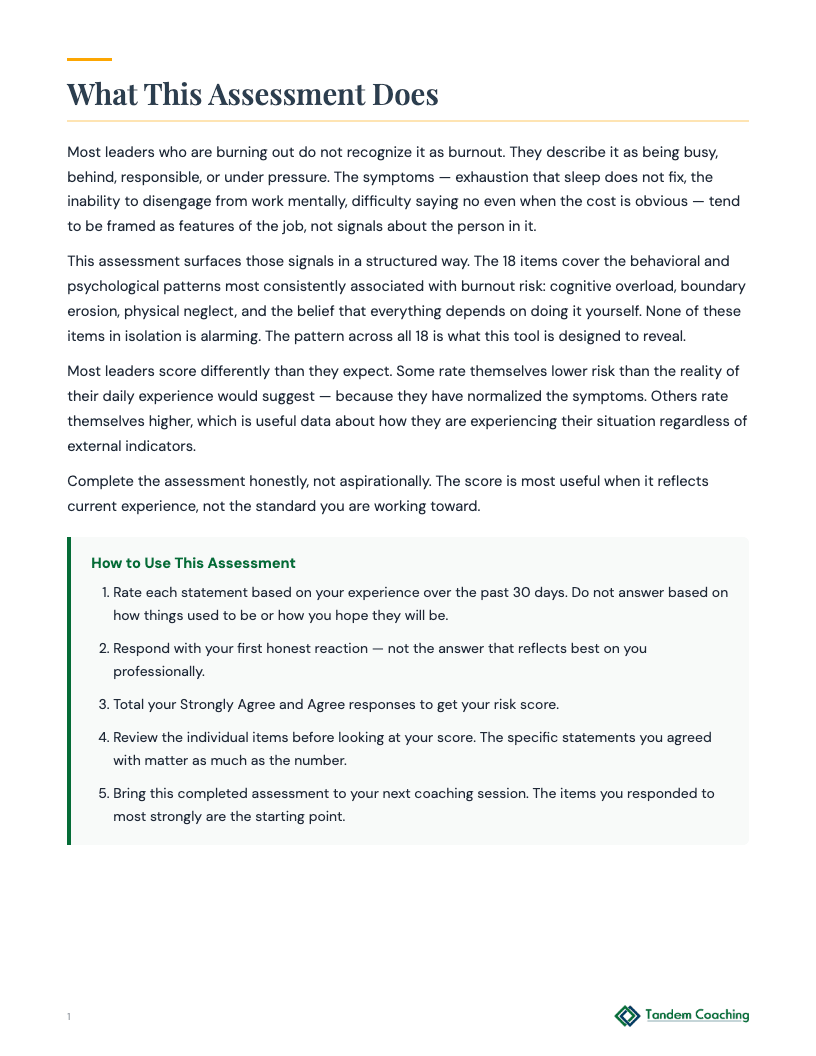
When to Use This Tool
A client who says they're tired all the time but attributes it to a busy season that never seems to end
Someone whose performance has started to slip and they're not sure if it's motivation or something deeper
A high-achiever who's started dreading work and can't explain why
How to Introduce This Tool Plus
This is a non-diagnostic reflection, not a burnout score. Which specific work patterns stand out, and which need coaching, organizational, or health support?
Coaching Tool Disclaimer
This tool is designed for coaching contexts, not clinical use. If you or your client is in crisis, contact the 988 Suicide and Crisis Lifeline (call or text 988) or Crisis Text Line (text HOME to 741741).
Browse All Pages
Tool Classification
Domain
Wellness
Type
Assessment
Phase
Discovery
Details
15 min
Opener
Monthly
Topics
Self-Care
Resilience
For the Coaching Practitioner
Plus
Coaching Scenarios
Plus
1 Executive who insists their 70-hour weeks are temporary until the merger completes ▶
Context
C-suite executive leading a complex merger integration, working 70+ hour weeks for eight months. Came to coaching for 'strategic leadership development' but mentions exhaustion in passing. Frames the workload as necessary and temporary, despite no clear end date for integration work.
How to Introduce
Position this as a baseline measurement, not a problem diagnosis. 'Before we work on strategic priorities, let's map your current operating state. This isn't about whether you should be working these hours - it's about understanding the cost so you can make informed choices.' Expect resistance to framing anything as unsustainable.
What to Watch For
Speed of completion indicates engagement level. If they rush through in under five minutes, they're dismissing the relevance. Watch for items 8, 11, and 13 - vacation, mental disengagement, and hour creep. These executives often underrate items 9 and 18 (guilt and proving worth) despite these driving the other behaviors.
Debrief
Start with items 1 and 7 - control and overwhelm. Ask: 'You rated feeling overwhelmed as Agree, but you also said you have control. Walk me through how those both exist.' Then move to the temporal items: 'What would need to change about the merger timeline for you to work 50-hour weeks instead of 70?'
Flags
If items 10, 11, and 14 are all Strongly Agree - exhaustion despite sleep, inability to mentally disengage, and neglecting health - the pattern extends beyond workload to nervous system dysregulation. Severity: moderate. Continue coaching but address the physical symptoms directly, potentially with medical consultation.
2 Department head who scores surprisingly low despite team expressing concern about their availability ▶
Context
Mid-level manager whose team has complained to HR about their unavailability and mood changes. The manager requested coaching to 'improve team dynamics' and genuinely believes they're managing stress well. They exercise regularly and maintain some boundaries, but something isn't adding up.
How to Introduce
Frame as a calibration tool between self-perception and impact. 'Your team's feedback suggests they're seeing something you might not be experiencing internally. This assessment helps us understand the gap.' Don't mention the HR complaints directly - let the tool surface the disconnect organically.
What to Watch For
Look for selective awareness patterns. They may accurately rate physical items (sleep, exercise) as low risk but miss relational ones (items 4, 12, 18). Pay attention to items they skip or spend extra time on. Neutral responses often indicate areas where they lack self-awareness rather than genuine middle ground.
Debrief
Start with their lowest scores and ask for specific examples. 'You marked Disagree on feeling guilty when not working. Tell me about last weekend.' Then contrast with team feedback: 'Your team mentioned you seem stressed. Looking at your responses, where might that impression come from if you're not feeling it internally?'
Flags
If they score 1-6 but items 16 and 18 are Strongly Agree - can't delegate, need to prove worth - the low score masks control patterns that create stress for others. Severity: low. The issue may be leadership impact rather than personal burnout, requiring different coaching approach focused on delegation and trust.
3 Startup founder who treats burnout symptoms as productivity features ▶
Context
Founder of a Series A startup, 18 months post-funding, working to hit growth targets for Series B. Views their ability to work without breaks, think constantly about the business, and sacrifice personal needs as competitive advantages. Came to coaching for 'scaling leadership skills' as the team grows.
How to Introduce
Reframe as a sustainability audit, not a wellness check. 'Founder burnout is the number one reason startups fail after Series A. This isn't about work-life balance - it's about protecting your ability to make good decisions under pressure.' Position symptoms as risk factors to business outcomes, not personal problems.
What to Watch For
They may rate items 9, 11, and 16 as Strongly Agree but frame them positively during completion - 'of course I think about work constantly, that's my job.' Watch for pride in high scores rather than concern. Items 1 and 7 (control and overwhelm) often get contradictory responses from founders who feel simultaneously in control and overwhelmed.
Debrief
Start with the business case, not the personal cost. 'You agreed strongly with thinking about work while relaxing. What decisions have you made in the past month while exhausted that you might have made differently when fresh?' Then: 'What would need to be true about your team for you to think about work 20% less?'
Flags
If items 10, 14, and 17 are all Strongly Agree - exhaustion, neglecting health, procrastinating on important tasks - the cognitive load is affecting decision quality. Severity: high. This pattern in founders often precedes serious strategic mistakes. Address immediately and consider whether they need operational support before continuing leadership coaching.
4 Recently promoted manager who cannot distinguish normal adjustment stress from burnout risk ▶
Context
Individual contributor promoted to management six months ago, struggling with the transition. Everything feels hard and overwhelming, but they're unsure if this is normal new-manager adjustment or something more concerning. Seeking coaching to 'figure out if I'm cut out for this role.'
How to Introduce
Position as a diagnostic tool to separate role adjustment from unsustainable patterns. 'New management is inherently stressful, but some stress patterns are temporary and others compound. This helps us identify which category you're in so we know what to work on first.' Normalize that some items will reflect the learning curve.
What to Watch For
New managers often score high on items 7, 12, and 15 (overwhelm, can't say no, disorganization) due to role transition rather than burnout patterns. The telling items are 9, 11, and 18 - guilt, mental preoccupation, and proving worth. These indicate identity fusion with the role rather than skill gaps.
Debrief
Separate transition stress from burnout indicators. 'Items 7 and 15 - feeling overwhelmed and disorganized - are normal for new managers. But you also strongly agreed with needing to prove your worth. What would it look like to be a manager without constantly proving you deserve the role?' Focus on the identity items first.
Flags
If items 9, 11, and 18 are all Strongly Agree while items related to workload and organization are moderate, the issue is imposter syndrome creating unsustainable work patterns rather than role demands. Severity: moderate. Address the identity component before skill development, or the coaching will reinforce the proving pattern.
Tool Flow
Plus
Requires
- None - standalone tool
→
Produces
- specific workload and boundary observations
- items needing attention
- questions for coaching, organizational, or health support
Pairs Well With
ADHD
Optional Week Review
Use this worksheet to explore executive function and accountability and turn the client’s observations into one optional next step.
Why it pairsUse it after the assessment to track whether energy actually shifts week over week as the client acts on the flagged behavior.
WellnessOptional Wellbeing Intentions
Use this worksheet to explore self care and values and turn the client’s observations into one optional next step.
Why it pairsOnce you have a risk score, this narrows the cause - pinpointing which of five domains is driving the depletion.
ADHDFeeling Context and Support Notes
Use this framework to structure a conversation about emotions and mindset while keeping interpretation with the client.
Why it pairsOnce you have named symptoms, use this to give the client a zone-matched action plan they can apply between sessions.
Related Articles


Executive AI Vulnerability Assessment | Know Where You Stand
Read article →Human Performance Under Pressure: What Organizational Coaching Addresses
Read article →
High-Performance Coaching for Executives: What It Is and How It Works
Read article →