Anxiety Breakdown Worksheet
Turn vague, overwhelming anxiety into clear triggers, thoughts, and next steps using an ADHD-informed breakdown used in evidence-based coaching.
Get This Tool
Free, print-ready PDF.
When to Use This Tool
A client is experiencing anxiety that feels undifferentiated and hard to work with
A client wants to break an anxious experience into its components to see it more clearly
A client is avoiding something because the anxiety around it feels too large to examine
How to Introduce This Tool Plus
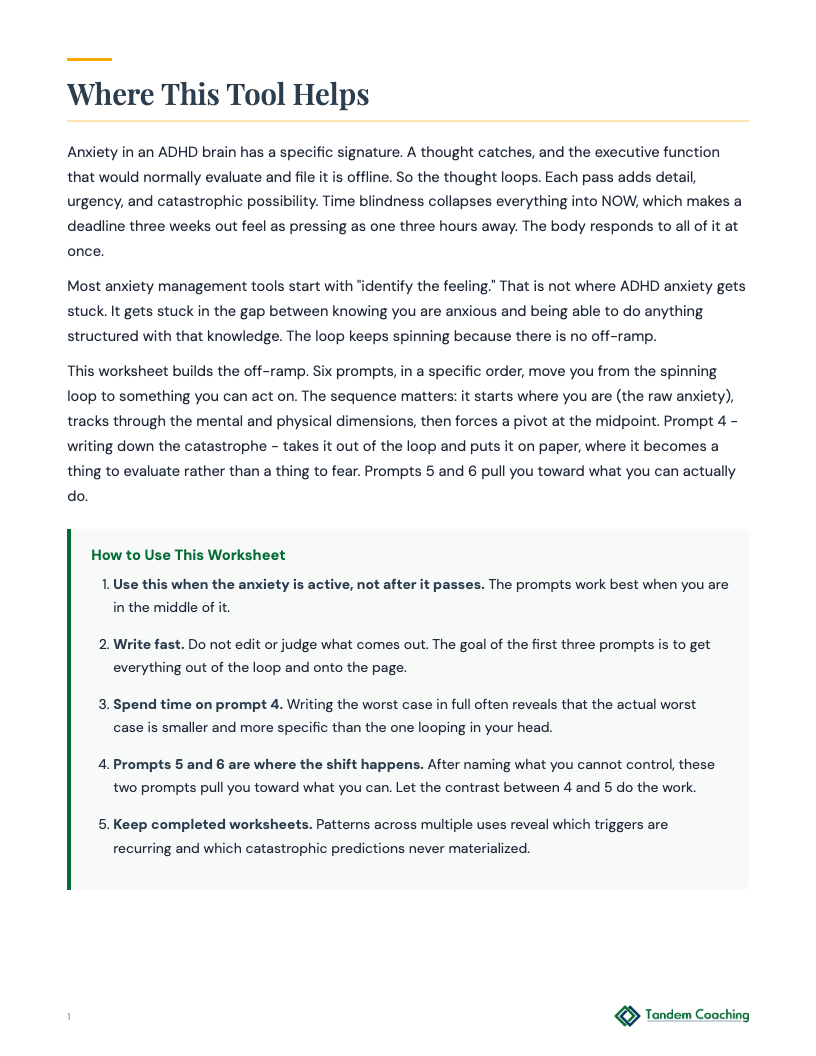
Anxiety often feels like one big undifferentiated thing. This worksheet breaks it into six components - trigger, body response, thoughts, behaviors, impact, and what you'd tell a friend - so it's smaller and more workable.
Coaching Tool Disclaimer
This tool is designed for coaching contexts, not clinical use. If you or your client is in crisis, contact the 988 Suicide and Crisis Lifeline (call or text 988) or Crisis Text Line (text HOME to 741741).
Browse All Pages
Tool Classification
Domain
ADHD
Type
Worksheet
Phase
Action
Reflection
Details
15 min
Between sessions
As-needed
Topics
Emotions
Mindset
Identity
For the Coaching Practitioner
Plus
Coaching Scenarios
Plus
1 Marketing director paralyzed by upcoming product launch presentation to board ▶
Context
Marketing director at a tech startup, three weeks before presenting launch strategy to the board. Has ADHD, medicated but struggling with executive function under pressure. Thinks the problem is imposter syndrome but keeps cycling through worst-case scenarios without landing on preparation steps.
How to Introduce
Frame this as a circuit breaker, not self-reflection. 'Your brain is stuck in a loop about this presentation. This worksheet interrupts the loop and gets the anxiety out of your head so we can see what we're actually working with.' Expect resistance to prompt 4 - many clients think naming the worst case will make it more likely to happen.
What to Watch For
Prompts 1-3 completed in under five minutes signals surface engagement. Look for specificity in prompt 2 - vague thoughts like 'I'll fail' versus detailed scenarios. If prompt 4 is shorter than prompts 1-3, the client is avoiding the catastrophic thinking that's actually driving the loop.
Debrief
Start with prompt 4, not prompt 1. 'Read me what you wrote for the worst case scenario.' Then ask: 'How much of your mental energy has been going to that specific outcome?' The gap between the written worst case and the felt intensity of the anxiety is where the coaching conversation lives.
Flags
If prompts 1-3 describe physical symptoms that interfere with daily function (can't sleep, can't eat, panic attacks), the anxiety may be beyond coaching scope. Severity: moderate. Response: continue with the worksheet but assess whether the client needs medical support for the physical symptoms.
2 Operations manager avoiding difficult conversation with underperforming team member ▶
Context
Operations manager at a manufacturing company, avoiding a performance conversation with a long-term employee who isn't meeting new quality standards. The conversation has been postponed three times. Client frames this as 'not wanting to hurt feelings' but anxiety spikes every time the topic comes up.
How to Introduce
Position this as preparation, not avoidance processing. 'Before we plan the conversation, let's map what's making it feel so charged for you.' Many clients resist this tool for interpersonal anxiety because they think the anxiety is about the other person. It's usually about their own competence or safety in conflict.
What to Watch For
Prompt 1 will likely focus on the employee's reaction rather than the client's own fears. Prompt 4 is diagnostic - if the worst case is about the employee quitting or getting upset, the client is externalizing. If it's about being seen as incompetent or cruel, that's the real anxiety.
Debrief
Focus on the shift between prompts 4 and 5. 'You wrote that the worst case is being seen as a bad manager. Then in prompt 5, you wrote that you can control how you deliver the message. What happens to the anxiety when you read those back to back?' This contrast often reveals that the client has more agency than the anxiety allows them to feel.
Flags
If the client cannot identify anything they can control in prompt 5, or if prompt 6 is blank, they may be in a learned helplessness pattern that goes beyond this situation. Severity: low to moderate. Response: explore whether this avoidance pattern shows up in other areas of their leadership.
3 Project manager with ADHD facing first major client presentation after medication change ▶
Context
Senior project manager at a consulting firm, recently changed ADHD medication and experiencing different anxiety patterns. Has a high-stakes client presentation in two days. Previous medication dampened anxiety but also creativity. New medication allows more emotional range but anxiety feels unfamiliar and harder to manage.
How to Introduce
Frame this as calibration, not crisis management. 'Your anxiety system is recalibrating with the medication change. This worksheet helps you separate what's medication adjustment from what's situational stress.' Normalize that anxiety patterns change with medication changes - this isn't regression, it's adaptation.
What to Watch For
Prompt 3 (body response) will likely be more detailed and intense than with previous medication. Look for the client comparing current anxiety to how it felt before. If prompts 1-2 are about the medication rather than the presentation, the real anxiety is about losing pharmaceutical support for executive function.
Debrief
Start with prompt 3 and work backward. 'Your body is responding differently than it used to. What does that tell you about what you need right now?' Then move to prompt 6: 'What worked for calming your body before may not work now. What feels right with how your system is operating today?'
Flags
If the client expresses regret about the medication change or wants to switch back before the presentation, the anxiety may be masking grief about losing a coping mechanism that worked. Severity: moderate. Response: continue coaching but consider whether they need medical consultation about the transition timeline.
4 Finance director discovers significant budget error three days before quarterly review ▶
Context
Finance director at a mid-size nonprofit, found a calculation error that overstated available funds by 15%. Quarterly board meeting is in three days. Error affects multiple program budgets already approved. Client is catastrophizing about professional reputation and organizational impact.
How to Introduce
Present this as triage, not damage control. 'Right now your brain is trying to solve the budget problem and manage the anxiety at the same time. This worksheet separates those two tasks.' The client will want to skip to problem-solving. Insist on completing the anxiety breakdown first - they can't think clearly while the loop is running.
What to Watch For
Prompt 2 will likely jump between self-blame and solution attempts. If the thoughts are more about professional consequences than fixing the error, the anxiety is about identity, not the mistake itself. Prompt 4 often reveals fears about competence that go beyond this situation.
Debrief
Focus on prompt 5 after reading prompt 4 aloud. 'The worst case you wrote is about losing credibility. What you can control is how you present the error and the correction plan. How do those two things relate?' This often shifts the client from shame-based thinking to professional problem-solving mode.
Flags
If prompt 4 includes thoughts about being 'found out' as incompetent or references to other mistakes, the client may have imposter syndrome that this error has activated. Severity: low. Response: continue with the immediate situation but note the pattern for future sessions.
Tool Flow
Plus
Requires
- active anxiety episode with named situation
→
Produces
- decomposed anxiety record with trigger and body response
- named worst-case scenario in writing
- identified controllable action steps
Pairs Well With
ADHD
ADHD vs Depression Comparison
A client wants to organize focus and mood observations before speaking with a licensed clinician
Why it pairsOnce anxiety is broken into its components, this framework helps you spot whether ADHD or depression patterns are driving the picture.
LifeConfidence Evidence and Learning Notes
Use this worksheet to explore identity and mindset and turn the client’s observations into one optional next step.
Why it pairsAfter the client names controllable steps, this scale shows whether their block is awareness or the ability to act on it.
ADHDCheck the Facts Worksheet
A client's emotional reactions feel valid but may be based on interpretation rather than fact
Why it pairsAfter the worst-case scenario is written down, this worksheet tests whether the client's anxiety is proportional to actual facts.
Related Articles


Adaptive ADHD Leadership: 7 Strategies That Work
Read article →
ADHD Mentorship: Support Networks That Work
Read article →
Leading With ADHD: Executive Leadership Strategies That Work
Read article →
ADHD Productivity: 9 Work Strategies That Stick
Read article →