
ACT Acceptance Worksheet
Defuse from sticky ADHD thoughts and feelings that trigger avoidance using an evidence-based ACT acceptance exercise used in therapy.
Get This Tool
Free, print-ready PDF.
When to Use This Tool
A client is fusing with difficult thoughts or feelings in a way that drives avoidance
A client wants to practice psychological acceptance rather than control or suppression
A client is working on separating themselves from the content of their thinking
How to Introduce This Tool Plus
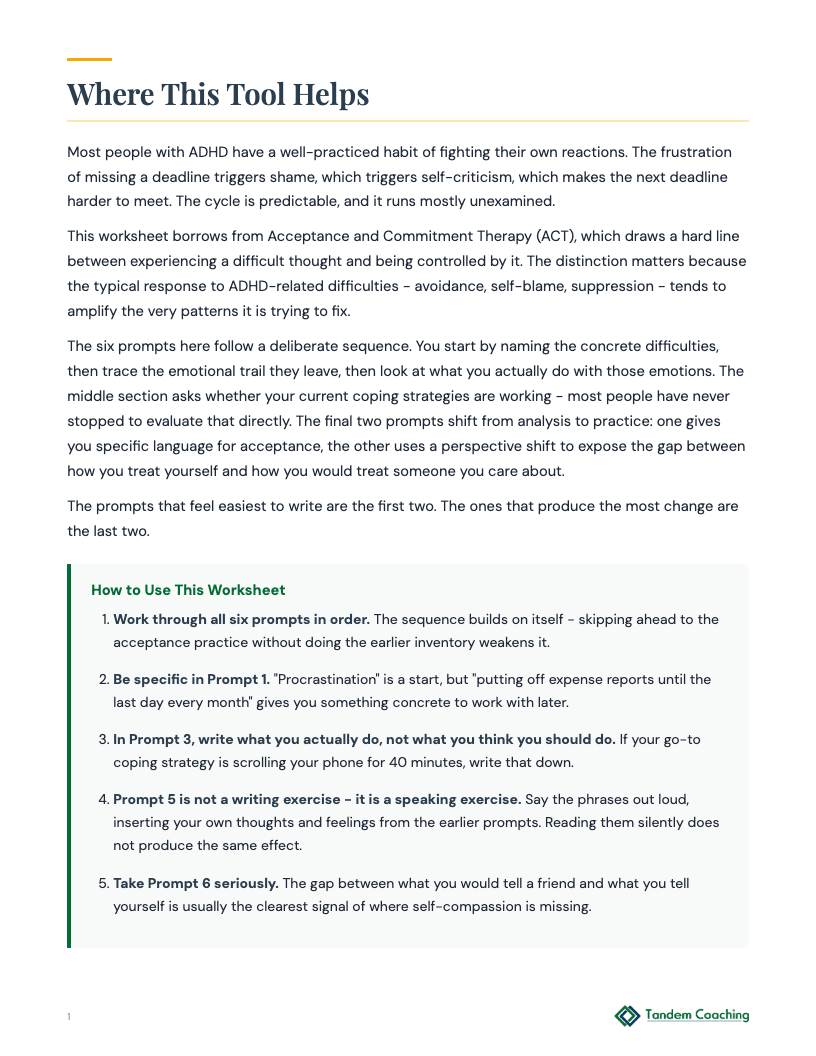
ACT takes a different angle on difficult thoughts and feelings - instead of trying to change them, it asks what it would look like to carry them without letting them steer. These six prompts walk through that process.
Coaching Tool Disclaimer
This tool is designed for coaching contexts, not clinical use. If you or your client is in crisis, contact the 988 Suicide and Crisis Lifeline (call or text 988) or Crisis Text Line (text HOME to 741741).
Browse All Pages
Tool Classification
Domain
ADHD
Type
Worksheet
Phase
Action
Reflection
Details
15 min
Between sessions
As-needed
Topics
Mindset
Identity
Emotions
For the Coaching Practitioner
Plus
Coaching Scenarios
Plus
1 Marketing director overwhelmed by constant context switching and reactive work patterns ▶
Context
A marketing director at a fast-growth startup manages five direct reports while juggling campaign launches, budget reviews, and executive requests. Recently diagnosed with ADHD at 34, she's realizing her coping strategies - working nights and weekends to catch up - are unsustainable as the company scales.
How to Introduce
Frame this as emotional inventory, not self-improvement. 'Before we look at time management or delegation, let's map what's happening internally when the day goes sideways.' Many newly diagnosed adults resist acknowledging emotional responses because they've spent years powering through them. Name that: 'This isn't about fixing feelings - it's about noticing what they're already doing to your decisions.'
What to Watch For
Prompt 3 reveals the real coping patterns. If she writes 'stay organized' or 'work harder' instead of 'check email obsessively' or 'snap at my team,' she's performing competence. Watch completion time on Prompts 2 and 6 - if Prompt 2 takes 30 seconds and Prompt 6 takes 5 minutes, the self-compassion gap is significant.
Debrief
Start with Prompt 4 - the impact assessment. Most clients skip past this or write generic answers. Ask: 'Read me the most specific thing you wrote about how your coping strategies affect your behavior.' Then connect to Prompt 6: 'What's the difference between what you just read and what you wrote to your imaginary friend?'
Flags
If Prompt 1 lists only work difficulties and Prompt 2 shows intense shame language, the ADHD diagnosis may be triggering identity crisis beyond executive function challenges. Severity: moderate. Response: explore whether she's grieving the pre-diagnosis narrative about her struggles before moving to acceptance practices.
2 Software engineer avoiding performance review conversations after missing project deadlines ▶
Context
A senior software engineer has missed three consecutive sprint deadlines due to hyperfocus on technical details and difficulty estimating task complexity. His manager scheduled a performance improvement plan meeting next week. He's convinced he'll be fired and has been avoiding his manager's attempts to discuss the situation.
How to Introduce
Present as preparation for the difficult conversation, not emotional processing. 'You have a meeting next week that you're dreading. This tool helps you separate what you're feeling about that meeting from what you need to communicate in it.' Expect resistance to Prompt 2 - many engineers treat emotions as bugs to be fixed rather than information to be processed.
What to Watch For
Engineers often intellectualize Prompt 2 - writing 'concern about job security' instead of 'panic' or 'dread.' If Prompt 3 focuses entirely on technical solutions ('work longer hours,' 'better planning tools') without acknowledging avoidance behaviors, he's not engaging with the emotional component. The gap between Prompts 5 and 6 often surprises technical clients.
Debrief
Start with Prompt 3 and ask: 'Which of these coping strategies are you using right now, in avoiding this conversation with your manager?' Then move to Prompt 5: 'Try saying that first phrase out loud, with your actual feeling from Prompt 2.' The shift from thinking about acceptance to practicing it often creates immediate awareness.
Flags
If Prompt 1 shows only work-related difficulties but Prompt 2 reveals catastrophic thinking ('I'm worthless,' 'I'll never succeed'), the performance issues may be triggering deeper self-worth patterns. Severity: moderate. Response: continue with current session but assess whether the job fear is masking broader identity fusion with work performance.
3 Operations manager who intellectualizes emotions and resists vulnerability in leadership role ▶
Context
An operations manager at a logistics company prides herself on being the 'calm one' during crises. Recently promoted to oversee three departments, she's struggling with decision paralysis and second-guessing herself. She describes her challenges in purely analytical terms and dismisses emotional responses as 'unprofessional.'
How to Introduce
Frame as operational efficiency, not emotional work. 'When you're second-guessing decisions, something is happening in the background that's slowing down your process. This tool identifies what that something is.' She'll likely resist the word 'feelings' - use 'internal responses' or 'background processes' instead. The resistance to emotional language is the point, not a problem to solve.
What to Watch For
Prompt 2 will be the sticking point. She may write 'uncertainty' or 'concern' when the actual experience is anxiety or fear. If she completes Prompts 1-4 quickly but stalls on Prompt 5, the acceptance language feels too vulnerable. Watch for clinical language in Prompt 6 - if she writes advice instead of comfort, she's maintaining emotional distance even from herself.
Debrief
Skip Prompt 2 initially and start with Prompt 4: 'What did you write about how your coping strategies affect your decision-making?' Connect the operational impact to the emotional source. Then return to Prompt 5: 'Try the first phrase with the word 'uncertainty' from Prompt 2. What happens when you say that out loud?'
Flags
If she cannot complete Prompt 5 at all or writes 'this doesn't apply to me,' the resistance to emotional awareness may be structural rather than situational. Severity: low to moderate. Response: continue coaching but focus on behavioral patterns rather than internal states until she develops more comfort with emotional vocabulary.
4 Project manager whose ADHD masking strategies are failing under increased workload ▶
Context
A project manager at a consulting firm has successfully masked her ADHD symptoms for years through elaborate organizational systems and working 60-hour weeks. A recent promotion doubled her project load, and her masking strategies are breaking down. She's making visible mistakes and fears her colleagues will discover she's 'not as competent as they thought.'
How to Introduce
Frame as recalibration, not failure. 'The systems that got you here aren't scaling with your new role. Before we build new ones, let's look at what's happening when the old systems break down.' Many high-masking clients resist acknowledging internal struggle because visibility feels dangerous. Name this: 'This stays between us. The goal is understanding your patterns, not exposing them.'
What to Watch For
High maskers often write socially acceptable versions in Prompts 2 and 3. 'Stress' instead of 'terror,' 'working harder' instead of 'hiding in the bathroom to cry.' If Prompt 6 is significantly more compassionate than her self-talk in Prompt 2, the masking extends to internal dialogue. She may rush through the acceptance phrases in Prompt 5 without actually saying them aloud.
Debrief
Start with the contrast between Prompts 2 and 6. 'Read me what you wrote to comfort a friend, then read what you wrote about your own thoughts and feelings. What do you notice about the difference in tone?' Then ask: 'What would happen if you used the Prompt 6 language on yourself when the masking systems break down?'
Flags
If Prompt 3 reveals only masking behaviors with no authentic coping strategies, or if she cannot identify any self-compassionate responses in Prompt 6, the masking may be so complete that she's lost access to her actual emotional responses. Severity: moderate. Response: focus on small experiments with authenticity rather than full acceptance practices until she rebuilds connection to internal experience.
Tool Flow
Plus
Requires
- None - standalone tool
→
Produces
- named ADHD difficulty and coping pattern inventory
- written acceptance language statements
- self-compassion gap identified via friend reframe
Pairs Well With
ADHD
ADHD vs Depression Comparison
A client wants to organize focus and mood observations before speaking with a licensed clinician
Why it pairsOnce a client names their coping patterns, this comparison clarifies whether they're accepting ADHD traits, depressive patterns, or a mix of both.
LifeConfidence Evidence and Learning Notes
Use this worksheet to explore identity and mindset and turn the client’s observations into one optional next step.
Why it pairsThe self-compassion gap you surface in acceptance work gets a measurable dimension score here, giving you a specific coaching focus.
ADHDCheck the Facts Worksheet
A client's emotional reactions feel valid but may be based on interpretation rather than fact
Why it pairsAfter acceptance language reduces avoidance, this worksheet tests whether the emotions driving that avoidance fit the actual facts of the situation.
Related Articles


Coaching Session Blueprints: What ADHD-Informed Executive Coaching Really Looks Like
Read article →
Why Letting Go Feels Like Losing Control
Read article →
Scaling Coaching Through Systems Thinking
Read article →
ICF Team Coaching Competencies: What They Look Like in Practice
Read article →