ADHD Daily Focus Planner
A simple daily plan for ADHD adults who lose track of time, built on evidence-based coaching to prioritize tasks and stay on track.
Get This Tool
Free, print-ready PDF.
When to Use This Tool
ADHD adult who starts the day without a plan and ends it wondering where the time went
A client who needs a structured daily template with time blocks and a brain dump section
Person whose priority list exists in their head but never gets written down
How to Introduce This Tool Plus
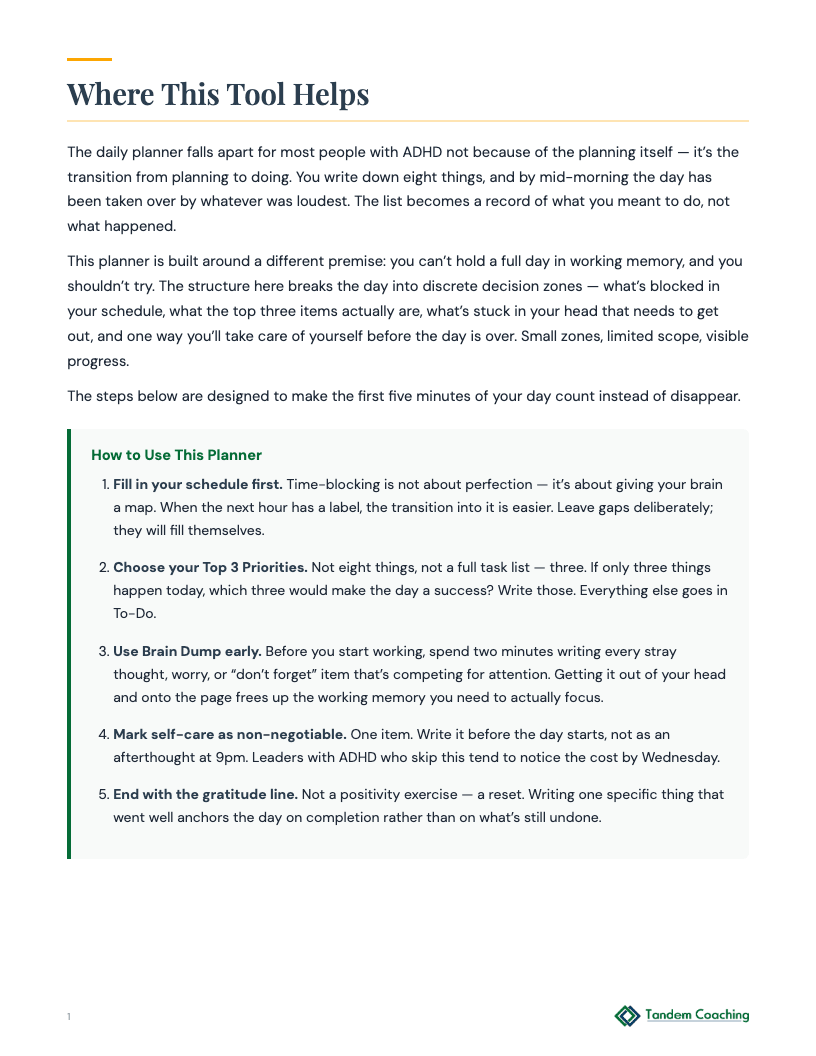
Having a plan for the day - even a rough one - is one of the highest-leverage things you can do for focus with ADHD. This planner gives you the structure to build that plan in about fifteen minutes each morning.
Browse All Pages
Tool Classification
Domain
ADHD
Type
Planner
Phase
Action
Details
15 min
Between sessions
Weekly
Topics
Executive Function
Time Management
Habits
For the Coaching Practitioner
Plus
Coaching Scenarios
Plus
1 Marketing director with ADHD who overpacks schedule then abandons it by 10am ▶
Context
Marketing director at a mid-size tech company, diagnosed ADHD at 35, six months into role. Creates detailed daily schedules with 15-minute blocks but consistently abandons them when the first interruption hits. Thinks the problem is willpower or the wrong planning system.
How to Introduce
Frame this as a transition tool, not a schedule. 'Instead of planning every minute, we're creating decision anchors for when things go sideways - and they will.' Address the abandonment pattern directly: 'Most people with ADHD think a broken plan is a failed plan. Here, a broken plan that you return to is a successful plan.'
What to Watch For
Time blocks filled with unrealistic precision - 'review Q3 campaigns 9:15-9:32' signals perfectionism over function. Top 3 Priorities that are actually project categories, not specific actions. Brain Dump section left empty or filled with work tasks only - emotional regulation items missing.
Debrief
Start with the schedule gaps, not the filled blocks. 'You left 11am-12pm open. What usually happens in that hour?' Then move to priorities: 'If a crisis hit at 2pm and you could only finish one of these three, which one?' The question that opens this up: 'What would need to be true for you to return to this plan after an interruption?'
Flags
Schedule blocks under 30 minutes consistently, or no gaps between blocks at all. This suggests the client is using planning as anxiety management rather than executive function support. Severity: moderate. Response: explore whether the overscheduling serves emotional regulation needs that coaching alone won't address.
2 Operations manager who fills Brain Dump with work tasks, avoids self-care section entirely ▶
Context
Operations manager at a logistics company, recently promoted from individual contributor. Uses task lists effectively but struggles with emotional regulation and boundary-setting. Came to coaching for 'time management' but real issue is treating self-care as optional.
How to Introduce
Position Brain Dump as a working memory tool, not a task collector. 'This isn't another to-do list - it's for the thoughts that interrupt your focus.' For self-care resistance: 'We're not talking about spa days. This is operational maintenance. What's one thing that keeps your system running?' Expect pushback about 'not having time' for self-care.
What to Watch For
Brain Dump filled entirely with work tasks that belong in To-Do section. Self-care line left blank or filled with work-adjacent items like 'organize desk.' Top 3 Priorities that are all urgent/reactive rather than important/proactive. Gratitude line focused only on work accomplishments.
Debrief
Start with what's missing, not what's present. 'I notice the Brain Dump has eight work items and the self-care line is empty. What does that tell you about where your mental energy goes?' Then: 'What would happen if you treated the self-care item with the same priority as item #2 on your list?'
Flags
Client cannot identify any self-care activities or dismisses them as 'selfish' or 'waste of time.' May indicate burnout pattern or identity fusion with work role. Severity: moderate. Response: continue coaching but assess whether client's support system and organizational culture enable sustainable practices.
3 Project manager who time-blocks perfectly but Top 3 Priorities change daily with no pattern ▶
Context
Senior project manager at consulting firm, manages multiple client engagements simultaneously. Excellent at operational planning but struggles with strategic focus. Priorities shift based on whoever contacted them most recently rather than actual importance or deadlines.
How to Introduce
Frame as a strategic filter, not just daily planning. 'The schedule shows you can manage time. This is about managing attention and client expectations.' Address the shifting priorities: 'We're looking for the difference between urgent and important, and what happens when they conflict.' Position Top 3 as non-negotiable anchors.
What to Watch For
Schedule section completed methodically with realistic time blocks. Top 3 Priorities that are all client-reactive or all from the same project. To-Do section that's longer than Top 3, suggesting everything feels equally important. Brain Dump focused on client communications and deadline anxiety.
Debrief
Start with priority selection criteria. 'Walk me through how you chose these three. What did you decide not to prioritize?' Then explore the pattern: 'Looking at your last week, how often do these Top 3 actually stay the Top 3 by end of day?' The key question: 'What would need to change for you to protect priority #1 from interruption?'
Flags
Top 3 Priorities consistently reflect external demands with no strategic thread connecting them across days. Client may lack decision-making authority or clear success metrics from leadership. Severity: low. Response: continue coaching but explore whether the priority-shifting reflects organizational dysfunction rather than personal planning issues.
4 Department head who uses planner as performance documentation rather than daily guidance ▶
Context
Department head at healthcare organization, manages team of 12, recently moved from clinical to administrative role. Approaches planner like medical charting - detailed, defensive, focused on proving compliance rather than improving function. Thinks coaching is about accountability systems.
How to Introduce
Distinguish between documentation and navigation. 'This isn't a record for anyone else to review - it's a GPS for your day.' Address the compliance mindset: 'The goal isn't to prove you planned well, it's to make better decisions when plans change.' Frame as private tool, not performance evidence.
What to Watch For
Entries written in formal language as if for external review. Self-care section filled with professional development items rather than personal maintenance. Gratitude focused on team performance rather than personal experience. Time blocks that account for every minute with no flexibility built in.
Debrief
Start with the audience question. 'Who are you writing this for?' When they say 'myself,' point to language that suggests otherwise. Then: 'What would you write differently if no one else would ever see this?' Focus on the gap between public and private planning needs.
Flags
Client cannot engage with tool authentically, treats every section as potential performance review material. May indicate high organizational surveillance or personal perfectionism that coaching alone won't resolve. Severity: moderate. Response: explore whether the defensive stance reflects actual workplace dynamics or internalized performance anxiety.
Tool Flow
Plus
Requires
- None - standalone tool
→
Produces
- time-blocked daily schedule with labeled hours
- top 3 priorities selected for the day
- externalized brain dump and self-care commitment
Pairs Well With
ADHD
ADHD Brain Dump
ADHD adult who feels overwhelmed by competing demands and can't prioritize what to work on first
Why it pairsUse this when the planner's top-3 selection keeps derailing - H-M-L ratings give the choice a factual basis instead of urgency.
ADHDOptional Digital Context and Cleanup Notes
Use this checklist to review habits and executive function without assuming every item applies.
Why it pairsAfter the planner creates labeled time blocks, this checklist removes the notification and inbox noise that breaks each block apart.
ADHDOptional Home Task Map
Use this planner to organize habits and time management into a client-owned sequence of possible next steps.
Why it pairsOnce the planner adds a household block, this scheduler fills it with a bounded room-by-day structure the client can finish.
Related Articles

Remote vs In-Person ADHD Coaching: The Research
Read article →
Executive Function Strategies for ADHD Leaders: Working Memory, Impulse Control & Flexibility
Read article →
Organize Your Success – ADHD Coaching to Master Organizational Skills
Read article →
ADHD Time Blindness at Work: Why I Underestimate Time
Read article →