A quick, ADHD-friendly starting plan for cleaning when you know what to do but can’t choose where to begin, built on coaching principles.
Free, print-ready PDF.
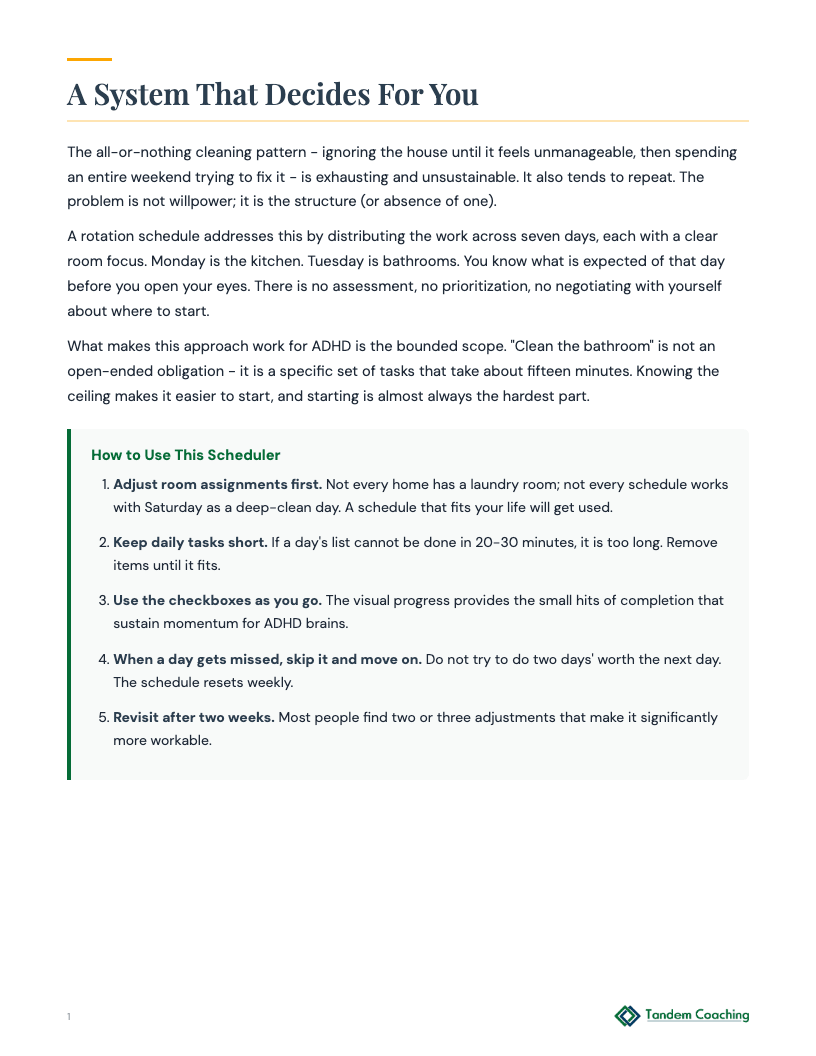
When cleaning feels overwhelming, the problem is usually not motivation - it is too many decisions at once. This schedule removes the decision and replaces it with a clear daily assignment.
A marketing director transitioned to full remote work six months ago. Her home office doubles as a catch-all space, and the visual chaos is making it hard to focus during video calls and client presentations. She's started working from coffee shops to avoid the mess but knows this isn't sustainable.
Frame this as workspace management, not housekeeping. 'Your environment affects your executive function. When your space is chaotic, your brain spends energy processing visual noise instead of strategic thinking.' Most remote workers resist home maintenance tools because they separate 'work' from 'life.' Connect the dots: Thursday's bedroom focus includes the home office section.
Notice if she skips or minimizes the home office tasks on Thursday. Many remote workers treat their workspace as separate from their living space, even when they're the same room. Also watch whether she front-loads weekend tasks - a sign she's still thinking in 'weekend cleaning marathon' mode rather than daily maintenance.
Start with Thursday's home office section. Ask: 'What would change about your workday if your desk surface was clear every Thursday?' Then move to the visual impact: 'Which rooms show up in your video calls?' The connection between space and performance often surprises clients who thought they could compartmentalize.
If she refuses to include workspace tasks or insists on keeping work and home completely separate, explore whether the boundary serves her or limits her. Severity: low. The resistance may indicate deeper issues with work-life integration that coaching can address, but it's not a referral-level concern.
An executive assistant recently diagnosed with ADHD at 34 recognizes her cleaning pattern: she'll spend four hours making the kitchen spotless while the rest of the house deteriorates. She's seeking structure to distribute effort more evenly and avoid the boom-bust cycle that leaves her exhausted.
Present this as an ADHD accommodation, not a productivity hack. 'Your brain wants to finish what it starts, which is actually a strength. This schedule works with that tendency by giving you a complete scope each day - you can still finish, but the finish line is defined.' Expect resistance to leaving a room 'incomplete' when she sees more to do.
Track completion times. If Monday's kitchen tasks take 90 minutes instead of 20, she's hyperfocusing. Also notice if she adds tasks to the daily lists - a sign she's trying to make each day 'complete' rather than working within the bounded structure. The goal is consistent maintenance, not perfection.
Start with the hardest day - usually the one where she wanted to keep going. 'Tuesday's bathroom tasks took you 15 minutes, but you saw three other things that needed attention. What was it like to stop?' The learning is in the stopping, not the cleaning. Then ask: 'What did you notice about your energy on Wednesday after stopping Tuesday's tasks on time?'
If she cannot stop tasks when the list is complete, or if she experiences significant distress about 'unfinished' work, the hyperfocus may be serving an anxiety regulation function. Severity: moderate. Continue coaching but explore what 'incomplete' means to her and whether perfectionism is masking deeper control needs.
An operations manager promoted three months ago now travels 40% of the time. Her home maintenance routine collapsed with the new schedule, and she returns from business trips to a chaotic house that adds stress to an already demanding role. She needs a system that works around irregular schedules.
Frame this as travel resilience, not time management. 'The goal isn't to maintain a perfect house while traveling - it's to come home to a space that supports your recovery, not adds to your stress.' Focus on the Sunday prep day and how it sets up the week. Many frequent travelers resist home routines because their schedule feels too unpredictable.
Notice how she handles travel weeks. Does she skip the entire week, or does she adapt tasks to pre-travel and post-travel days? Also watch for all-or-nothing thinking - trying to catch up on missed days when she returns instead of jumping back into the current day's focus.
Start with travel weeks: 'Show me a week when you traveled Tuesday through Thursday. What happened to the schedule?' Then explore adaptation: 'What would it look like to do Wednesday's living area tasks on Monday before you left?' The insight is usually that some maintenance is better than no maintenance, even if the timing shifts.
If she cannot adapt the schedule to her travel patterns or insists it only works if followed exactly, she may be using rigidity to manage anxiety about control. Severity: low. This is typically a coaching conversation about flexibility versus structure, not a deeper issue requiring referral.
A senior accountant works normal hours most of the year but 70-hour weeks during tax season and quarterly closes. Her home maintenance completely stops during busy periods, creating a cycle where she spends her first week of normal hours just catching up on personal tasks instead of recovering from the work intensity.
Present this as seasonal adaptation, not failure management. 'The schedule needs two versions - regular season and busy season. During tax season, you're not maintaining the same standard; you're preventing complete breakdown.' Most seasonal workers think they need to pause all routines during busy periods. The goal is minimal viable maintenance.
Notice whether she creates a realistic busy-season version or just plans to 'pause' the routine entirely. Also watch for guilt about lower standards during busy periods - many high-performers struggle with 'good enough' maintenance when they're used to doing things thoroughly.
Start with the seasonal comparison: 'What does Monday's kitchen focus look like during tax season versus July?' Then explore the transition: 'When busy season ends, what would help you restart the routine without spending a week catching up?' The key insight is that some structure during chaos prevents total system breakdown.
If she cannot accept reduced standards during busy periods or insists on maintaining the same level year-round, explore whether perfectionism is creating unnecessary stress. Severity: low. This is typically about realistic expectations and seasonal rhythms, manageable within coaching.
ADHD adult who feels overwhelmed by competing demands and can't prioritize what to work on first
ADHDADHD adult whose digital environment is disorganized and adding cognitive load
ADHDPerson with ADHD who does all their cleaning in one exhausting weekend burst