ADHD Brain Dump
ADHD Brain Dump turns overwhelming to-dos into a clear, prioritized next step using ADHD-informed coaching prompts.
Get This Tool
Free, print-ready PDF.
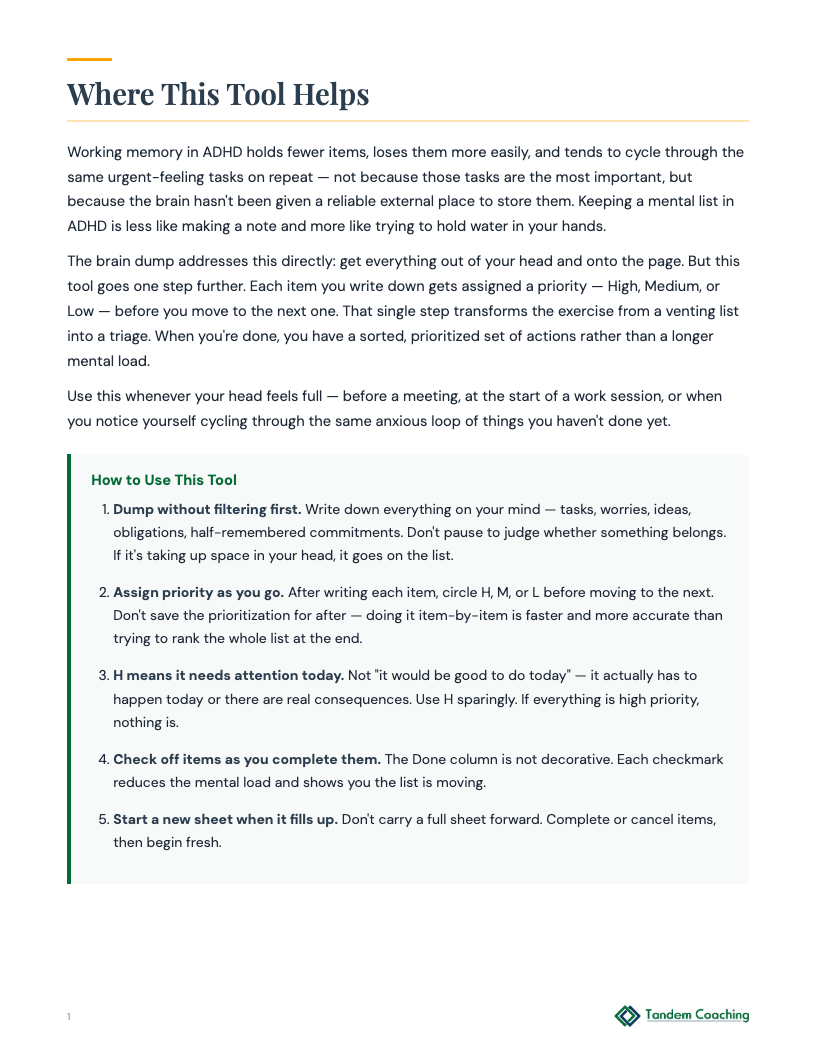
When to Use This Tool
ADHD adult who feels overwhelmed by competing demands and can't prioritize what to work on first
A client whose mind is too full to start anything and needs to externalize before planning
Person who needs to clear mental clutter before a productive session or focused work block
How to Introduce This Tool Plus
Before we look at this week, take a few minutes to get everything out of your head onto this page - tasks, worries, anything that's taking up space. We'll sort it after.
Coaching Tool Disclaimer
This tool is designed for coaching contexts, not clinical use. If you or your client is in crisis, contact the 988 Suicide and Crisis Lifeline (call or text 988) or Crisis Text Line (text HOME to 741741).
Browse All Pages
Tool Classification
Domain
ADHD
Type
Worksheet
Phase
Action
Reflection
Details
15 min
Opener
As-needed
Topics
Time Management
Habits
Executive Function
For the Coaching Practitioner
Plus
Coaching Scenarios
Plus
1 New engineering director can't separate inherited tasks from their own priorities ▶
Context
A software engineering director, three weeks into a new role at a company they joined from outside. They inherited a team mid-sprint with open incidents, deferred maintenance, and a reorg the previous director started but didn't finish. The client says they 'can't figure out what to work on first' but the actual issue is that most items in their head belong to someone else's accountability.
How to Introduce
Frame this as a handoff tool, not a productivity exercise. 'You've absorbed a lot in three weeks. Before we talk about what your first 90 days should look like, write down everything that's occupying your attention right now - your stuff, their stuff, inherited stuff, all of it.' The resistance here is filtering too early. New leaders want to appear in control, so they'll try to write down only items that sound directorial. Push past that: 'Include the things you're tracking mentally even if you think you shouldn't be the one tracking them.' The brain dump works here because it doesn't ask for a plan - it asks for inventory, and inventory is what this client needs before strategy.
What to Watch For
Count how many items the client marks as High. If more than half the list is H, they haven't distinguished between inherited urgency and actual urgency - everything feels pressing because it's all new. Look at whether any items reference delegation or handoff ('tell Sarah to...' or 'check if team knows about...'). If the list is entirely personal action items with no delegation, the client is absorbing the whole team's workload into their own working memory. Genuine engagement looks like items appearing that surprise the client - things they forgot they were tracking.
Debrief
Start with the H items. Read them back and ask: 'Which of these have a deadline this week, and which feel urgent because they're unresolved?' That distinction - deadline-driven vs. anxiety-driven urgency - is usually where the conversation opens. Then look at the full list and ask: 'How many of these were on your plate before you took this job?' Typically zero. The follow-up that creates movement: 'If you handed this list to the person who had this role before you, which items would they say aren't yours to carry?'
Flags
If every item is marked H and the client can't downgrade any of them after the debrief conversation, the overwhelm may not be situational. Three weeks into a new role with an inability to triage suggests either the role is genuinely under-resourced (structural, not coaching-solvable) or the client's executive function is under more strain than a new-job adjustment explains. Severity: moderate. Explore whether this pattern - absorbing everything, unable to release - shows up in previous roles too.
2 Senior product manager writes a pristine list that avoids everything actually weighing on them ▶
Context
A senior product manager at a mid-size SaaS company, referred to coaching after their skip-level flagged that the client seems 'scattered and reactive.' The client is high-performing on paper - ships on time, stakeholders are satisfied - but privately tells you they spend Sunday evenings in dread. They present as organized and competent in sessions.
How to Introduce
Position this as a warm-up, not the main event. 'We're going to do something quick before our regular agenda. Take five minutes and write down everything that's in your head right now - not your task list, not your project tracker, but the stuff that's living in your working memory that hasn't been written down anywhere else.' The resistance with this client is performance. They'll produce a clean, well-organized list because they're good at appearing on top of things. Preempt it: 'This isn't a task list for me to review. Include the half-formed worries, the things you keep almost bringing up, the item you thought of at 2 AM and told yourself to deal with later.'
What to Watch For
A list with fewer than 8 items from someone described as scattered is a signal. Either the brain dump is working as intended (they genuinely only have 8 things) or they're curating. Look at the priority distribution: if everything is neatly sorted with 2-3 in each tier, they're organizing rather than dumping. A real brain dump from someone under load looks messy - inconsistent handwriting, items crammed in margins, priority letters changed mid-list. Also watch for absence: if there's nothing personal on the list (no 'call dentist,' no 'figure out summer plans'), the client is filtering out the life items that compete for the same working memory.
Debrief
Don't start with the list. Start with what's not on it. 'You mentioned Sunday evening dread. Is the thing causing that dread on this page?' If not, that's the conversation. If they say they don't know what causes the dread, point to the list: 'Everything here looks manageable. So either you're carrying something that didn't make it onto the page, or the weight isn't about any single item - it's about the volume.' Then ask: 'What would you add to this list if you knew I wouldn't ask you to do anything about it?' That question separates the items the client is willing to own from the ones they're protecting.
Flags
If the client repeatedly produces clean, sparse lists across multiple sessions while reporting overwhelm outside of sessions, the gap between their presented self and experienced self is significant. This isn't a tool problem - the client may be managing their coaching relationship the same way they manage their stakeholders: controlled presentation. Severity: moderate. Name the pattern directly rather than continuing to assign tools that the client will complete compliantly.
3 ADHD client marks everything High because urgency signals are indistinguishable ▶
Context
A marketing director with a recent ADHD diagnosis (diagnosed at 38, medicated for four months). They came to coaching to 'get organized' but the real pattern is that every task feels equally urgent. Their medication helps with focus duration but hasn't changed the urgency-flattening that makes everything feel like it needs to happen now. They've tried other productivity tools and abandoned them within two weeks.
How to Introduce
Name the ADHD-specific challenge before handing over the tool. 'This is a brain dump with built-in triage - you write the item and assign it a priority before moving on. For most people, that's straightforward. With ADHD, the prioritization step is where it gets interesting, because your brain is telling you everything is urgent. We're going to use that as data rather than fight it. If everything feels like H, mark it H. We'll work with what comes out.' This preframe matters because the client has already failed at tools that required them to prioritize correctly. Removing the pressure to get priority 'right' lets them engage honestly.
What to Watch For
The priority column is the entire diagnostic. If 12 of 14 items are H, that's not a failure to use the tool - that's the tool doing its job. It's showing you exactly what ADHD does to this client's urgency signaling. Now look at whether the H items are actually urgent: 'respond to CEO email from this morning' and 'research conference in September' both marked H tells you the client's internal urgency meter doesn't calibrate to external timelines. Watch for the client apologizing ('I know they can't all be high priority') - that's the shame pattern from previous tool failures.
Debrief
Start by validating the output without fixing it. 'You marked almost everything H. That matches what you described - everything feels urgent. So let's use a different filter. Read me each H item, and for each one, tell me: what happens if this doesn't get done today?' This introduces consequence-based prioritization rather than feeling-based. The items where the answer is 'nothing, actually' can be downgraded - not because the urgency feeling was wrong, but because the consequence doesn't match the feeling. That distinction between felt urgency and consequential urgency is the insight this tool can deliver for ADHD clients.
Flags
If the client cannot identify even one item where delayed action has no real consequence - every single item carries genuine immediate stakes in their description - explore whether the client's role actually requires this pace or whether they've constructed a work environment that matches their ADHD activation pattern. Some ADHD executives unconsciously build crisis-dependent roles because urgency is the only state that produces focus. Severity: moderate. Continue coaching, but shift from organization skills to role design.
4 Operations VP uses the dump to list tasks but avoids the decision they're actually stuck on ▶
Context
A VP of Operations at a logistics company, in coaching because they're 'drowning in execution' after a warehouse automation project went sideways. They're six months into a turnaround and have been working 65-hour weeks. They asked for help with time management. In the first two sessions, they talked exclusively about tasks and deadlines, never about people or decisions.
How to Introduce
Position it as a pressure release, not a planning tool. 'You've been running at high RPM for six months. Before we look at your calendar, take everything that's in your head and put it on this page. Tasks, decisions, conversations you've been putting off, worries about the project - anything occupying bandwidth.' The word 'decisions' is doing specific work here. This client talks about tasks because tasks are safe - they have clear next steps. Decisions are where they're stuck, and the brain dump can surface that if the prompt includes it explicitly.
What to Watch For
A list composed entirely of action items ('call vendor,' 'review Q3 forecast,' 'schedule team standup') with zero decision items ('decide whether to replace the warehouse manager,' 'choose between the two automation vendors') signals the client is using the dump the same way they're using their work hours: staying busy to avoid the hard calls. Count the ratio. Twelve tasks and zero decisions from someone who says they're drowning usually means they're drowning in avoidance, not volume.
Debrief
Read back the list, then observe: 'I count [X] action items and [Y] decisions on this list. What decisions are you sitting on that didn't make it onto the page?' Silence or deflection here is information. If they name a decision, ask: 'How long have you been carrying that one?' The question that tends to open the real conversation: 'If you made that decision today - either direction - how many of these tasks would come off the list?' This connects the undecided item to the task volume directly.
Flags
If the client names a decision involving someone's employment or role change and immediately reframes it as a task ('I need to have a conversation with them'), they may be avoiding a termination or demotion decision. Six months of 65-hour weeks during a turnaround with no personnel changes is a pattern. Severity: low. This is within coaching scope, but the coach should assess whether the client has the organizational authority to make the decision or whether they're stuck because the authority sits elsewhere.
5 Client's brain dump reveals they are tracking obligations for everyone around them ▶
Context
A nonprofit program director, in coaching to develop leadership presence after being told they're 'too in the weeds.' ADHD diagnosed in college, managed without medication through external structure systems. Their direct reports describe them as 'always available' and 'the person who remembers everything.' The client views this as a strength.
How to Introduce
Frame it as a snapshot of current mental load. 'Write down everything that's in your head right now that you're tracking, holding, or monitoring. Your tasks, other people's tasks, things you're waiting on - all of it.' Don't signal what you're looking for. The tool will reveal it. The resistance with this client isn't refusal - it's over-engagement. They'll write eagerly because externalizing is their comfort zone. The issue is what the list contains, not whether they'll complete it.
What to Watch For
Count whose tasks are on the list. If more than half the items are things someone else should be tracking ('remind Devon about the grant report,' 'check if Maria submitted the budget,' 'follow up with board member re: event'), the brain dump is showing you the client's actual role: they're functioning as the team's external working memory. Look at the priority assignments for other people's items. If the client marks someone else's deliverable as H, they've internalized that accountability. The Done column will likely stay empty because these items can't be completed by the client - only monitored.
Debrief
Sort the list into two groups with the client: 'Let's mark each item - is this yours to do, or yours to track?' Most clients can categorize this quickly. Then ask: 'What happens to the items in the tracking column if you stop tracking them?' The client's answer reveals whether the tracking is necessary (the team genuinely drops things without this person) or self-imposed (the client doesn't trust delegation). The question that opens the deeper conversation: 'When did you become the person who remembers everything for everyone, and what would it cost you to stop?'
Flags
If the client's list is 70%+ other people's obligations and they describe this as 'just how my brain works' or 'it's an ADHD thing - I can't help noticing what's not done,' explore whether the tracking behavior is compensatory. Some ADHD adults build value in organizations by becoming indispensable monitors - it's a role that rewards hypervigilance and provides constant activation. Giving it up feels like losing both their value and their coping mechanism. Severity: moderate. Continue coaching, but the 'leadership presence' goal may need reframing - the weeds aren't the problem; the identity built around being in the weeds is.
Tool Flow
Plus
Requires
- None - standalone tool
→
Produces
- externalized prioritized task list with H-M-L ratings
- cleared mental queue ready for focused work
Pairs Well With
ADHD
Weekly Household Task Grid
A client wants to use Weekly Household Task Grid as an optional reflection
Why it pairsOnce the brain dump has rated home tasks, use this to spread them across the week - stopping the weekend-burst cycle.
ADHDOptional Home Task Map
Use this planner to organize habits and time management into a client-owned sequence of possible next steps.
Why it pairsUse the brain dump's H-M-L ratings to feed this tool, converting scattered home items into a room-by-day execution plan.
ADHDHome Reset Checklist
ADHD adult who needs a concrete room-by-room checklist to complete a full home reset
Why it pairsAfter the brain dump surfaces home tasks, this gives the client a room-by-room sequence with a clear done point.
Related Articles


ADHD Strategic Planning: Frameworks for Visionary Leaders
Read article →
Coaching Session Blueprints: What ADHD-Informed Executive Coaching Really Looks Like
Read article →
Remote vs In-Person ADHD Coaching: The Research
Read article →
Adaptive ADHD Leadership: 7 Strategies That Work
Read article →