What Does a Career Coach Do? (And How to Choose One)
What does a career coach do?
A career coach helps you clarify your direction, weigh decisions, and build the confidence to act on your own career, without telling you what to do. The coach holds the process and asks the questions; you stay the expert on your own life and own the answers you reach. It is coaching, not advice.
You have probably heard that a career coach can help you get unstuck, and also wondered whether that is just advice wearing a nicer title. So what does a career coach do, really? In the coaching sense, far less telling and far more asking than most people expect. This guide covers what the work actually involves, how it differs from a consultant, a counselor, or a recruiter, and how to tell a qualified coach from someone who simply printed business cards.
Key Takeaways
- A career coach helps you reach your own clarity and decisions; they hold the process while you own the answers, which makes it coaching rather than advice.
- The work is clarity, decision-making, and career strategy - not writing your resume, finding you a job, or acting as your agent.
- A career coach differs from a consultant (who advises), a counselor (clinical or vocational), and a recruiter (paid by employers to fill roles).
- ICF credentials - ACC, PCC, and MCC - are the clearest signal a coach was trained to coach rather than advise, so ask before you hire.
- You need a coach when the block is in your thinking, not when you are missing information - that points to a consultant or recruiter instead.
What a Career Coach Actually Does
Ask most people what a career coach does and they will list tasks: fix the resume, clean up the LinkedIn profile, run some interview preparation, map out a job search. A career coach can help with all of that, and plenty do. If that were the whole job, though, you would be hiring a resume writer and a LinkedIn editor, not a coach. The real work sits underneath the tactics.
Start with clarity. Most people arrive able to describe what they think they should want - the promotion, the bigger title, the safer path - far more fluently than what they actually want. The first real task is separating the two. In a first session you will field more questions than answers, and the one that catches people off guard is usually some version of "so should I take it?" A skilled coach will not answer that. They will ask what makes the decision hard, and the genuine issue tends to surface there: a fear, an identity you have outgrown, a career path you chose for reasons that have quietly expired, or a set of career goals that no longer aligns with your values.
From clarity comes decision architecture. Rather than handing you a recommendation, a coach helps you lay out the trade-offs, name the assumptions you have been treating as facts, and read your own strengths and weaknesses honestly. The same holds for strategy. Whether you are planning a career change, mapping your longer-term career development, advancing your career inside your current organization, or trying to find a new job in a cold job market, the coach helps you build the plan from your own reasoning instead of installing theirs. Career planning done this way holds up, because you can run it again later without the coach in the room.
One boundary is worth stating plainly. A career coach does not write your resume for you, does not place you in a role, and does not act as your agent. Those are real services, and they matter, but they are not coaching. Cover letters, interview skills, and the tactical layer of a search are things a coach helps you get sharper at owning - not chores they complete on your behalf.
For senior professionals the center of gravity shifts further still. At the executive level the work is usually about identity, narrative, and strategic positioning - how you think about your own career advancement, your management style, and the soft skills of leadership and communication - rather than which keywords belong on a profile. The higher you go, the more the bottleneck is perspective, and coaching is what moves perspective.
A career coach does not hand you the answer. They help you find the one you can actually act on.
What a Career Coaching Engagement Looks Like
It helps to make the abstract concrete, because "I help you think" tells you nothing about what you would actually be buying. Most coaching sessions run bi-weekly, sixty to ninety minutes each, over a three to six month arc. The structure is not open-ended drift. Each session opens on a focus you set, moves into exploration - the assumptions, the options, the barriers you keep circling - and closes on something you commit to before the next one.
The arc itself is where the value compounds. Month one is almost always about naming the real problem, which is rarely the one you walked in with: "I need a new job" tends to become "I have outgrown how I have been defining my work." The middle months are where you test those assumptions through small experiments and conversations between sessions, and start generating your own options rather than waiting for the coach to supply them. By month five, the change you can measure is that you are making decisions without the coach. That is the point of the career coaching process. A good engagement ends with you not needing it.
What a career coach can provide, then, is not a job and not a guarantee. It is a decision made on your own terms, a professional narrative that finally sounds like you, and a way of working through career challenges that outlasts the engagement. That is a different thing from a one-off career consultation, where you pay for an hour of advice and leave with someone else's answer. Choosing to work with a career coach is choosing a process over a transaction, which is exactly the right call when the thing keeping you stuck is not missing information. If you have been feeling stuck for months despite knowing the facts, that gap is what a career coaching session is built to close.
Career Coach vs. Consultant, Counselor, and Recruiter
Part of the confusion about what a career coach does is that three other roles sit close by and get used interchangeably. They are genuinely different jobs, and the difference comes down to one question: who is generating the answer? The table below lays the four side by side.
| Role | Who drives the agenda | Primary method | Typical outcome | Choose when |
|---|---|---|---|---|
| Career coach | You do | Questions, reflection, accountability | Your own clarity and decision | The block is in your thinking |
| Career consultant | The consultant | Assessment and expert advice | A recommendation to follow | You need a specific answer |
| Career counselor | Shared / clinical | Assessment, vocational or mental-health support | Diagnosis, testing, or healing | Distress or testing is involved |
| Recruiter | The employer | Matching you to an open role | Placement in a job | You are ready to be placed |
A career consultant is an expert who assesses your situation and tells you what to do - useful when you actually lack the information, and the opposite of the coaching stance where you hold the answers. A career counselor works in a vocational or mental-health context; career counseling is often clinical or assessment-based, with different training and licensure, and it is where you turn if the real issue is closer to burnout or the need for retraining than to a stuck decision. Mentorship is different again - a mentor shares their own road and tells you what worked for them, which is generous but is not the same as coaching. A recruiter is hired and paid by employers, not by you, which means their accountability runs to filling a role and to the employment market, not to your long-term interest. None of that makes any of them lesser; it makes them different tools.
This is also why "career coach" and "life coach" are not synonyms, and why a career coach differs again from what an executive coach does - overlapping crafts, distinct focus. If your situation is specifically a job change or pivot, that intent has its own specialist; the work of career transition coaching is built around exactly that arc. And if you want the cleaner version of the coaching-against-advice distinction itself, it is worth reading the line between coaching and consulting in full. Get the role right and you stop paying for the wrong kind of help. The remaining question for most people is not which of these is best in the abstract, but whether a coach is the right career partner for where they actually are.
ICF Credentials: Why They Matter When Choosing a Career Coach
Here is the part the rest of the internet skips. Anyone can call themselves a career coach. There is no license to lose, no exam to fail, no body that checks whether the person across from you was ever trained to coach rather than simply to give opinions. That is the credential gap, and it is why a working knowledge of certification is the single most useful thing a buyer can carry into the search. For those drawn to the field themselves, our guide on the path to becoming a career coach maps the training and credentialing arc from the aspiring coach’s side.
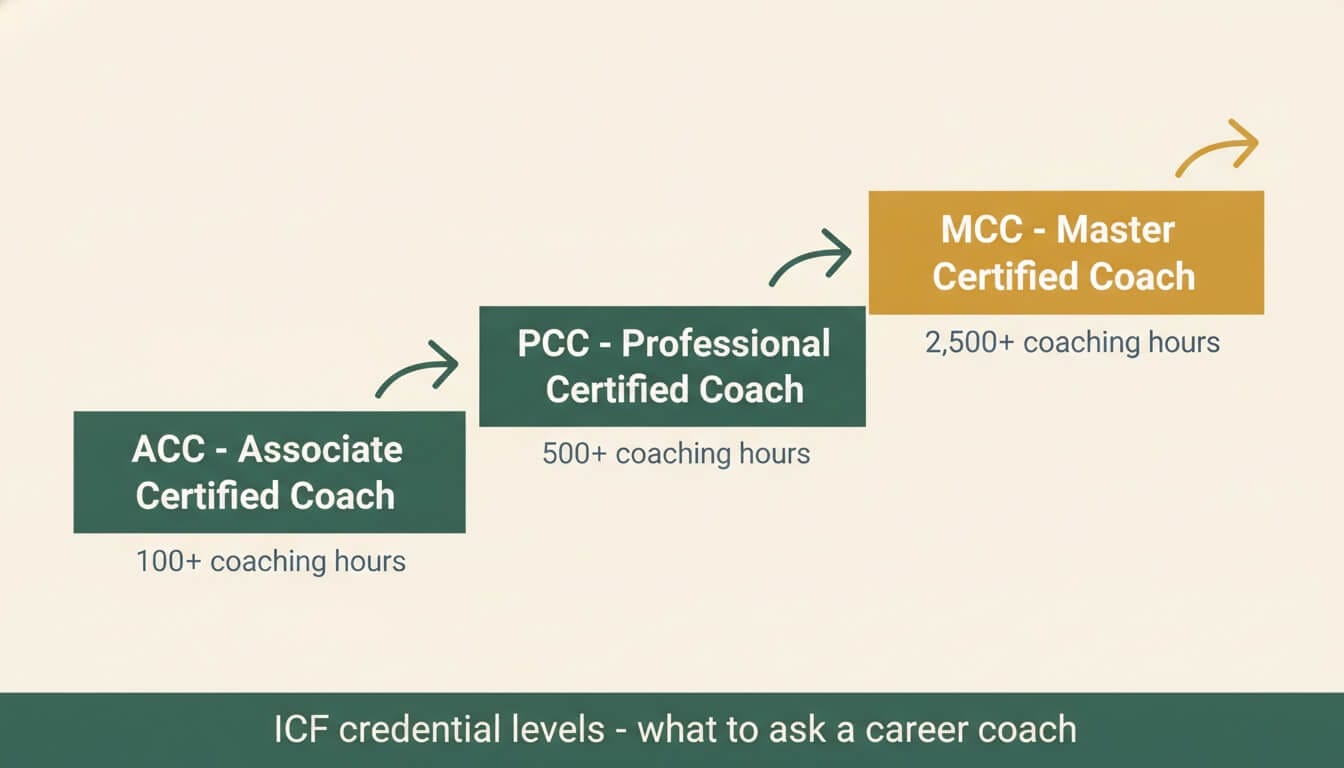
The most recognized standard is the International Coaching Federation, and its credential ladder has three rungs. An ACC, or Associate Certified Coach, has completed foundational ICF training and logged at least 100 hours of coaching experience. A PCC, or Professional Certified Coach, has at least 500 hours and has passed a deeper evaluation of actual coaching skill. An MCC, or Master Certified Coach, sits at the top with 2,500 or more hours and a rigorous performance assessment that comparatively few coaches ever clear. Each rung also carries rising education requirements, and an ICF-accredited training program is the mark that a coach's preparation was held to that standard rather than self-declared. You can review the levels on the ICF's own ICF credentials page.
So what does an MCC do differently from an uncredentialed "career coach," in terms you would actually notice? An uncredentialed coach tends to default to advice - they tell you what worked for them and call it coaching. A certified coach trained to that level asks more than they tell, does not rush to fix, catches the thing underneath the thing you said, and stays comfortable while you sit in a silence and think. The simplest tell is how you feel afterward. After a session with a real coach, you did the thinking. After a session with an advice-giver, they did the talking. The credential is not a trophy; it is evidence that someone was assessed on the difference and held accountable to it.
One concrete move makes all of this usable: ask. "Are you ICF-credentialed, and at what level?" is a fair, normal question, and a qualified coach will answer it without flinching. It is the same instinct you would apply to any other expert. For context on where this sits, Tandem Coaching is an ICF-accredited organization led by Master Certified Coaches, including Cherie Silas, MCC and Alex Kudinov, MCC - which is rare enough that we mention it as fact, not flourish. Credentials are not the only thing that matters, and chemistry and fit matter too, but they are the floor, and the floor is exactly what most career-coaching content leaves you standing without. The same credential logic carries into adjacent fields like leadership coaching, where the depth of the coach's training shows up directly in the quality of the leadership skills work.
Do You Need a Career Coach?
Not every career problem needs a coach, and a good one will tell you so. The useful question is not whether coaching is valuable in general but whether you should hire a career coach for what you are carrying right now. A few signs point clearly toward a coach:
Still Weighing Whether You Need a Coach?
A short, free consultation is the fastest way to tell. We will help you name the real obstacle and whether coaching is the right tool for it.
- You are in decision fog - you know something needs to change but cannot see what, and more information has not helped.
- You are in a leadership or management transition, moving up, across, or out of your current role, and the old map no longer works.
- You feel stuck in your current job and cannot tell whether the answer is a new role, a new career path, or a different relationship to the work you already have.
- You want to be challenged rather than told, and you have noticed that your own attempts to think it through keep stalling at the same place.
- The block is about perspective, not facts - which is the moment people most often benefit from career coaching and most often try to hire a consultant instead.
Other situations point elsewhere, and naming them is part of an honest answer. If you need a specific recommendation, a resume audit, or a strategy delivered rather than co-created, a consultant is the better and faster hire. If you already know your target role and are ready to be placed, a recruiter is what you want. If the difficulty is tied to mental health, sustained burnout, or a need for vocational testing, a counselor or therapist is the right call, not a coach. And if you are simply early in a new career and unsure where it goes, sometimes the answer is time and a few honest conversations before you find a career coach at all.
The clearest single signal is the one from the first bullet: more information has not helped. When the obstacle is informational, you need an expert. When it is internal - you "know" the answer but cannot move on it, or every option looks fine on paper and none feels right - that is a clarity problem, and clarity is what coaching is built for. This is especially true at senior career stages, where the right career coach is often the only person in your professional life with no stake in which choice you make. If you are weighing a senior, high-stakes move, that is also where executive coaching for career transitions earns its place, and where it can make sense to work with an executive coach directly. The goal is not to need a career coach forever; it is to build a more fulfilling career and a working life you can steer yourself.
What Career Coaching Costs - and What You Get for It
Money is the question everyone has and few articles answer cleanly, so here is the honest range. Career coaching commonly runs from about $150 to $500 a session, and executive-tier coaching with an MCC-credentialed coach often sits between $300 and $600 or more. Most coaches work in packages rather than single sessions, and a three to six month engagement frequently lands somewhere between $2,000 and $8,000 depending on the coach's credential level and the scope of the work.
Whether that is worth it is less a question about the number than about what the decision is worth. A career decision at a senior level shapes the next decade of your trajectory, and against that, the cost of getting it right is small. The honest framing is to size the fee against the outcome and your own budget, not against an hourly rate in the abstract. For a fuller breakdown by credential level and engagement type, see how much career coaching costs, and if you are still weighing the basic question of value, whether hiring a coach is worth it takes it on directly.
Frequently Asked Questions About Career Coaches
What does a career coach actually do?
A career coach helps you clarify what you want, weigh decisions, and build the confidence to act on your own career - without telling you what to do. The work is client-led: the coach holds the process and asks the questions, while you stay the expert on your own life and own the answers you reach.
Is a career coach worth it?
It depends on the problem you are solving and the coach's credential level. Coaching is worth it when the block is in your thinking rather than in missing information, and when you hire someone actually trained to coach. If you mainly need facts or a placement, a consultant or recruiter is a better use of the money.
What is the difference between a career coach and a career consultant?
A career coach builds your own decision-making capacity so you can work through this transition and the next one yourself. A career consultant assesses your situation and delivers a recommendation. Same goal of a better career, different contract: one grows the thinker, the other hands over the answer.
Is a career coach the same as a recruiter?
No. A recruiter is hired and paid by employers to fill a role, so their accountability runs to the company, not to you. A career coach is hired by you and works in your interest, helping you decide what you actually want before anyone tries to place you in a job.
How do I know if a career coach is qualified?
Ask about credentials. The clearest signal is an ICF credential - ACC, PCC, or MCC - which shows the coach was trained and assessed against a recognized standard rather than simply adopting the title. Ask "Are you ICF-credentialed, and at what level?" before you hire, and treat the answer as your quality floor.
How much does a career coach cost?
Career coaching typically runs $150 to $500 per session, with executive-tier MCC coaching often $300 to $600 or more, and three to six month packages commonly between $2,000 and $8,000. The exact figure depends on the coach's credential level and the scope of the engagement.
Figure Out Whether a Career Coach Is the Right Call
In a free consultation, our MCC-led team helps you map where you are and what kind of support - coaching, or something else - would actually move you forward.
Book a Free Consultation →