CEO Priorities 2026: Coaching the Future of Leadership
What are CEOs prioritizing in 2026, and what does it mean for coaching?
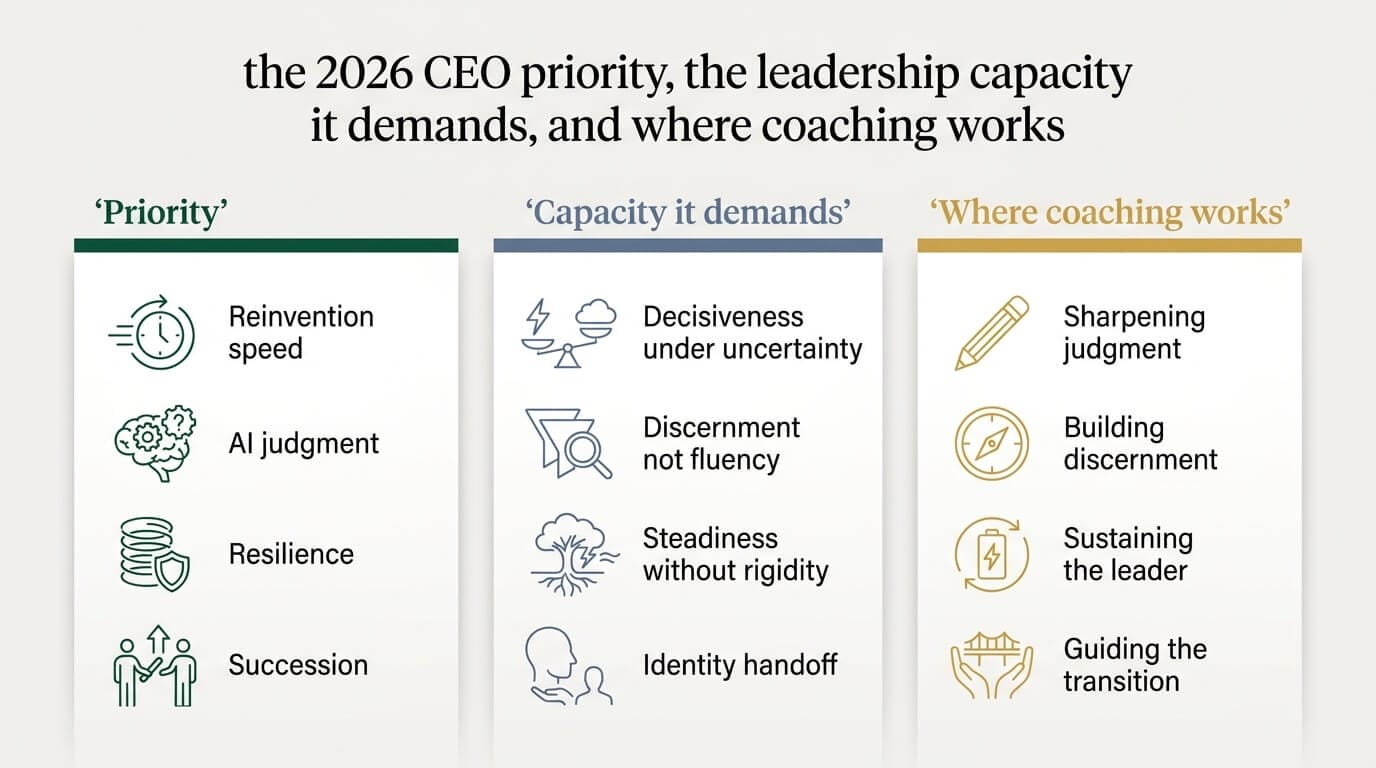
In 2026, CEOs are prioritizing faster reinvention, sound AI judgment, operational resilience, and orderly succession, all while revenue confidence sits at a five-year low. Each priority is a leadership capacity before it is a strategy. Coaching is how senior leaders build the judgment, steadiness, and self-awareness those priorities demand.
The Year the Priorities Changed
Picture a leader who reached the top job on the strength of a decade of good decisions. Eighteen months in, those same instincts are not landing the way they used to. The market keeps moving, the board wants AI answers nobody fully has, and the playbook that built the career feels a step behind. This is the quiet problem underneath the 2026 leadership headlines, and it surfaces in coaching rooms long before it surfaces on earnings calls.
The mood matches the moment. According to PwC 2026 CEO insights and leadership priorities, confidence in revenue growth has fallen to its lowest level in five years, with only about three in ten chief executives saying they feel confident about the next twelve months. Leaders are being asked to move faster on reinvention while feeling less certain than they have in years. That combination of high demand and low confidence is exactly the pressure coaching is built to work with.
Key Takeaways
- Every priority CEOs name for 2026 is a leadership capacity before it is a strategy.
- Confidence is low and the pressure to reinvent is high; that gap is where leaders get stuck.
- AI rewards judgment and discernment in leaders, not tool fluency.
- Succession is an identity handover, and coaching is where that handover gets done well.
What CEOs Say They’re Prioritizing
Across the 2026 reports, four priorities keep surfacing: reinvent the business faster, get real returns from AI, build resilience against shocks, and prepare the next generation of leaders. None of these are new ambitions. What changed is the speed leaders are expected to deliver them, and the cost of getting them wrong in a volatile year.
The data sharpens the picture. PwC 29th Global CEO Survey found that fewer than a quarter of chief executives say AI is applied extensively across their core work, and most report no meaningful revenue or cost gains from it yet. The leaders who do see returns share one trait: they built the foundations first, and they are roughly three times more likely to report real financial results. Cyber risk and economic volatility sit at the top of the threat list, right where they keep leaders awake.
Read as a coach, none of these are technology problems at heart. A leader who freezes without complete information will stall on reinvention no matter how sharp the strategy deck looks. Most CEO development programs train the analysis and skip the harder capacity: deciding well under uncertainty, repeatedly, in front of people who are watching. That capacity grows through practice and reflection, not a slide library.
The same is true of AI. The leaders pulling ahead are not the ones who learned the most prompts. They are the ones who built enough discernment to know when a model is useful and when it is confidently wrong. That is a leadership skill, and it develops the way leadership skills always have.
Resilience lands the same way. A board can mandate backup suppliers and contingency budgets, but resilience finally lives in how a leader behaves when the plan breaks. Does the team see someone who steadies the room, or someone who transmits their own alarm? With cyber risk and economic shocks topping the worry list, the deciding factor is rarely the continuity binder. It is whether the person in charge can regulate themselves well enough to be the calm signal everyone else reads. That is human capacity, and it is coachable.
The 2030 Leadership Profile
Look past 2026 and the shape of the job changes again. Analysts describe a 2030 chief executive who runs on proactive, data-aware oversight instead of reactive firefighting, who treats AI as a sharp research assistant under firm human judgment, and who builds resilience into operations before the next shock arrives. The skills that earn the corner office are not the skills that keep someone in it.
This is the picture Analytics Insight paints of the future CEO: deep, real-time attention to what is actually happening inside the business, paired with the discipline to keep AI in an advisory seat rather than the driver’s seat. The same analysis points to operational resilience as a core habit, with backup vendors across regions and cross-trained teams that can absorb a hit without stalling.
For coaches, this is familiar ground. The hardest leadership development challenges have never been about information access. They are about the human work of holding steady when the data is incomplete and the stakes are public, and of trusting a team enough to let them carry real weight.
None of this is downloadable. A leader becomes proactive by being coached through the discomfort of acting early, when the evidence is thin and the instinct is to wait for more. The 2030 profile reads like a job description for judgment, and judgment is grown in reps, not read in a report.
Succession Is a Coaching Problem First
Succession is having a moment in the headlines, and most of it gets framed as governance. Yet the strongest leadership development and succession planning work is human before it is procedural. When Zabka set a multi-year handover running from 2022 toward a 2027 transition, or when a four-decade leader like Hyatt’s Pete Sears passed the Americas to a successor, the org chart was the easy part.
The market is moving the same direction. When LifeLabs Learning named a new chief executive to lead its next era of human-centered leadership development, it was betting that the future of the field is science-backed behavior change, not charisma. Succession at the top of any company raises the same question that bet does: who is ready to lead what comes next, and how would we actually know?
There is a part of succession that rarely makes the press release. The outgoing leader has to release an identity built over years, and the incoming leader has to grow into one they have not fully tested. Both shifts are emotional, and both can quietly derail a handover that looked clean on paper. A multi-year timeline like Zabka’s exists precisely because the human readiness takes longer than the legal paperwork.
When a succession is announced, begin coaching the outgoing leader on what they are letting go of, well before transition day. Handovers stall most often on the exit, not the entrance.
What Coaching Brings to the 2026 Agenda
If the 2026 priorities are capacities, then the work is developmental, and this is exactly where CEO coaching earns its place. A coach does not hand a leader the answer to reinvention or AI strategy. A coach builds the leader who can find good answers faster, hold steadier under pressure, and stay honest about what they do not yet know.
Need a Place to Think Before the Boardroom?
Use a free consult to stress-test decisions under volatility, clarify your AI discernment, and lead with steadiness instead of urgency.
Three capacities matter most right now. The first is judgment under volatility. With confidence low and threats stacking up, leaders have to decide on partial information and own the call. Coaching gives them a place to pressure-test thinking before the boardroom does, and to catch the patterns that push them toward delay or toward false certainty. The work is noticing where the instinct to act fast, or to stall, actually comes from, and then choosing on purpose instead of on habit.
The second is human-centered leadership in an AI-heavy company. As routine analysis shifts to machines, a leader’s edge becomes attention, trust, and the discernment to know when a model is wrong. Part of what an executive coach actually does is keep leaders connected to the people side of the work while the technical side gets automated around them. The leaders who lose that thread end up managing dashboards and wondering why their best people stopped bringing them the truth.
The third is identity through transition. Whether a leader is stepping up, stepping aside, or reinventing the role in place, the hardest work is internal. Coaching is where leaders sort out who they are becoming, so the external change has someone steady to land on.
The 2026 agenda is asking for steadier leaders, and steadiness is built, not born.
This is slow work in a fast year. The leaders who invest in it tend to be the ones still standing, and still recognizably themselves, when the next disruption lands.
Three Coaching Questions for Leaders Facing 2026
Whether you coach senior leaders or you are one, these three questions move a person from reacting to the 2026 pressure toward leading through it. Each targets a different capacity, and each tends to surface the assumption quietly steering the decisions a leader is already making.
1. Where are you waiting for certainty that is not coming? Volatility punishes leaders who treat every decision as if more data will rescue them. This question separates principled patience from avoidance, and it usually reveals which calls a leader is delaying out of fear rather than strategy.
2. If your role changed tomorrow, what part of how you lead would you keep? Reinvention and succession both threaten identity. Naming what stays constant gives a leader something solid to stand on while everything around the role shifts, which makes the change feel survivable rather than total.
3. Of everything the board wants, what is the one capacity your team most needs you to build this year? The 2026 list is long and the temptation is to chase all of it. This question forces a priority and points the leader’s development at the constraint that actually limits the team.
Where the Future CEO Is Made
The future chief executive is not made in a strategy offsite or an AI workshop. That leader is made in the unglamorous reps of deciding, reflecting, and adjusting, with someone in the room who can name the blind spots out loud. That is the quiet promise of executive coaching for the priorities of 2026 and the leadership demands waiting in 2030.
If you lead at the top, or you coach the people who do, the work starts before the next crisis rather than during it. The leaders who begin now will have built the judgment by the time the moment asks for it. The ones who wait will be trying to learn it mid-storm, which is the most expensive classroom there is.
Frequently Asked Questions
A few questions come up often when leaders and coaches talk through the 2026 agenda, covering what the priorities actually are, whether coaching can prepare a leader for AI-era demands, and how coaching supports succession at the top.
What are CEOs prioritizing in 2026?
In 2026, CEOs are prioritizing faster business reinvention, getting real returns from AI, building operational resilience against shocks, and preparing for leadership succession. Surveys also show revenue confidence at a five-year low, so leaders are pursuing those priorities while feeling less certain than usual. The common thread is that each priority depends on leadership capacity, not just a strategy or a tool.
Can executive coaching prepare a CEO for AI-era leadership?
Yes. The leadership edge in an AI-heavy company is judgment, discernment, and trust, not tool fluency. Coaching helps a leader decide when to rely on a model and when to override it, stay connected to the people side of the work, and lead a team through constant change. That is developmental work, which is what coaching is built for.
How does coaching support CEO succession?
Coaching supports both sides of a handover. It helps the incoming leader grow into a role they have not fully tested, and it helps the outgoing leader release an identity built over years. Most successions stall on the human transition rather than the governance steps, so coaching the people through it protects the plan.
Pressure-Test Your 2026 Agenda with a Coach
Talk through reinvention speed, AI judgment, resilience, or succession—and pinpoint the leadership capacity that unlocks results.
Book a Free Consultation →