From Maker to Multiplier: The Executive Delegation Framework That Actually Works
How do I transition from maker to multiplier?
Use the Executive Delegation Matrix to categorize every decision by impact and reversibility, then advance people through the five-level Progressive Delegation Ladder — from task offloading to strategic ownership. Document your thinking process during each handoff. The Pull Request Model turns every delegation interaction into bench-building that compounds without your involvement.
Here's the number that makes executives go quiet: after optimizing every personal productivity system perfectly, you'll cap at about 3x improvement. The executive coaching tools that surface delegation barriers — ProfileXT, LEAD NOW!, and 360-degree feedback — reveal the behavioral patterns underneath that ceiling. But there's one lever that delivers 10x or more, and most executives are terrible at it. Marcus learned this the hard way when his company nearly failed despite his 90-hour weeks — a pattern amplified when leaders also lack the executive AI fluency framework with five competencies for strategic decision-making.
Marcus had built the sales organization from scratch. Every major deal, every client relationship, every competitive strategy had his fingerprints on it. At 200 employees and $30M in revenue, his company was stuck. Not because of market fit or funding. They were stuck because Marcus couldn't let go of being the maker.
I see this pattern everywhere—whether you came up through finance, operations, marketing, or technology. You've completed your productivity audit, implemented cognitive contexts, and protected your deep work time. You've achieved remarkable personal gains. But there's a ceiling. Even doubling your output means you're still just one person producing twice as much. Meanwhile, your organization needs 10x, 20x, 50x more leadership capacity — a gap that often coincides with the inflection point explored in the framework for evaluating and executing an executive career pivot.
The solution isn't working harder. It's transforming from maker to multiplier—building a delegation system that turns your expertise into organizational capability. The executive coaching guide covers the full engagement arc that makes this transformation structured and measurable rather than aspirational. Coaches who support this shift draw on the core listening competencies for coaching agile leaders and executives to identify where the identity block actually lives. For executives whose cognitive variability makes the maker role especially draining, adaptive ADHD leadership strategies provide the operating model that makes that transformation sustainable. Leaders navigating delegation in organizational contexts where they have disclosed ADHD will also benefit from understanding ADHD workplace rights and accommodation strategies for leaders — the structural supports available can make delegation frameworks significantly more effective. For agile leaders, this shift is also a team-level challenge: the 5 strategic steps to establish an effective engagement plan for agile leadership teams provides a structured framework for building that capacity across the organization.
Key Takeaways
- After optimizing personal productivity systems perfectly, executives cap at about 3x improvement, but delegation can deliver 10x or more.
- Most executives struggle with delegation because it conflicts with their identity as makers who were promoted for individual excellence.
- The Executive Delegation Matrix divides work into four quadrants to help prioritize decisions based on impact and reversibility.
- 67% of new executives keep doing individual work long after it makes economic sense, due to perfectionism.
- Delegation transforms expertise into organizational capability and expands leadership capacity beyond individual output.
The Maker's Curse
Let me be direct: if you rose through the ranks by being exceptional at the work itself, delegation isn't just difficult—it's an identity crisis. Understanding why delegation feels like losing control is the first step past it.
Stuck in Perfectionism? Stop Doing “Hero Work”
If delegation feels like an identity crisis, coaching helps you shift from personal excellence to organizational capability—without losing quality.
You got promoted because you were the best. The rainmaker who closed impossible deals. The operations wizard who could fix any process. The creative genius behind breakthrough campaigns. Your maker skills were your superpower. Now they're your kryptonite.
Harvard Business School research shows 67% of new executives continue doing individual work long after it makes economic sense. Why? Because making feels productive. Delegating feels like... managing.
"The very perfectionism that made you great at your craft makes you a terrible delegator."
Sarah, a retail executive I work with, spent 25 hours weekly reviewing store operations reports personally. She'd built her career on operational excellence. But those 25 hours meant she wasn't developing her regional managers, building strategic partnerships, or crafting the expansion strategy the board needed. Her maker addiction was costing millions in opportunity.
The Executive Delegation Matrix

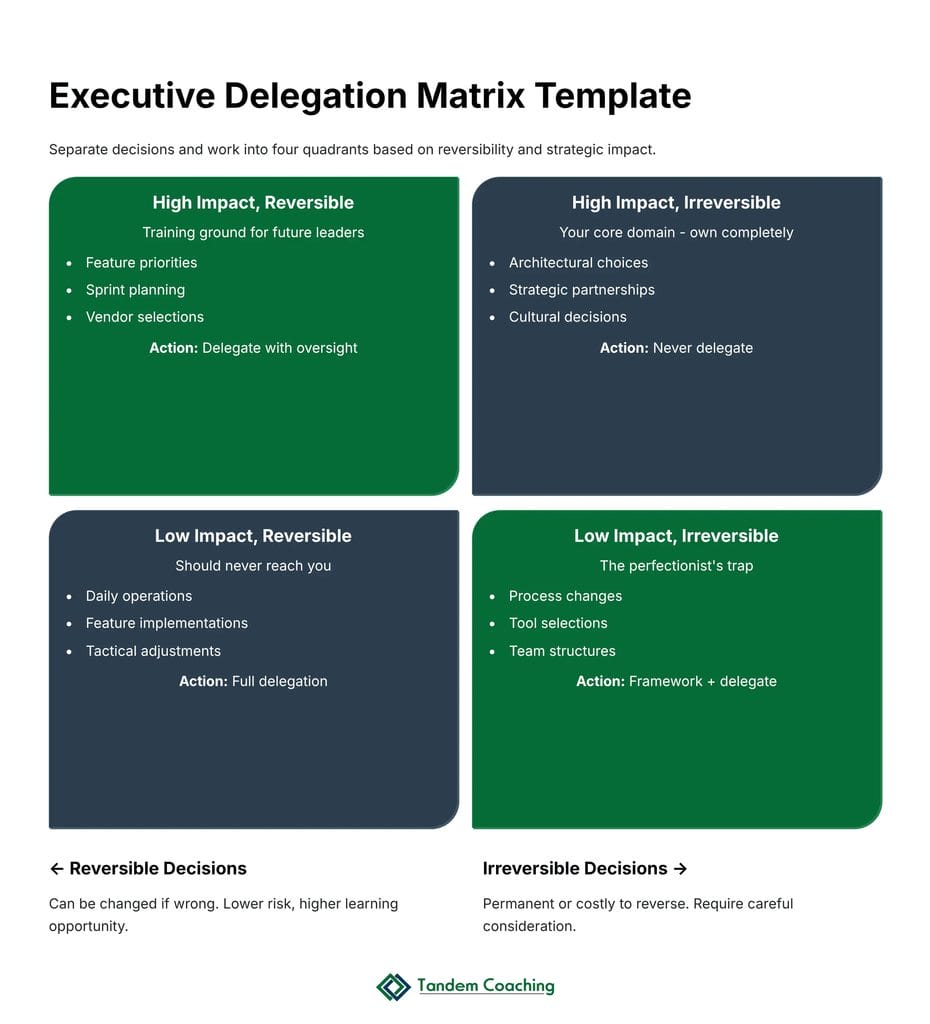
After working with hundreds of executives across every industry, I've developed a framework that actually works. The Executive Delegation Matrix separates all work into four quadrants:
High Impact, Irreversible decisions stay with you. Major acquisitions, cultural transformations, strategic pivots—these represent 10% of decisions but drive 90% of outcomes.
High Impact, Reversible decisions become your training ground. Quarterly priorities, campaign strategies, vendor selections. Yes, they matter. But mistakes won't sink the company, and the learning is invaluable.
Low Impact, Irreversible decisions trap perfectionists. Process changes, system implementations, team structures. Create frameworks and let others own these within guardrails.
Low Impact, Reversible decisions shouldn't reach you. Daily operations, routine approvals, tactical adjustments. If these hit your desk, your delegation system is broken.
Sorting decisions this way is what frees the calendar. But it only works with the right progression system.
Delegate From the Right Role
The matrix tells you which decisions to release. What it assumes is that you already know which role you are releasing them from. Most executives are quietly operating in three roles at once—operator (doing the work), manager (directing the work), and strategic leader (deciding which work matters)—and they delegate as if all three are the same job. They are not.
Before you sort a decision into a quadrant, name the role it belongs to. Operator work should already be gone. Manager work is what you hand to your bench with clear frameworks and guardrails. Strategic work is what you protect. The maker-to-multiplier shift is not about doing less; it is about being deliberate about which of the three hats each decision requires—and refusing to wear the operator hat for anything that reaches the matrix at all.
The Three Jobs You Cannot Delegate
The matrix and the role test both work by subtraction. They tell you what to release; neither names what stays. That omission is why executives who get good at delegating still feel unanchored. They have cleared the desk without deciding what earned a permanent place on it.
The most durable answer to what not to delegate predates every productivity system on this page. Asked early in his career what a CEO actually does, Fred Wilson got a three-part answer he has repeated ever since: set the vision and strategy and communicate it to every stakeholder; recruit, hire, and retain the best people; and make sure there is always enough cash in the bank. Everything else belongs to somebody on the team. Dave Kerpen builds his book Get Over Yourself on the same three: strategy, the right people in the right seats, and access to the capital and resources the work requires.
Read against the matrix, those three are not a fourth framework to memorize. They are what the High Impact, Irreversible quadrant actually contains. If a decision touches none of direction, people, or resources, it does not belong in that box no matter how loudly it asks for you. That test settles most of the arguments executives have with themselves about their own priorities.
The Progressive Delegation Ladder
Most delegation fails because we jump from everything to nothing instantly. You need systematic progression.

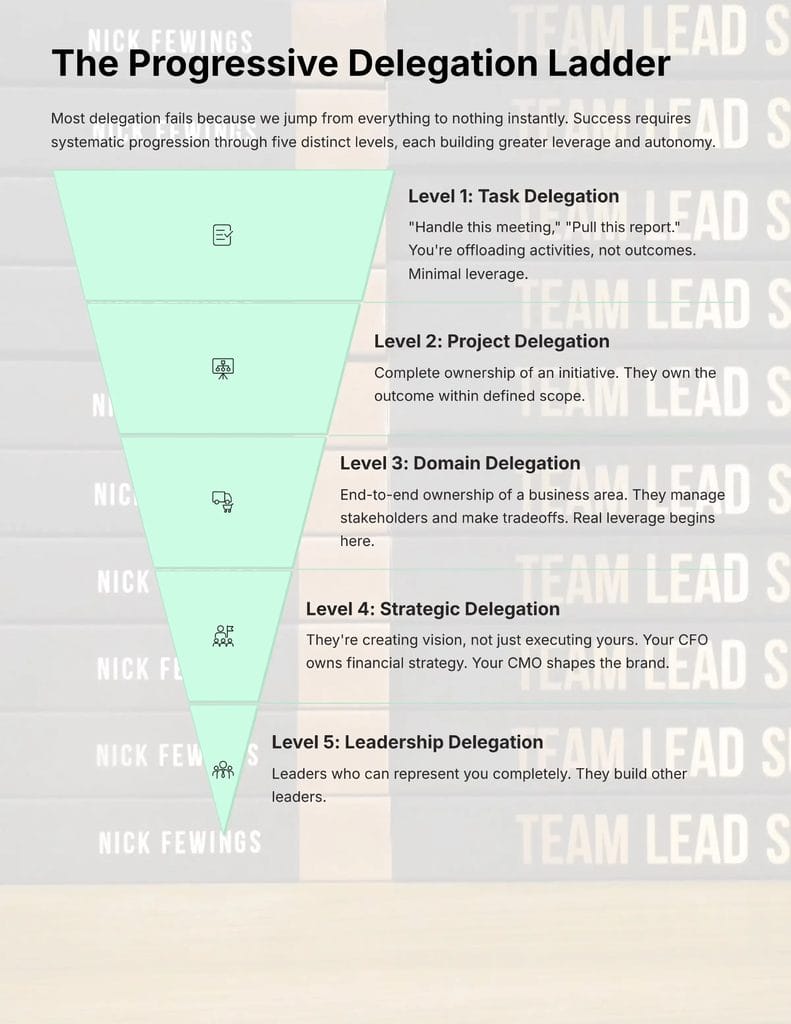
Level 1: Task Delegation—"Handle this meeting," "Pull this report." You're offloading activities, not outcomes. Minimal leverage.
Level 2: Project Delegation—Complete ownership of an initiative. They own the outcome within defined scope.
Level 3: Domain Delegation—End-to-end ownership of a business area. They manage stakeholders and make tradeoffs. Real leverage begins here.
Level 4: Strategic Delegation—They're creating vision, not just executing yours. Your CFO owns financial strategy. Your CMO shapes the brand.
Level 5: Leadership Delegation—Leaders who can represent you completely. They build other leaders.
I watched Sarah progress her best regional manager through these levels. Started with store visit reports (Level 1). Within six months, she owned the entire Southeast region (Level 3). Today, she's driving the national operations strategy (Level 4).
Building Your Bench
Here's what most executives miss: delegation isn't about offloading work—it's about building capability that compounds. Gallup research found that CEOs with high delegator talent generated 33% greater revenue than those with low delegator talent.
"Every delegation interaction either builds or erodes your bench strength."
I call it the "Pull Request Model." Like reviewing code, you don't just approve or reject—you teach. When someone brings a decision, share your thinking process. Explain the factors you're weighing. Show them your mental models.
Jennifer, a hospital administrator, told me the breakthrough wasn't when her director started making good decisions. It was when he started explaining decisions using her frameworks to his own team. Her thinking patterns now influence hundreds of daily decisions without her involvement.
The Delegation Tech Stack
Your consolidated tools need specific capabilities for delegation at scale.
Documentation Systems become delegation infrastructure. Every repeated decision needs a playbook. Whether it's Notion, SharePoint, or Google Docs—the tool matters less than the discipline.
Asynchronous Communication replaces synchronous meetings. Record ten-minute videos explaining context instead of hour-long meetings. That's time multiplied.
Dashboard Systems provide visibility without micromanagement. Track outcomes, not activities.
Marcus now spends two hours weekly reviewing dashboards that once required twenty hours of meetings.
When Delegation Fails
Let's be honest: 30% of initial delegations won't meet expectations. This isn't failure—it's learning.
Treat Delegation Like Debugging
Build failure budgets, feedback loops, and review systems so misses become learning—not a reason to reclaim the work.
The worst response? Taking the work back. Instead, treat failures like debugging. What went wrong? Unclear requirements? Missing context? Wrong person?
"Create explicit failure budgets. Tell people upfront: 'This might fail, and that's okay as long as we learn.'"
David, a pharmaceutical executive, had a painful failure when he delegated a regulatory submission. His instinct was to take over. Instead, he paired with the director to fix it together. They created a checklist. That director hasn't had a failure in three years and now teaches the process to others.
Frequently Asked Questions
How do I delegate when I'm genuinely the only one who knows how?
Start by delegating adjacent work that builds context. Document your approach. Pair with someone. If you’re truly the only person who can do something critical, you’ve created an existential risk. Fix that immediately.
What if delegation takes longer than doing it myself?
It usually does—the first three times. But track properly: 2 hours to do it yourself versus 3 hours to delegate initially, 30 minutes the second time, 10 minutes the third, then zero forever. The ROI turns positive quickly.
How do I maintain quality?
Quality comes from systems, not personal oversight. Define standards. Build review processes. Create feedback loops. Quality problems indicate missing systems, not missing oversight.
What's the difference between delegation and abdication?
Delegation includes context, criteria, and support. Abdication is throwing work over the wall. Good delegation front-loads investment. Abdication tries to save time by skipping context, which always fails.
How do I delegate when everyone's already busy?
First, audit what they’re doing. Often they’re busy with low-value work. Second, delegation can be substitutive—what can they stop doing? Third, if everyone’s at capacity with high-value work, you need more people.
Should I delegate to direct reports or skip-level?
Primarily direct reports. Skip-level delegation undermines your middle management. Exception: specific development opportunities for high-potential talent.
How do I know someone's ready for the next level?
Success at current level with decreasing oversight. Watch for them proposing solutions not problems, anticipating issues, and stakeholders going to them instead of you.
What if my culture doesn't support delegation?
Then you have a bigger problem than productivity. Culture follows leadership behavior. Model effective delegation. Celebrate successes publicly. Make it a performance metric. Culture changes through consistent action, not proclamation.
What is the best delegation framework for executives?
The most reliable executive delegation framework has two parts. The Executive Delegation Matrix decides what to hand off by sorting work along impact and your unique ability. The Progressive Delegation Ladder decides how far to hand it off, from doing to deciding. Together they turn delegation into a repeatable system instead of a case-by-case judgment call.
What should a CEO never delegate?
Three things: the vision and strategy, who sits in which seat, and access to the money and resources the plan needs. Fred Wilson’s 2010 formulation has outlasted every productivity trend since, and it maps onto the High Impact, Irreversible quadrant of the matrix. If a decision touches none of the three, it belongs to somebody on your team.
This pattern connects to related dynamics: gtd fundamentals modern executive, mastering time management productivity coaching, and optimal work rhythm chronotypes.
Your Multiplication Moment
You've optimized everything. You've built your systems, consolidated your tools, and protected your context. You've maximized personal productivity. If you're working with an ADHD coach to maintain these systems, the question of format matters: the guide to remote vs in-person ADHD coaching helps you choose the modality that best supports the delegation and systems work you're sustaining.
Now you stand at the multiplication threshold. The jump from 3x to 10x isn't about doing more—it's about enabling more.
"For the first time in five years, I took a real vacation. The company had its best quarter while I was gone. That's when I knew I'd succeeded as a leader."
That's Marcus today. From 90-hour weeks of doing to 50-hour weeks of multiplying. His company hit $100M last year.
The framework is here. The progression is clear. The only question is: are you ready to stop being the hero and start being the multiplier?
If you're ready to transform your leadership impact through systematic delegation, book a consultation to talk through your delegation plan. Because while frameworks show the path, transformation happens through practice, feedback, and accountability.
Ready to dive deeper into maximizing your mental capacity? Explore cognitive performance optimization to enhance the strategic thinking that great delegation requires.
From Maker to Multiplier—With a Clear Plan
In a free consult, map your highest-leverage delegations, set guardrails, and choose 1–2 domains to hand off first.
Book a Free Consultation →