Virtual Executive Coaching: What It Is, How It Works, and How to Choose
How do I choose a remote or virtual executive coach?
To choose a remote or virtual executive coach, filter first on credential: ICF PCC minimum, MCC for C-suite work. Verify genuine remote experience, then run the chemistry call on your real session platform, watching for camera eye contact, comfort with silence, and no note-reading. Remote and virtual coaching match in-person outcomes; the coach, not the medium, decides results.
The assumption that executive coaching requires a shared conference room died years ago. For the broader shifts reshaping how coaching is delivered, see the overview of trends in executive coaching. Trust — the foundation of any coaching relationship — proves equally buildable at a distance, as the 2024 leadership insights on building trust document across hybrid and virtual contexts. The virtual format is particularly well-suited to ADHD coaching for executive success, where scheduling flexibility and a familiar environment reduce the friction that derails engagement. It just took most of the industry a while to notice. Virtual executive coaching is a structured, sustained coaching engagement delivered through video — and for leaders managing distributed teams, the coaching focus often centers on improving leadership skills for hybrid and remote teams, where the virtual format makes the coach-client pairing especially natural., where the coach and executive work together on leadership development without ever being in the same room. This is not a pandemic workaround. For many executives, it is the better format.
The distinction matters because the word "virtual" still carries a connotation of compromise. In practice, the research shows no meaningful difference in outcomes between virtual and in-person coaching. What does make a meaningful difference is the quality of the coach, the commitment of the executive, and the structure of the engagement. The exception is group settings: see group coaching supervision pros and cons for where virtual group work has genuine tradeoffs.
What Virtual Executive Coaching Is
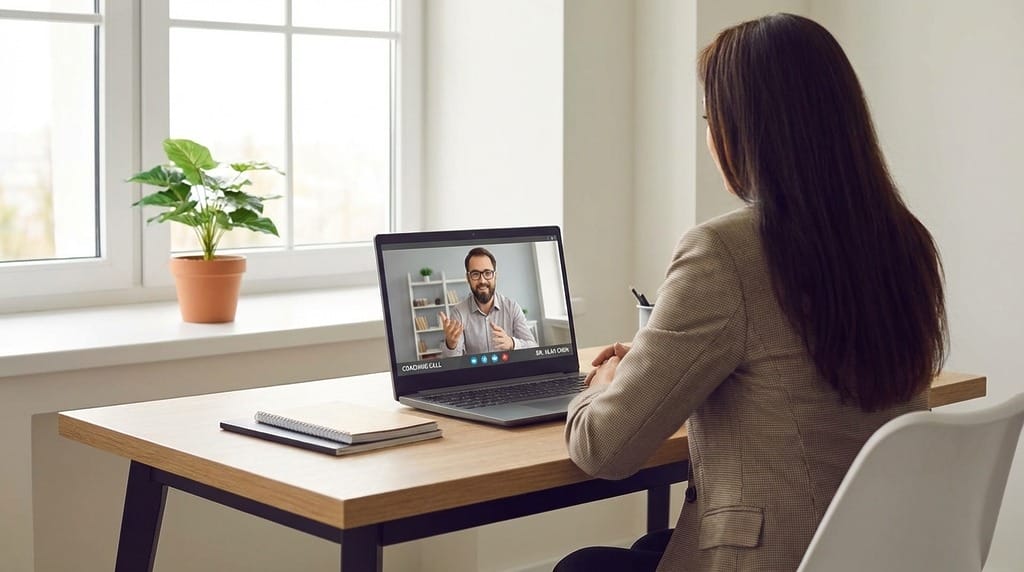
Virtual executive coaching is a one-on-one professional development engagement conducted through video between a credentialed coach and a senior leader. Sessions typically run 60 minutes on a biweekly cadence over four to twelve months. The engagement follows the same structured methodology as in-person work: assessment, goal-setting, ongoing coaching sessions, and measurement.
Key Takeaways
- Virtual executive coaching produces the same measurable outcomes as in-person coaching — the differentiator is coach quality, not delivery medium.
- Executives gain access to the best-matched coach by credential and expertise rather than settling for whoever is geographically convenient.
- Session completion rates are consistently higher in virtual engagements because scheduling flexibility removes the most common cancellation triggers.
- The screen can actually increase candor — executives in their own environment, behind a closed door, tend to drop the performative posturing that surfaces in on-site coaching rooms.
- Credential verification matters more in virtual coaching: look for ICF PCC at minimum, MCC for C-suite work, and pay attention to how the coach uses the medium during the chemistry call.
What changes is the medium, not the method. The coach still works with the executive on leadership identity, decision-making patterns, communication effectiveness, and strategic thinking. The ICF core competencies that define professional coaching apply identically regardless of format. An MCC-level coach on video brings the same 2,500+ hours of experience, the same depth of inquiry, and the same capacity to hold productive silence as they would across a table.
Why Virtual Coaching Works for Executives
Senior executives are the hardest population to schedule. A CEO who would cancel an in-person session for a board emergency can keep a virtual session because there is no commute, no travel, no room to book. Organizations that deploy virtual coaching across distributed leadership teams consistently report higher session completion rates than previous in-person programs.
The scheduling flexibility matters, but the real differentiator is access. The best executive coaches are not evenly distributed. Virtual coaching makes credential quality the selection criterion instead of geographic proximity. A CFO in Houston can work with an MCC-level coach in Atlanta without either person traveling. That access expands the pool from whoever is local to whoever is best.
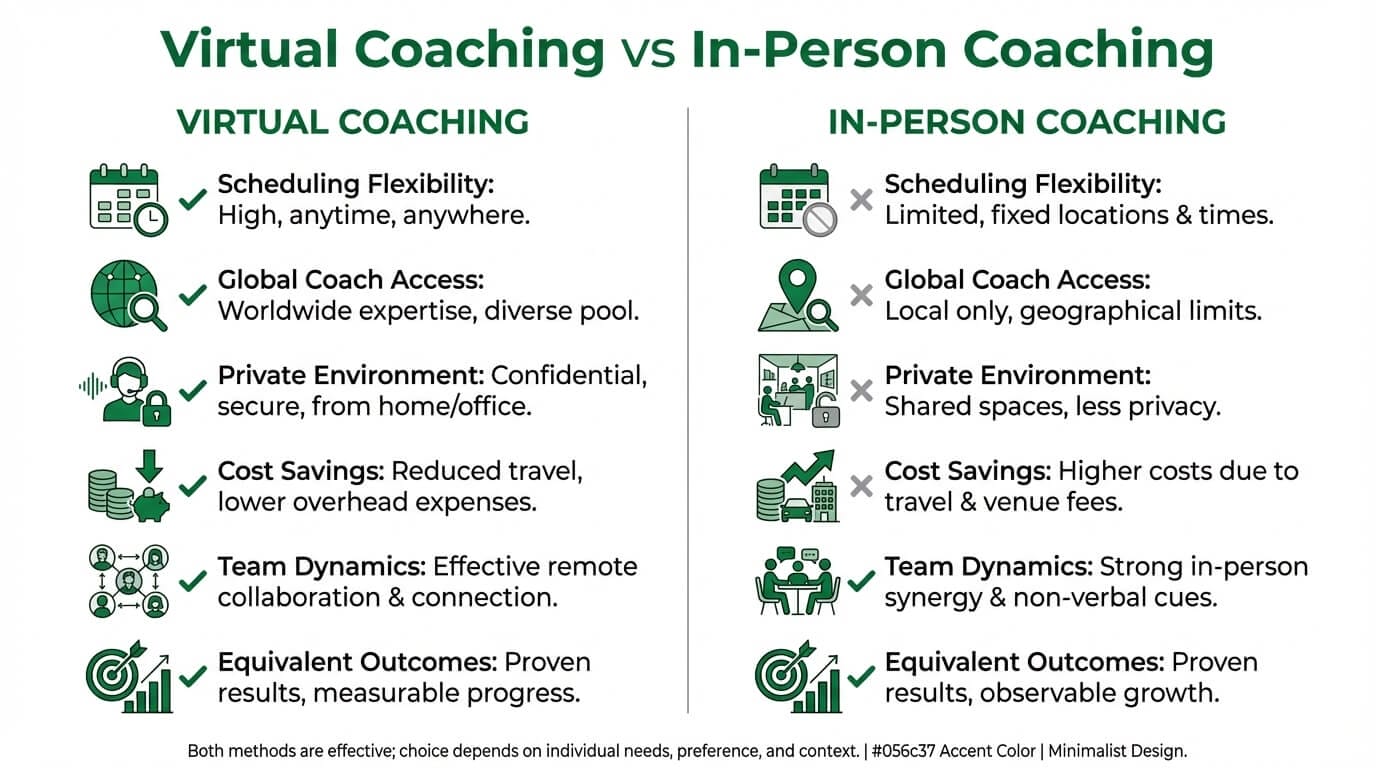
| Dimension | Virtual Coaching | In-Person Coaching |
|---|---|---|
| Scheduling | No travel, minimal rescheduling | Requires coordinated travel or co-location |
| Coach access | Select by expertise, not geography | Limited to local or willing-to-travel coaches |
| Environment | Executive’s own space (often more candid) | Office or coaching center (more formal) |
| Cost | No travel expenses for either party | May include coach travel fees |
| Team dynamics | Works well after baseline is established | Preferred for initial team coaching sessions |
| Outcomes | Equivalent to in-person (ICF research) | Equivalent to virtual (ICF research) |
An observation that surprised us: executives are often more candid in virtual sessions. In their own environment, with the door closed, there is less performative posturing than in a coaching room at the corporate campus where colleagues might see them entering. The psychological distance of the screen can reduce the social performance.
The best coaching conversations happen when the executive stops performing leadership and starts examining it. A closed door and a screen make that shift easier than most people expect.
Privacy is another factor. Executives dealing with sensitive topics, whether succession uncertainty, peer conflict, or personal burnout, often speak more freely when they are not worried about being seen entering a coaching room at the office. The virtual format provides discretion by default.The honest limitation is reading group dynamics. When coaching leadership teams, the first two or three sessions benefit from being in person because the coach needs to observe the nonverbal patterns between people. After that baseline is established, team sessions can shift to virtual without loss. Coaches who build coaching confidence through rigorous practice are the ones who navigate this virtual/in-person calibration most effectively.
How Virtual Coaching Sessions Work
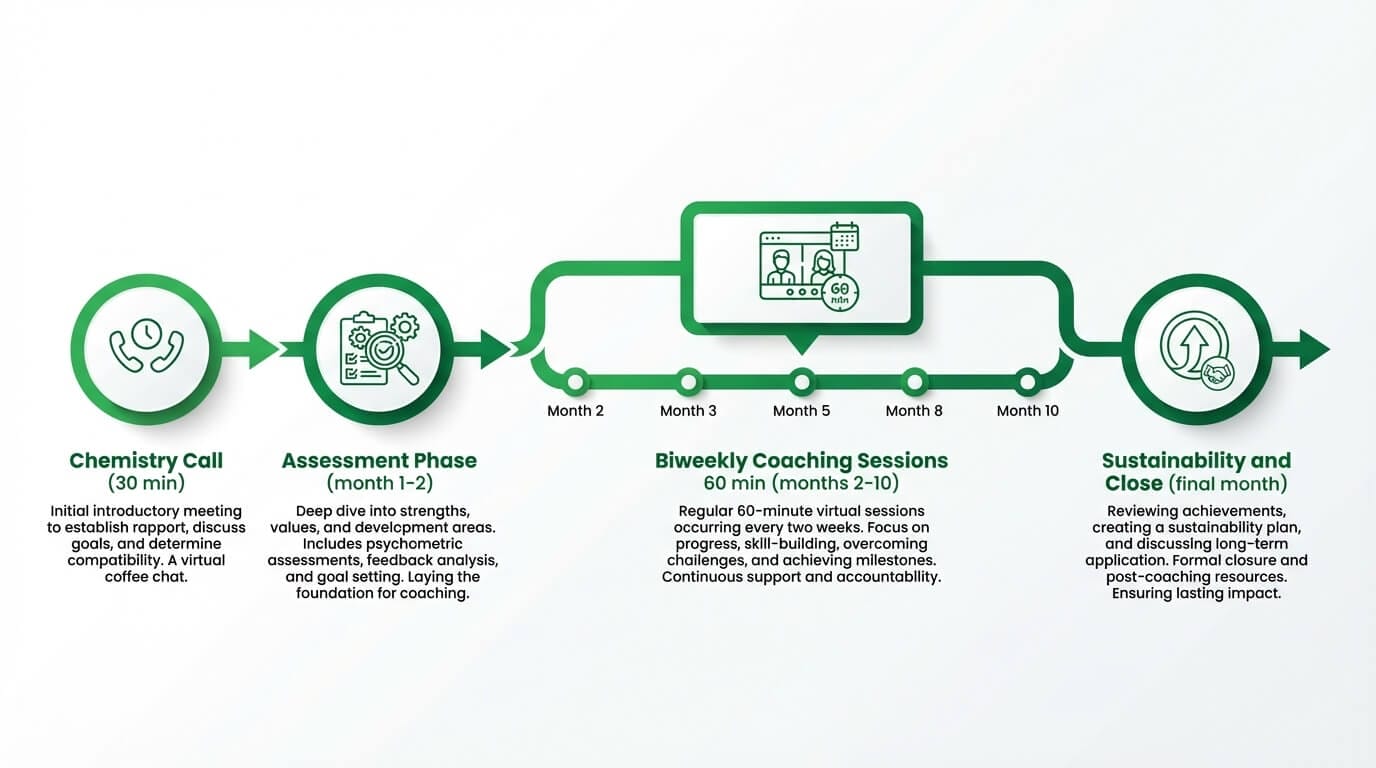
A typical engagement runs six to twelve months on a biweekly cadence. The first interaction is a chemistry session: a 30-minute video call where coach and executive assess mutual fit. This is not a sales conversation. Both parties are evaluating whether the working relationship will produce results.
After contracting, the engagement opens with assessment. Depending on the scope, this might include a 360-degree feedback process, a leadership style inventory, stakeholder interviews, or emotional intelligence assessment. The coach debriefs results via video because seeing the executive’s reaction to the data in real time matters.
Regular sessions follow: 60 minutes via video, biweekly. The executive sets the agenda. The coach facilitates exploration, challenges assumptions, and co-creates action commitments. The coaching tools and assessments are the same as in-person work, and the choice between a boutique firm or a coaching platform determines the depth of that assessment infrastructure. Tandem structures engagements through the ASPIRE framework (Assess, Strategize, Plan, Inspire, Reflect, Evolve), which provides a progression from assessment through sustainable self-directed development. For a deeper look at coaching approaches, see executive coaching models. One advantage of virtual engagement: the executive practices in their actual working environment, which means the coaching directly intersects with real calendar pressures — including the fragmentation documented in the research on context switching costs and solutions.
Between sessions, the executive practices in their actual context. The development happens in the application, not in additional coaching contact. A session might surface a pattern where the executive dominates meetings; the practice is noticing and adjusting that pattern in the next three meetings before the following session.
Coaching doesn’t happen in the session. It happens in the three meetings after the session, when the executive catches the old pattern mid-sentence and chooses differently.
The engagement closes with a reflection session and a stakeholder check, measuring against the goals set at the beginning. The goal is not ongoing dependency but sustainable capacity that persists after coaching ends.
What Results to Expect
The ICF Global Coaching Study reports that over 80% of coaching clients report increased self-confidence and over 70% report improved work performance. These figures hold regardless of delivery format. Virtual coaching does not produce different outcomes than in-person coaching. It produces the same outcomes with fewer logistical barriers.
Organizations typically measure coaching impact through behavioral change visible in 360-degree follow-up assessments, stakeholder feedback on the executive’s leadership effectiveness, and the executive’s own assessment of progress against their stated goals. Some organizations also track business metrics that the coaching engagement was designed to influence: team retention, decision-making velocity, cross-functional collaboration scores.
The engagement patterns that predict success are straightforward: consistent session attendance, completing between-session practice commitments, and organizational support for the executive’s development goals. A detailed analysis of whether coaching is worth the investment breaks down the ROI evidence.
An honest note: coaching outcomes depend on the executive’s commitment and the coach’s skill level, not the medium. A weak coach on video produces the same weak results as a weak coach in person. The medium does not compensate for the practitioner. Conversely, a strong coach on video often outperforms an average coach in person, because coaching quality is determined by the practitioner, not the proximity.
A mediocre coach in the same room is still a mediocre coach. The medium never compensates for the practitioner.
How to Choose a Virtual Coach
Credential level matters more in virtual coaching because you cannot rely on in-person presence to assess quality. At minimum, look for an ICF PCC (Professional Certified Coach) with documented training from an ICF-accredited program. For C-suite work, an ICF MCC (Master Certified Coach) with 2,500+ hours of coaching experience provides the depth to work with identity-level complexity rather than surface-level skill development.
Find the Right Virtual Coach
Credential quality matters more than geography. Talk with an MCC-level coach to see if the fit is right.
Virtual-specific experience is a real differentiator. A coach who has refined their virtual practice over years delivers a different experience than one who treats video as an inferior substitute. Red flags include filling every silence (discomfort with virtual pauses), reading from notes on a second monitor, or declining to use video altogether.
The chemistry call should be on the same platform you will use for sessions. Pay attention to how the coach uses the medium: eye contact with the camera, comfort with silence, presence that feels equivalent to sitting across a table. That 30-minute call is a live demonstration of what every session will feel like.
For organizations deploying virtual coaching at scale, the selection criteria expand to include the firm’s coach bench, virtual coaching pricing structures, and whether they can match coaches to executives based on expertise rather than availability. Our guide to choosing a coaching firm covers the full evaluation framework. Tandem delivers virtual executive coaching through MCC-level coaches with our executive coaching services.
FAQ
Is virtual coaching as effective as in-person coaching?
Yes. The ICF Global Coaching Study and multiple peer-reviewed studies show no significant difference in outcomes between virtual and in-person coaching. The factors that determine coaching effectiveness are the coach’s skill level, the executive’s commitment, and the quality of the coaching relationship, not the delivery medium. The one area where in-person has an edge is initial team coaching sessions, where observing group dynamics benefits from physical proximity.
How long does a virtual coaching engagement last?
Most virtual executive coaching engagements run four to twelve months with biweekly 60-minute sessions. The first one to two months focus on assessment and goal-setting. The core coaching phase runs three to eight months. The final phase addresses sustainability and transition to self-directed development. Shorter engagements are possible for targeted skill development; longer ones suit complex transitions like new role onboarding or organizational change leadership.
What technology do I need for virtual coaching?
A computer or tablet with a camera, a reliable internet connection, and a private space where you will not be interrupted. Most coaches use standard video platforms like Zoom or Microsoft Teams. No specialized software is required. The technology barrier is minimal; the real requirement is a distraction-free environment where you can speak openly without colleagues overhearing.
Start With a Virtual Chemistry and Scope Conversation
Test the working chemistry, confidentiality, technology, and engagement scope with an MCC-level coach before choosing a virtual coaching arrangement.
Discuss Virtual Coaching →Plan the engagement first →