AI Leadership Development: Why Your Learning Rate Is Now the Job
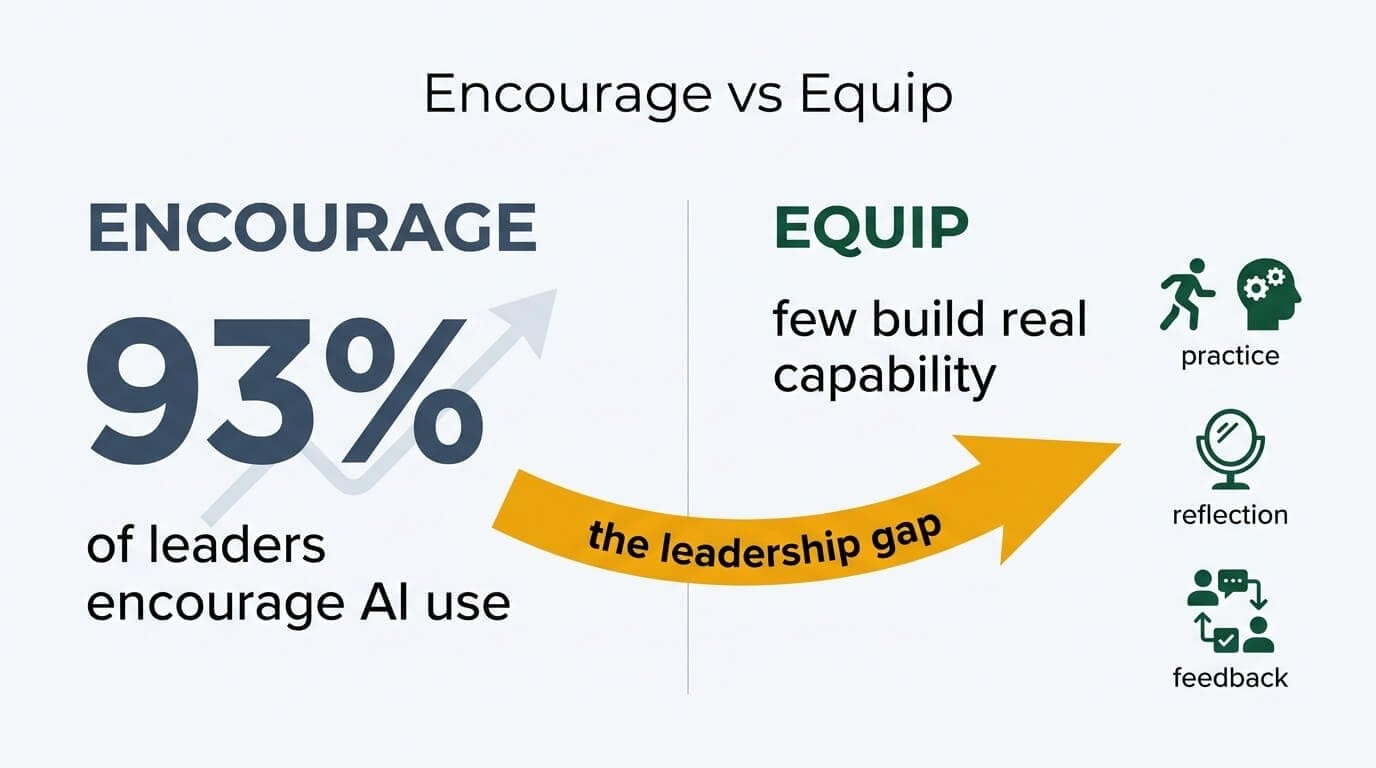
Here is the number that should stop every leader cold: 93% of leaders say they actively encourage their teams to use AI, but only about a quarter are using it for anything strategic. That gap — reported by Chief Learning Officer from a survey of more than 500 senior leaders — is the real leadership story of the moment. It isn’t a story about tools. Almost everyone has the tools now. It’s a story about what leaders are being asked to be good at, and how few of us have actually retooled ourselves to meet it.
AI didn’t just hand your team a faster way to write emails. It quietly rewrote the job description for the person in charge. The half-life of any given skill keeps shrinking, the “right answer” you carried for years gets stale faster, and your people are watching to see whether you’re learning at the pace you’re asking of them. AI leadership development is the work of closing that gap — not by buying another platform, but by treating your own learning rate as part of the job.
Quick answer
AI leadership development is the practice of building a leader’s capacity to lead well in an AI-shaped workplace: learning faster than the tools change, modeling that learning openly, sharpening the human judgment AI can’t replace, and deciding what to automate and what to protect. It is a shift from knowing the answer to being able to learn anything quickly, and it is built through practice and reflection, not software rollouts.
This piece is for the leader, not the IT budget. We’ll look at what the term actually means now, the trap most leaders fall into, the skills that matter more than ever, and the practical way to build them.
What AI leadership development actually means now
The lazy version of AI leadership development is a training calendar: a prompt-writing workshop, a tool demo, a policy memo, done. That checks a box. It does not change how anyone leads. The useful version starts somewhere less comfortable — with the leader’s own rate of learning.
Boston University’s Questrom School made the point plainly: access to AI is no longer the differentiator. They cite research showing 88% of organizations now use AI in at least one business function, up from 78% a year earlier, yet only a small fraction of employees use it in ways that genuinely change how they work. One survey of 15,000 employees across 29 countries found just 5% using AI to fundamentally transform their work, with companies leaving up to 40% of possible productivity gains on the table. The bottleneck isn’t the technology. It’s execution, and execution is a leadership skill.
The learning industry has noticed. GP Strategies, a 60-year-old training company, rebuilt its whole identity around the phrase “learning velocity” — the speed at which a person or a team can pick something up and put it to work. Their own research found that only 19% of learning teams are seen as strategic partners inside their companies, and nearly a third of leaders name fear of failure as the top barrier to working in new ways. Read that again: the barrier isn’t capability. It’s the discomfort of being a beginner.
So when I say AI leadership development, I mean the deliberate work of raising your own learning velocity and your team’s — building the muscle to absorb a change, test it, keep what works, and move on, faster than the change cycle that’s coming at you. That is a competency now. It can be developed, and it can be neglected.
Notice what this reframe does. It moves the question from “Which AI tools should we buy?” to “How fast can we, as a team, learn and adapt?” The first question has a vendor answer. The second one has a leadership answer, and it points straight back at you.
The trap: sponsoring AI for everyone but yourself
Here is the pattern I see most often. A leader champions AI loudly. They fund the licenses, they send the all-staff email, they put “AI fluency” on everyone’s development plan. And then they quietly exempt themselves. They delegate the actual learning — the fumbling, the bad first attempts, the not-knowing — to people three levels down.
Stop Quietly Exempting Yourself
A coach can help you step into beginner mode without losing authority—and turn your own adoption into the signal your team follows.
It’s an understandable move. Senior roles are built on the comfort of expertise. You got promoted because you had answers. Being visibly bad at something new cuts against every instinct that got you here. But the exemption is exactly the problem. When you opt out of being a beginner, you’re not protecting your authority. You’re modeling the precise behavior that stalls your organization.
Chief Learning Officer’s data put a sharp point on where adoption breaks down: vice presidents, the people closest to turning executive vision into operational reality, are the ones falling behind. The bottleneck isn’t the front line. It’s the middle and upper layers of leadership who encourage the change without living it. A team takes its cue from what its leader does, not from what the leader assigns.
The cost compounds quietly. Your people learn that learning is for juniors. They learn that not-knowing is dangerous to admit. They learn to perform competence rather than build it. None of that shows up on a dashboard, and all of it slows you down.
The leadership skills AI can’t hand you
As more of the production work gets automated, the value of distinctly human capability goes up, not down. Tey Bannerman — a former McKinsey partner and trained engineer — argues that the version of leadership that worked five years ago is no longer sufficient: when the production layer is automated, ethical judgment, contextual understanding, and systems thinking become the core leadership skills. The machine can draft the plan. It cannot own the call.
Watch what happens when leaders forget that line. Forbes ran a piece on what executives are now asking AI about their own people — how to handle a difficult employee, how to lift a struggling team. On the surface it looks resourceful. Underneath, it reveals something harder: many leaders never built the confidence or skill to manage people, because the programs that used to teach those things got cut or watered down. As the author put it, reaching for a chatbot to script a hard conversation isn’t innovation. It’s a workaround for a capability that was never developed.
The same caution applies to the tools that promise to find your next leaders for you. Workhuman, for example, launched an AI product that mines recognition and collaboration data to flag high-potential employees years before a traditional process would. Used as one input, that’s genuinely useful — it can surface people the org chart overlooks. Used as the decision, it quietly hands one of leadership’s most consequential judgments — who gets developed, who gets the shot — to a model trained on what leadership has looked like in the past. A coach would ask the obvious question: is the system finding tomorrow’s leaders, or just cloning yesterday’s?
That question — deciding what to automate and what to keep in human hands — is itself a leadership skill, and a new one. So is asking the sharper question instead of accepting the first fluent answer. So is reading the room, holding a hard conversation, and carrying the weight of a decision the model will never have to live with. These don’t come bundled with a license.
Don’t let people and culture become the casualty
There’s a real risk in this moment that the rush to deploy AI crowds out the human development that leadership actually runs on. When every budget conversation is about tooling, the slow, unglamorous work of growing people loses the argument. The capability you stop investing in is the one that took years to build and won’t come back overnight.
The BBC’s chief people officer put it bluntly: if HR and people leadership don’t take an active role, the AI transformation will not succeed. Technology adoption is, underneath, a people-and-culture problem — how trust gets built, how change gets absorbed, how fear gets named instead of buried. Treating people leadership as administrative overhead while you chase the tooling is how a transformation stalls with all its licenses paid for.
Tools change what your team can do. Culture decides whether they’ll actually do it. Lead the second one and the first takes care of itself.
This is where leadership development and AI strategy turn out to be the same conversation. The places moving fastest aren’t the ones with the biggest tech spend. They’re the ones whose leaders made it safe to experiment, safe to fail small, and safe to say “I don’t know yet.” That’s a culture call, and it’s made by people, not platforms. Even national systems are treating it that way — Qatar’s government, for instance, paired AI training with leadership development in the same workforce-readiness program rather than running them on separate tracks.
How leaders actually build the capability
If the goal is a higher learning rate and sharper human judgment, the method matters. You don’t get there by consuming more content. You get there the way anyone builds a hard skill: deliberate practice, honest reflection, and feedback from someone who isn’t impressed by your title. That’s the mechanism coaching has always used, and it’s exactly what this moment calls for.
Turn Dabbling into Deliberate Practice
Build the try–reflect–adjust loop, sharpen human judgment, and get real feedback from someone who won’t defer to your title.
Three moves do most of the work. First, model learning out loud. Pick something you’re genuinely new at, struggle with it in front of your team, and narrate the struggle. The point isn’t the skill — it’s showing that a senior person can be a beginner on purpose and survive it. That single behavior gives everyone below you permission to learn instead of perform.
Second, run small experiments with real reflection attached. Most leaders dabble with AI and call it learning. Dabbling without reflection is just activity. Try a defined thing, then ask the questions that turn activity into capability: What did that actually change? What would I do differently? Where did my judgment add something the tool couldn’t? That loop — try, reflect, adjust — is what converts experimentation into durable skill.
The authority that holds up in an AI-shaped workplace isn’t “I have the answer.” It’s “I can learn anything fast, and I’ll show you how.” The first kind erodes a little every time the ground shifts. The second kind compounds.
Third, get a thinking partner who holds you to it. Left alone, every leader drifts back to the comfortable expert role. A coach’s job is to keep you in the productive discomfort of learning — to ask the question you’re avoiding, to notice when you’ve quietly exempted yourself again, and to hold the standard you set for everyone else. This is precisely the gap GP Strategies pointed at: leaders know they should adapt, and fear of failure stops them. A good coaching relationship makes the failure small, safe, and useful instead of something to hide.
What to do this quarter
You don’t need a transformation program to start. You need a few concrete commitments and the willingness to be seen doing them.
Start a beginner ritual. Once a week, spend an hour learning something genuinely new about how AI touches your work, and tell your team what you tried and where you got stuck. Run an AI-question audit: for one month, every time you’re tempted to ask a chatbot how to handle a person, write down the question instead and ask whether it points to a leadership skill you should be building rather than outsourcing. And draw a line: write down, with your team, the two or three decisions you will keep in human hands — who you promote, how you handle someone in trouble, what you stand for — and say why.
Key takeaways
- The real gap isn’t access to AI; 93% of leaders encourage it. It’s capability: only about a quarter use it strategically.
- AI leadership development means raising your own learning velocity, not rolling out tool training.
- The most common failure is sponsoring AI for everyone while quietly exempting yourself from being a beginner.
- Judgment, the right question, reading people, and deciding what to keep in human hands are the skills that now matter most.
- Protect people and culture; a transformation stalls when human development loses every budget argument to tooling.
- Capability is built through practice, reflection, and feedback — the coaching mechanism — not through more content.
None of this requires you to predict where AI goes next. It requires you to become the kind of leader who can learn whatever comes, and to show your people you’re doing it. That’s the development worth investing in, and it’s the work we do with leaders every day. If you want a thinking partner to build that learning habit deliberately, our leadership development and executive coaching teams are a good place to start.
What is AI leadership development?
It’s the work of building a leader’s capacity to lead well in an AI-shaped workplace: learning faster than the tools change, modeling that learning openly, sharpening the human judgment AI can’t replace, and deciding what to automate and what to protect. It’s developed through practice, reflection, and feedback, not software rollouts.
How is AI changing leadership development?
It moves the center of gravity from knowing the answer to being able to learn quickly. With AI tools nearly universal, the differentiator is no longer access; it’s execution and learning velocity. That makes a leader’s own adaptability, and their ability to build it in others, the core thing to develop.
What leadership skills matter most in the age of AI?
The distinctly human ones that automation raises the value of: ethical judgment, contextual understanding, systems thinking, asking the sharper question, reading and developing people, and deciding what to keep in human hands. These don’t come with a software license and have to be deliberately built.
Can AI replace leadership coaching?
No. AI can offer scripts and instant answers, but reaching for it to handle people problems is usually a workaround for a capability that was never developed. Coaching builds the underlying skill — judgment, presence, the habit of reflection — through practice and feedback a model can’t provide.
Close the 93%–25% Strategy Gap
If you’re encouraging AI but not using it strategically, let’s map what to learn, what to automate, and what to keep human—starting this quarter.
Book a Free Consultation →