Forgiveness Reflection
Clarify what your resentment is costing you and what you want instead, using a structured, coach‑tested reflection grounded in real-life scenarios.
Get This Tool
Free, print-ready PDF.
When to Use This Tool
Client acknowledges a resentment they are carrying but has not examined what it is costing them
Client knows intellectually they need to move forward but has not processed the emotional weight
Client applies self-criticism to past decisions without any structured path toward self-compassion
How to Introduce This Tool Plus
This worksheet moves through what you're carrying, what it's costing you, and what moving forward might look like - would you be open to working through it on your own and bringing what comes up into our next conversation?
Coaching Tool Disclaimer
This tool is designed for coaching contexts, not clinical use. If you or your client is in crisis, contact the 988 Suicide and Crisis Lifeline (call or text 988) or Crisis Text Line (text HOME to 741741).
Browse All Pages
Tool Classification
Domain
Life Coaching
Type
Worksheet
Phase
Action
Reflection
Details
30 min
Between sessions
As-needed
Topics
Emotions
Self-Care
Identity
For the Coaching Practitioner
Plus
Coaching Scenarios
Plus
1 Client carrying resentment that is consuming more bandwidth than they realize ▶
Context
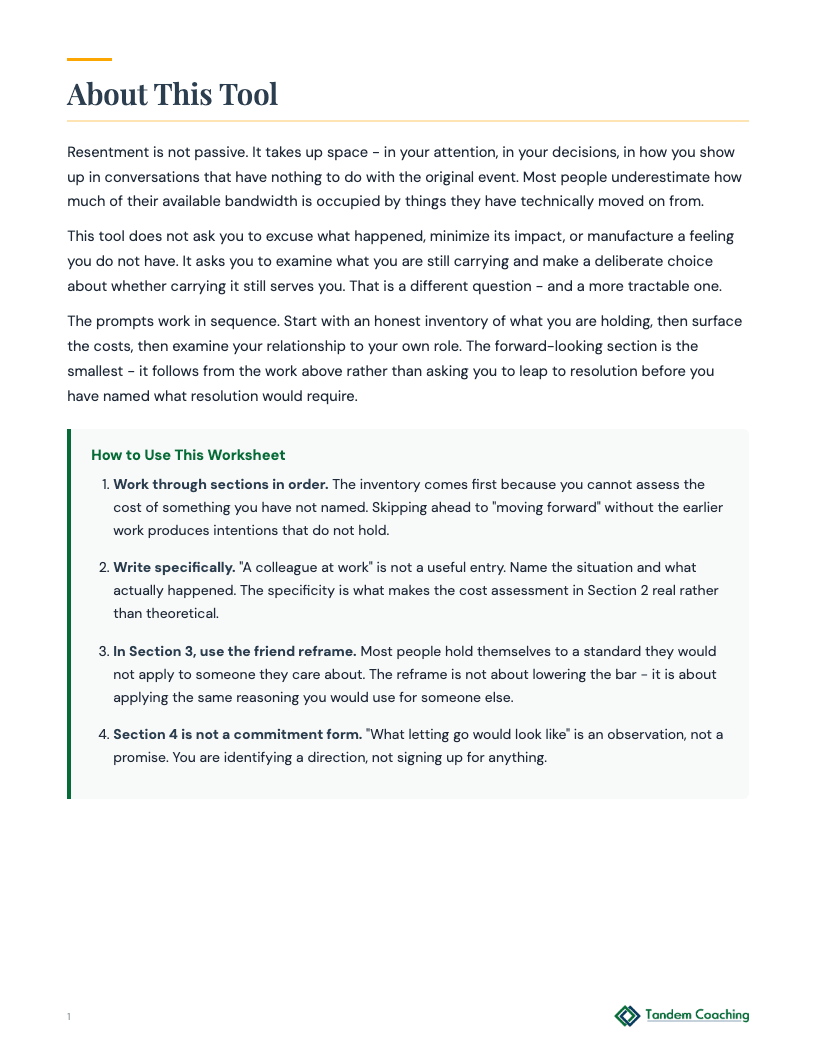
A professional describes a current challenge — a difficult relationship, a stalled project, a leadership decision that didn't go their way — and in the description, references to a past event keep surfacing. They mention it as context but it's clearly still active. They haven't examined how much of their available attention is occupied by something they consider resolved. The inventory table in Section 1 makes what's being carried concrete.
How to Introduce
Frame as a bandwidth audit rather than a forgiveness exercise. 'What I want to understand is how much of your current capacity is occupied by things from the past — not to judge whether that's reasonable, but to make the cost visible. The first section is just an inventory: what happened, how it affected you, what you're still holding. Once we can see it, we can decide what to do with it.' The bandwidth framing is more accessible for professionals than any framing that centers the concept of forgiveness.
What to Watch For
Watch Section 2 — the cost assessment — for the 'how it shows up in my behavior' field. For clients who are unaware of how much something is still affecting them, this field is often the most revealing. They know it bothers them; they may not have named how it shows up in current decisions, current conversations, current relationships. If the behavioral description includes current professional contexts, that's worth examining directly.
Debrief
Start with the energy ratings in Section 2. 'Look at these numbers. If you add them together — that's how much of your available capacity these items are drawing on. Does that match how you'd describe your available bandwidth right now?' The aggregate makes visible what individual items obscure. Then: 'For the highest-rated item — what specifically would change in your current work if that number dropped by half?'
Flags
If Section 1 contains items from more than three years ago at high energy ratings, the resentment is not incidental. Severity: moderate. Resentment that persists at high intensity over years is worth examining more carefully: what specifically keeps it active, what function it serves (protection, identity, narrative), and whether this is work that coaching can address adequately or whether other support would be appropriate to explore.
2 Client who is intellectually ready to move forward but hasn't actually moved ▶
Context
A professional can describe, in sophisticated terms, why a past event no longer needs to occupy their attention. They understand that resentment is costly, that holding on doesn't change what happened, and that moving forward is in their interest. They have said they've forgiven the situation. Their behavior — how they talk about the person involved, how they approach related situations, what decisions they make — suggests otherwise. The tool works at the level the intellectual understanding hasn't reached.
How to Introduce
Name the gap without making it pathological. 'You've done the intellectual work on this — you know the case for moving forward. What we're going to do with this tool is work at a different level: not the argument for letting go but the actual cost, the specific behavior, the concrete step. The intellectual understanding gets you to the decision to let go. This gets you through it.' The distinction between deciding and doing is usually recognizable to analytically oriented clients.
What to Watch For
Watch Section 3 — self-forgiveness — for this client specifically. Clients who are intellectually ready to move forward but haven't done so often have something in Section 3 that they haven't examined: a role they played, a decision they made, a way they contributed to what happened. The forgiveness work that's been delayed may be less about the other party and more about the client's own judgment or behavior. The friend reframe in Section 3 is diagnostic here.
Debrief
Start with Section 4's 'one step I can take' column. 'Read me the step you wrote for the highest-energy item.' Then: 'On a scale of 1-10, how likely are you to take that step in the next week?' For clients who have been intellectually committed but behaviorally stuck, the likelihood question surfaces whether the step named is actually one they'll take or whether it's an aspiration. If the number is below 7, explore what specifically is in the way.
Flags
If Section 3 is left blank or nearly blank — the client moves through Sections 1, 2, and 4 but skips the self-forgiveness section — the omission is often the most important piece. Severity: low to moderate depending on the situation. Ask directly: 'What would go in this section if you wrote what's actually true rather than what sounds right?' The answer to that question often contains what's keeping the client stuck.
3 Client with persistent self-criticism who has no path toward self-compassion ▶
Context
A professional who holds themselves to exacting standards has been working through a significant mistake, failure, or professional setback. They understand what went wrong, have done the analysis, and have taken corrective action. They continue to hold the event against themselves in a way that is no longer productive — it shows up as ongoing self-criticism, reluctance to take comparable risks, and difficulty fully engaging in current work. Section 3 of the tool is the primary intervention point.
How to Introduce
Position Section 3 as the center of the exercise for this client, not a subsection. 'The first two sections are context — we need to name what happened and what it cost. But the work for you is in Section 3: the friend reframe. When you read back what you've written about what happened, how does the judgment you're applying to yourself compare to what you would say to someone you care about in the exact same situation?' That question, asked before the tool is completed, frames the whole exercise.
What to Watch For
Watch whether the 'what I would say to a close friend' response in Section 3 is genuinely warmer than how the client has been treating themselves, or whether they hold even hypothetical friends to the same standard. Clients with high self-criticism sometimes produce friend responses that are only marginally kinder: 'I'd tell them they made a mistake and should learn from it.' That response indicates the standard is so deeply held that even the perspective shift doesn't move it much. Note that and explore it.
Debrief
Read the client's 'something I blame myself for' and their 'what I would say to a close friend' responses back to them. 'You wrote this about yourself. You wrote this about someone you care about. Read them both. What do you notice?' The contrast, read aloud, often produces a recognition that the self-criticism doesn't survive contact with the standard the client applies to others. Then: 'What would it mean to apply the same reasoning to yourself — not just intellectually, but actually?'
Flags
If the self-blame item in Section 3 describes a single decision or event from years ago that the client has been carrying at high intensity — and the 'friend' response they wrote is clearly wiser and more compassionate than how they've treated themselves — but the client reports that reading it back doesn't shift anything, the self-criticism may have an identity function that goes beyond the specific event. Severity: moderate. Consider whether this pattern is worth exploring with a different kind of support alongside coaching.
Tool Flow
Plus
Requires
- None - standalone tool
→
Produces
- named inventory of resentments still being carried
- quantified energy cost per grievance
- self-forgiveness statement ready for release
- one concrete letting-go action per item
Pairs Well With
Life
Leadership Interaction Context Reflection
Use this assessment to take stock of emotions and self care before the client chooses what deserves attention.
Why it pairsOnce you've quantified the energy cost of each grievance, the EQ assessment reveals whether self-regulation gaps are what kept them entrenched.
LifeEmotion Vocabulary Wheel
Client describes feeling 'bad' or 'off' but cannot name the emotion with any specificity
Why it pairsAfter naming resentments, the wheel gives clients precise emotion labels for what sits underneath each grievance, moving beyond broad words like 'angry'.
LifeOptional Daily Reflection
Use this tracker to notice patterns in accountability and self care over time before drawing conclusions.
Why it pairsUse this after the self-forgiveness statement to give clients a daily check-in that tracks whether released resentments actually stay released.
Related Articles


ICF Team Coaching Competencies: What They Look Like in Practice
Read article →How to Structure a Coaching Conversation That Actually Moves
Read article →
Chief AI Officer Career Path: Is CAIO Right for You?
Read article →
Boosting Your Confidence and Self-Esteem Through Coaching
Read article →