Weekly Memory Pattern Log
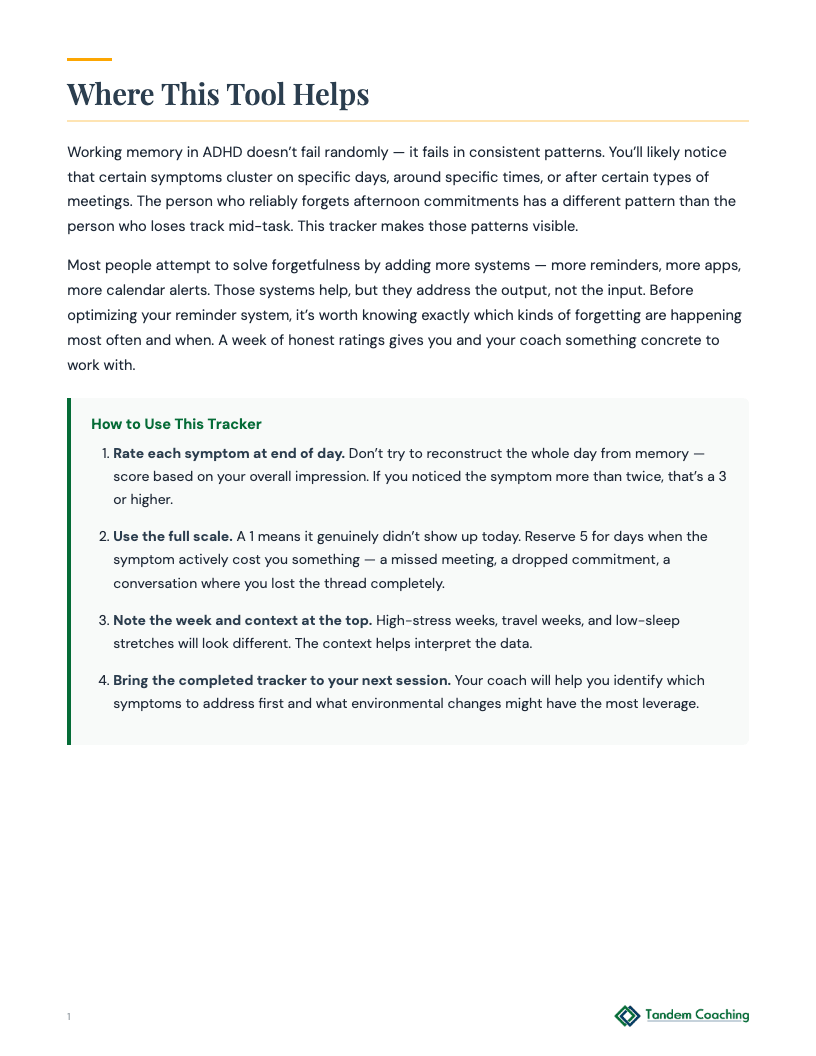
Log weekly memory slips and their context or impact without calculating a symptom score.
Get This Tool
Free, print-ready PDF.
When to Use This Tool
ADHD adult who is struggling with forgetfulness and wants to understand when and what type of things are being missed
A client who needs objective data on their forgetfulness patterns to bring to coaching or share with a healthcare provider
Person who feels like they forget everything but can't say whether it's getting better or worse over time
How to Introduce This Tool Plus
Looking at your weekly memory log, what context appears around the events that mattered most, and what support would you like to test next week?
Coaching Tool Disclaimer
This tool is designed for coaching contexts, not clinical use. If you or your client is in crisis, contact the 988 Suicide and Crisis Lifeline (call or text 988) or Crisis Text Line (text HOME to 741741).
Browse All Pages
Tool Classification
Domain
ADHD
Type
Tracker
Phase
Action
Review
Details
5 min
Between sessions
Weekly
Topics
Executive Function
Accountability
Habits
For the Coaching Practitioner
Plus
Coaching Scenarios
Plus
1 Senior manager who thinks their forgetfulness is just stress from promotion ▶
Context
Director of Operations promoted six months ago from individual contributor role. Managing 12 people across three departments. Came to coaching because direct reports are starting to comment on missed follow-ups and forgotten commitments. Client attributes everything to adjustment stress and increased workload.
How to Introduce
Frame this as a pattern diagnostic, not a stress assessment. 'Before we build systems to handle the workload, let's see what types of forgetting are actually happening.' Many newly promoted leaders resist tracking because it feels like documenting failure. Reframe: 'This shows us which executive demands are hardest for your brain right now.'
What to Watch For
Notice if they rate everything as 3s across the board - that's averaging to avoid specificity. Look for resistance to rating weekend days, especially items 6 and 8. New managers often compartmentalize work vs personal forgetting. If they skip the context field, they're not connecting patterns to environmental factors yet.
Debrief
Start with the highest-rated items, not the patterns. 'Read me your 4s and 5s.' Then ask: 'Which of these would your direct reports notice?' This connects internal experience to external impact. The question that opens it up: 'What's different about the days when item 2 was a 1 versus a 4?'
Flags
If items 1, 2, and 6 are consistently 4-5 and the client dismisses this as 'normal promotion adjustment,' the executive function demands may exceed their current capacity. Severity: moderate. The role itself might need restructuring before coaching can address the symptoms. Consider whether this is a skills gap or a neurological mismatch.
2 Project manager tracking symptoms to prepare for ADHD evaluation with psychiatrist ▶
Context
Mid-level project manager at tech company, age 34, scheduling psychiatric evaluation after researching ADHD symptoms online. Wants objective data to bring to appointment. Has been using productivity apps for years but forgetfulness is getting worse despite systems. Spouse suggested professional evaluation.
How to Introduce
Position this as documentation for medical consultation, not self-diagnosis. 'Your psychiatrist will want to know frequency and severity, not just whether symptoms exist.' Expect the client to over-analyze each rating - they want to be accurate for the doctor. Redirect: 'Your gut reaction is more useful than perfect precision.'
What to Watch For
Client may rate conservatively because they're comparing themselves to neurotypical standards rather than their own experience. Watch for explanations that minimize ratings: 'Well, everyone forgets sometimes.' If they spend more than 30 seconds per rating, they're overthinking. The most diagnostic data comes from quick, instinctive responses.
Debrief
Start with the context field - what external factors affected this week? Then move to clustering: 'Which symptoms tend to show up together?' Don't interpret the data for medical significance, but do help them see patterns. Ask: 'What would you want your psychiatrist to understand about how this shows up in your daily work?'
Flags
If the client rates everything as 4-5 consistently, they may be in crisis rather than seeking evaluation. Severity: moderate. If they express relief at seeing high numbers because 'it proves something is wrong,' explore whether they're seeking diagnosis to explain broader life difficulties. Consider referral timeline urgency.
3 Executive assistant whose forgetfulness is affecting their reputation with C-suite clients ▶
Context
Executive assistant to CEO at mid-size consulting firm. Fifteen years of experience, previously reliable. Started making mistakes six months ago - double-booking meetings, forgetting to send materials, losing track of travel arrangements. CEO is supportive but EA is panicking about job security.
How to Introduce
Frame as a precision instrument, not a performance review. 'This helps us figure out whether the mistakes are random or if there's a pattern we can work with.' EAs often resist tracking because their job is to be invisible - documenting problems feels like advertising failure. Emphasize: 'We're looking for what changed, not what's wrong with you.'
What to Watch For
EAs typically underrate items 1, 6, and 8 because they have backup systems for everything. Look for the gap between their rating and their emotional reaction - they may rate something a 2 but describe it with language that suggests a 4. Pay attention to which items they rate on weekends; work-life boundaries are often blurred in this role.
Debrief
Start with items 1 and 6 - appointment and deadline management are core EA functions. Ask: 'When you look at your 4s and 5s, what's different about those days?' Then: 'What would need to change for these to become 2s?' The key question: 'Which of these symptoms would your CEO notice, and which ones do you catch before they see them?'
Flags
If items 1, 2, and 6 are consistently high while items 4 and 8 are low, this suggests cognitive load rather than general attention issues. Severity: high if job security is genuinely at risk. The sudden onset after years of competence warrants exploring whether this is situational stress, health changes, or role evolution beyond current capacity.
4 Sales director who forgets client details and follow-ups but excels at closing deals ▶
Context
Regional sales director for software company, consistently hits targets but struggles with relationship maintenance. Forgets names, previous conversation details, and promised follow-ups. Relies heavily on CRM but still misses things. Team is starting to handle client relationships to compensate.
How to Introduce
Present this as a business optimization tool, not a deficit assessment. 'You close deals, so your brain works fine under pressure. This shows us where working memory gets overloaded in the relationship-building phase.' Sales professionals often resist because forgetting client details feels like a character flaw in their industry.
What to Watch For
Sales directors typically rate items 3 and 6 higher than items 1 and 2 - they remember structured commitments but lose conversational details. Watch for defensive explanations: 'I was focused on the deal, not small talk.' If they rate weekends significantly lower, the issue is cognitive load, not baseline attention.
Debrief
Start with the split between task-based items (1, 2, 6) and relationship-based items (3, 8). Ask: 'What's the difference between the types of things you remember versus forget?' Then explore: 'When you look at your high-scoring days, what was competing for your attention?' The opening question: 'Which of these symptoms cost you deals, and which ones just make relationships harder?'
Flags
If items 3 and 9 are consistently high while items 1 and 2 are low, this suggests selective attention rather than general forgetfulness. Severity: low for coaching, but moderate for role fit. The client may need systems that match their cognitive strengths rather than trying to fix their weaknesses.
Tool Flow
Plus
Requires
- None - standalone tool
→
Produces
- weekly memory-event pattern log
- context and impact notes
- questions for coaching or qualified health support
Pairs Well With
ADHD
Work Habits Reflection
A client wants to use Work Habits Reflection as an optional reflection
Why it pairsOnce the tracker shows which types of tasks the client forgets most, the assessment pinpoints which executive function domain to address first with daily habits.
ADHDGoal Planning Practice Pack
A client wants to use Goal Planning Practice Pack as an optional reflection
Why it pairsThe tracker's pattern data tells you which tasks the client consistently forgets, giving the worksheet a concrete starting point for step sequencing.
ADHDWeekly Screen Time Summary
ADHD adult who has been logging daily screen use and wants to synthesize the week into patterns and reflections
Why it pairsComparing the two trackers week-over-week lets you test whether screen habits are driving the forgetfulness patterns the client just documented.
Related Articles


ADHD and People-Pleasing: Why I Say Yes When I Should Say No
Read article →
Remote vs In-Person ADHD Coaching: The Research
Read article →
Coaching Session Blueprints: What ADHD-Informed Executive Coaching Really Looks Like
Read article →
Organize Your Success – ADHD Coaching to Master Organizational Skills
Read article →