Weekly Screen Time Summary
Turn your daily screen logs into weekly ADHD-friendly patterns and reflections, with structured prompts grounded in your tracked data.
Get This Tool
Free, print-ready PDF.
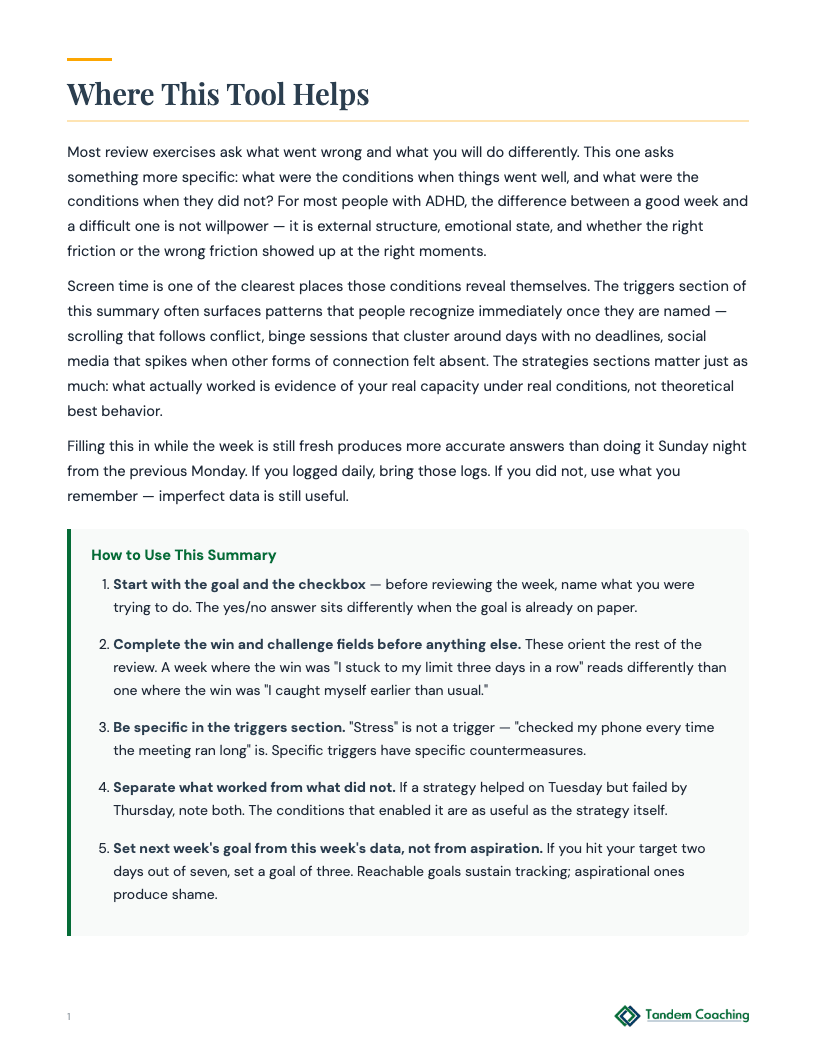
When to Use This Tool
ADHD adult who has been logging daily screen use and wants to synthesize the week into patterns and reflections
A client who is preparing for a coaching session and wants to arrive with a clear summary of what the week showed
Person who collects data but doesn't take time to interpret it before the session
How to Introduce This Tool Plus
Before we get into this week, walk me through your summary - what did the numbers say, and what did the numbers miss?
Browse All Pages
Tool Classification
Domain
ADHD
Type
Worksheet
Phase
Reflection
Review
Details
15 min
Opener
Weekly
Topics
Habits
Accountability
Executive Function
For the Coaching Practitioner
Plus
Coaching Scenarios
Plus
1 Marketing director whose team productivity concerns mask personal phone use guilt ▶
Context
Marketing director at a mid-size company who came to coaching about team engagement issues. Three weeks in, admits the real concern is her own phone checking during meetings and work blocks. Feels hypocritical addressing team focus when she can't model it herself.
How to Introduce
Frame this as data collection, not behavior modification. 'Before we work on team dynamics, let's get a baseline on your own attention patterns. This isn't about judgment - it's about understanding when your focus is available versus when it's not.' Expect resistance to tracking because she already feels shame about the behavior.
What to Watch For
If she fills out goals but leaves triggers blank, she's avoiding the emotional component. Watch for vague language in challenges - 'distraction' instead of 'checked Instagram during budget review.' The strategies section reveals whether she's tried willpower-based solutions or environmental changes.
Debrief
Start with strategies that worked, not challenges. 'Read me what you wrote under strategies that worked.' Then connect to leadership: 'When you had a good focus day, what did your team interactions look like?' This links personal attention management to her stated concern about team dynamics.
Flags
If triggers section mentions conflict avoidance or checking phone after difficult conversations, explore whether screen time is emotional regulation. Severity: moderate. The leadership role means personal patterns affect team culture. Continue coaching but address the modeling concern directly.
2 Software engineer with ADHD returning from medical leave for burnout ▶
Context
Senior software engineer returning to work after three-month medical leave for burnout. ADHD diagnosis came during leave. Company requires coaching as part of return-to-work plan. Concerned about screen time boundaries when work and dopamine-seeking both happen on the same device.
How to Introduce
Position this as boundary mapping, not restriction. 'Your brain needs stimulation, and your job provides it - but not consistently. This tool helps identify when work stimulation is sufficient versus when you're seeking it elsewhere.' Address the medical leave directly: recovery includes sustainable attention patterns.
What to Watch For
Look for all-or-nothing patterns - either perfect adherence or complete abandonment of goals. ADHD brains often interpret partial success as failure. Watch for triggers that cluster around low-stimulation work tasks - code reviews, documentation, waiting for builds to complete.
Debrief
Focus on the conditions that enabled success, not the success itself. 'You met your goal on Tuesday and Friday. What was different about those days?' Often reveals that high-engagement work days require less external stimulation. Connect this to sustainable work pacing.
Flags
If screen time spikes correlate with work avoidance or if the client reports using stimulating content to 'gear up' for work tasks, this may indicate inadequate ADHD treatment. Severity: moderate. Response: continue coaching but suggest medical follow-up for medication or treatment adjustment.
3 Executive assistant who tracks meticulously but never changes anything based on data ▶
Context
Executive assistant to C-suite executives who has been tracking screen time for months using various apps and spreadsheets. Brings detailed logs to sessions but continues same patterns week after week. Treats data collection as the solution rather than input for decisions.
How to Introduce
Reframe tracking as diagnosis, not treatment. 'You've been excellent at gathering data. Now we're going to use it differently - not to track more precisely, but to identify what needs to change.' Position this summary as the bridge between data and action.
What to Watch For
She'll complete this thoroughly and accurately, but watch for analysis paralysis in the strategies sections. If 'strategies that worked' is longer than 'next week's goal,' she's collecting insights instead of committing to change. Perfectionist tendencies show up as over-detailed entries.
Debrief
Skip the data review - she knows her patterns. Go straight to the change question: 'Based on everything you wrote, what's the smallest shift that would make the biggest difference?' If she gives multiple options, make her choose one. The goal is decision-making, not analysis.
Flags
If she's been tracking for months without behavior change, consider whether the tracking itself serves an anxiety management function. Severity: low. The detailed tracking may be providing a sense of control that substitutes for actual change. Continue coaching but name the pattern directly.
4 Sales manager whose screen time patterns reveal avoidance of difficult client conversations ▶
Context
Regional sales manager struggling with a challenging quarter. Came to coaching for pipeline management and client relationship issues. During intake, mentioned phone use has increased but didn't connect it to work avoidance patterns.
How to Introduce
Connect screen time to sales performance directly. 'When you're avoiding a difficult client call, where does your attention go instead? This tool maps those patterns.' Don't frame as personal habit - frame as professional effectiveness. Sales managers understand that attention management affects revenue.
What to Watch For
Look for triggers that correlate with sales activities - phone checking before cold calls, social media after difficult client conversations, news reading during prospecting blocks. The timing of avoidance behavior is more important than the duration.
Debrief
Start with the triggers section and connect each one to specific sales activities. 'You wrote that you scroll after tense client calls. Which clients? What makes those calls tense?' This reveals whether the issue is skill-based (needs training) or emotional regulation (needs coping strategies).
Flags
If screen time consistently spikes before high-stakes sales activities, this may indicate performance anxiety that goes beyond normal sales stress. Severity: moderate. Response: continue coaching but explore whether anxiety is situational or generalized. Consider whether sales role is a good fit.
Tool Flow
Plus
Requires
- seven-day screen time breakdown by category
→
Produces
- weekly screen habit review with trigger patterns named
- next week's screen time goal with specific change
- what worked and what failed conditions identified
Pairs Well With
ADHD
Work Habits Reflection
A client wants to use Work Habits Reflection as an optional reflection
Why it pairsThe weekly screen data names trigger patterns, so this assessment lets you trace those patterns back to the specific EF domains - attention, initiation, or regulation - actually driving them.
ADHDADHD Progress Tracker
ADHD adult who sets goals but loses sight of them within a few weeks
Why it pairsOnce the summary surfaces next week's screen goal, this tracker gives the client a four-week structure to hold that goal past the first few days.
ADHDHabit Tracker Weekly
ADHD adult trying to build consistency with 3-5 specific habits over a week
Why it pairsThe screen summary identifies what worked and what failed, so this tracker lets the client immediately log the replacement or reduction habit the very next day.
Related Articles


Coaching Session Blueprints: What ADHD-Informed Executive Coaching Really Looks Like
Read article →
Remote vs In-Person ADHD Coaching: The Research
Read article →
Executive Function Strategies for ADHD Leaders: Working Memory, Impulse Control & Flexibility
Read article →
Organize Your Success – ADHD Coaching to Master Organizational Skills
Read article →