Identify which stated values truly drive your choices, not just what sounds right, using a structured, evidence-based reflection process.
Free, print-ready PDF.
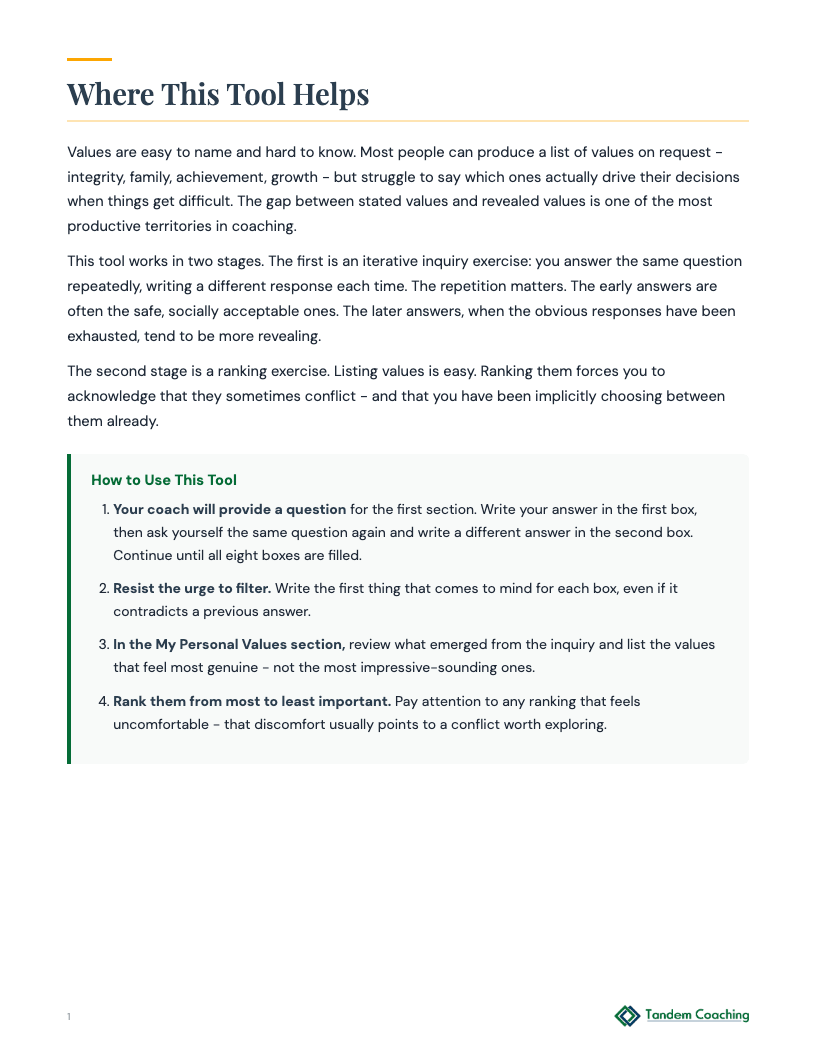
When you ranked your values, which ranking felt uncomfortable or hard to accept — and what might that discomfort be pointing to?
Your client can name their top values without hesitation - integrity, collaboration, excellence - and has recited them in multiple coaching sessions. When asked to describe a recent decision where these values drove their behavior, they pause, then offer an example that does not quite land. The values are real but they function as identity markers rather than actual decision inputs.
Frame this as moving from values declaration to values excavation. 'Most people can name their values - that's the easy part. What this tool does is ask a different question: which values are actually doing the work when you make choices under pressure? Those might not be the same list.' The iterative 8-box inquiry structure creates space to reach past the performed answer. The resistance to name upfront: clients who have been through values exercises before often bring the same answers they always bring. Name this directly.
Watch how many revisions your client makes as they work through the eight boxes. Minimal revision - settling quickly on the same values they named before - suggests the tool is not reaching below the prepared response. Three to five genuine iterations, with values being added, removed, or reconsidered, indicates real engagement. Also watch whether the final list includes any values that surprise the client; surprise is a better outcome than confirmation.
Start with the final values list, not the process. Ask your client to pick one value from the list and trace it to a specific decision in the last 30 days where it was the actual driver - not where it was present, but where it made the difference. If they cannot locate a decision, that value may be aspirational rather than operative. This distinction - between values we hold and values that hold us - is the productive edge of the debrief.
If your client's excavated values look substantially different from the values they brought in at the start of the session, take time with that gap. A large divergence between declared and discovered values is not a failure - it is significant information. Severity: low. Response: do not rush to reconcile the lists; let the client sit with what the discovery means.
Your client says they value work-life balance - and means it sincerely. They also send emails at 11pm, take calls during family dinners, and have not taken a full vacation in two years. They are aware of the contradiction and articulate it as a temporary situation. The situation has persisted for four years. The coaching conversation keeps circling this tension without resolution.
Frame this as using the iterative exercise to find what they actually value - not to catch them being inconsistent, but to find the value that is winning when balance and work compete. 'We've talked about the tension between balance and work commitment many times. Rather than analyzing it again, let's try a different approach: what does the iterative inquiry surface when you don't start from a place of what you're supposed to want?' The tool works because it bypasses the rehearsed answer.
Watch whether 'achievement' or 'impact' or 'recognition' surfaces in later iterations after the client moves past socially acceptable answers. These are not wrong values - but if they are what actually drives behavior, and they are absent from the declared values list, the coaching conversation has been working with incomplete information. Also watch whether 'belonging' or 'external validation' appears - workaholism often has a relational driver that the client has not named.
Once the excavated list is complete, put the declared values and the excavated values on paper side by side. Ask: 'Which list better explains the choices you have made in the last 12 months?' The answer to that question is usually the coaching conversation waiting to happen. Do not move too quickly to action planning - the dissonance itself is the work.
If the gap between declared values and behavioral reality is substantial and persistent, and if the client shows signs of distress about the discrepancy rather than curiosity, explore whether the misalignment is generating a deeper sense of integrity loss or inauthenticity. Severity: moderate. Response: continue the tool work, but name what you are observing and assess whether the dissonance warrants deeper exploration than values excavation can hold.
Your client has two real options in front of them: a promotion into organizational leadership at their current company, or a lateral move into a smaller company where they would build a function from scratch. Both are compelling on paper. They cannot make the decision because they do not know which path reflects what they actually value, as distinct from what they believe they should want.
Frame this as using the iterative exercise to gather decision-making data, not to produce a decision. 'We're not going to use this to pick a path. We're going to use it to find out what your actual values are - and then see which path those values point toward.' The distinction matters because clients often resist values exercises when they feel instrumentalized. The tool should produce a values list first; the decision conversation comes after.
Watch whether different values emerge when your client imagines themselves one year into each path - some clients process this implicitly during the iterative exercise and can reflect back on it afterward. Also watch for values related to belonging, status, or security appearing in later iterations; these are often the deciding factors in career crossroads decisions but are rarely the ones clients lead with.
After completing the iterative exercise, ask your client to hold their final values list against each option. 'If you could only pick the path that honors the top three values on this list, which path would it be?' This is not a binding question - it is a diagnostic one. The client's hesitation or immediate clarity in answering tells you more than the answer itself.
If your client's inability to decide between two paths persists even after clear values excavation - if they understand their values and can see the alignment but still cannot commit - the block may not be a values clarity problem. Severity: low. Response: note that values clarity has been reached, and explore whether fear of the foreclosed path rather than uncertainty about the chosen one is what is actually in the way.
A client making decisions that feel off but can't say why
LifeMy client says they know what they value but their choices don't reflect it
LifeA client feels successful but unfulfilled and wants to understand why
![Best Leadership Development Tools [Top 5 Ranked and Compared]](https://cdn.tandemcoach.co/wp-content/uploads/2024/08/TC-113-1.jpg)