Identify which core values your decision conflicts with, using a structured worksheet grounded in evidence-based values clarification.
Free, print-ready PDF.
When you look at your recent decisions, which ones felt most aligned with who you are — and which ones left you feeling a little off?
A VP has been offered a role that represents a significant title and compensation increase but would require relocating her family and joining a company she finds less mission-aligned than her current employer. She's been 'making the list' - pros and cons - for three weeks and the list keeps coming out even. She describes the decision as 'purely rational' but visibly becomes tense when discussing the relocation component.
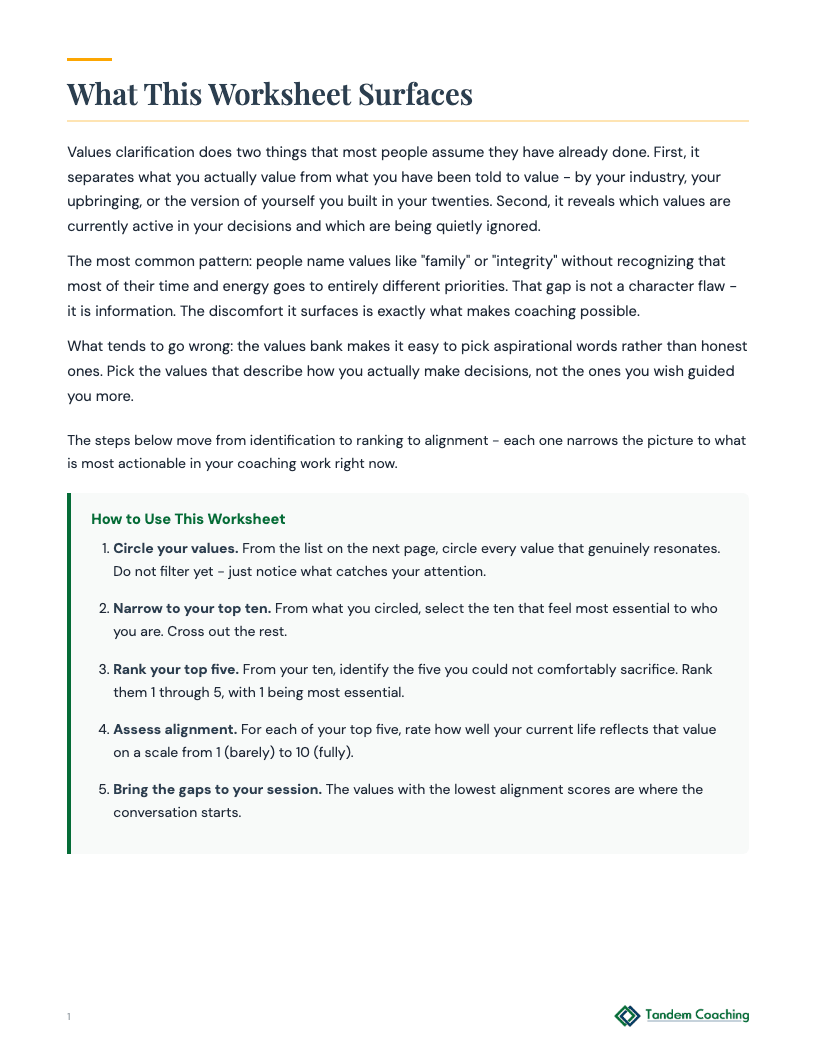
Frame this as decision infrastructure, not a decision. 'Before we look at the specific offer, let's identify what values are actually in play. Most decisions that won't resolve with a pro/con list are values conflicts, not information deficits - you have enough information. You're missing clarity on which values are non-negotiable.' The three-step process (circle all, narrow to 10, rank top 5) works best without overthinking at the circle stage; tell her to mark every value that has ever mattered to her, not just the ones that are active today.
Watch whether the top 5 values include any that directly conflict with each other when applied to this specific decision. A client who ranks both Achievement and Family equally at the top is not confused - she has a genuine conflict that the decision cannot resolve without trading one. Also watch the alignment scores: if Family ranks #1 but has a low alignment score in her current life, the decision isn't adding a new conflict - it's surfacing one that already exists.
Start with the 'where the gap is largest' section. 'You wrote [value]. What specifically gets in the way?' This is usually the real lever. Then apply her top 5 values directly to the decision: 'Which of these five does Option A serve better, and which does Option B serve better?' This moves from abstract ranking to decision filter. The before-session prompt - find a past-month decision that honored #1 and one that contradicted it - often reveals which values she actually acts on versus which she aspires to.
If the client's top-ranked values are in active conflict with each other and the coaching conversation surfaces that she has been choosing one value over another systematically for years, this may open material about identity and trade-offs that goes beyond the current decision. Severity: low. Response: continue the decision work, but note that the values conflict is older than this job offer and may need its own conversation.
A 29-year-old product designer has left three roles in four years. Each departure felt right at the time; the pattern is only visible in retrospect. She's now in a new role that she initially found exciting and is starting to feel the same restlessness. She can describe what she doesn't like about each job but can't name what she's looking for.
Name the pattern upfront as a values mismatch hypothesis rather than a character trait. 'Three departures with the same timing suggests you're running into the same wall, not that you're uncommitted. This exercise helps us identify what that wall is actually made of - which specific values keep getting violated once the initial energy wears off.' The circle-and-narrow process often surfaces values the client has intuited but never articulated, which is more useful here than a general conversation about what she wants.
Watch for values that score low on alignment even in a role she's only been in for a few months - those are the early signal of the pattern. If Autonomy scores low on alignment already, ask what's changed since the first month. If Creative Freedom is in her top 5 and she's in an increasingly process-heavy role, the restlessness isn't about commitment; it's about structural mismatch that was always present but obscured by novelty.
Apply the top 5 values to each of her three previous roles. 'Which of these values were being honored in month 1 versus month 12 at [company]?' The pattern of which values degrade over time - as the organization's norms reassert themselves over the honeymoon period - is more diagnostic than any single departure. Then apply the same analysis to her current role: 'Where are you now on each of these five, and what's the trajectory?'
If the values clarification exercise reveals a top-ranked value that is inherently difficult to sustain in any organizational context - extreme autonomy, complete creative control, constant novelty - explore whether the client is seeking conditions that employment cannot provide. Severity: low. Response: surface the structural question without pathologizing it. Some people are built for freelance or entrepreneurial contexts; naming that is useful, not a failure of the work.
A senior director has received consistent 360 feedback across two cycles that his team finds him unpredictable - sometimes highly collaborative, other times unilaterally directive. He describes this as 'adapting to circumstances' and is puzzled that it reads as inconsistency. His team is uncertain what he stands for and how to read him.
Frame this as a calibration exercise, not a values lecture. 'Your team's experience of inconsistency suggests they can't identify a stable operating principle behind your decisions. This exercise maps your actual top values - not aspirationally, but as demonstrated by how you act under pressure. Once we have that map, we can look at whether the values are genuinely in tension or whether the inconsistency is something else.' The alignment score section is particularly useful for leaders: low alignment in a stated top value often explains behavioral inconsistency.
Watch for Collaboration and Achievement in the top 5 with mismatched alignment scores. A leader who values both will swing between collaborative and directive depending on which value feels more under threat in a given situation - which is exactly what produces the unpredictability his team experiences. If the 'what gets in the way' field names external pressures (organizational timelines, senior leadership demands), he may be managing upward expectations by abandoning the values he signals downward.
Start with the alignment score for his #1 value. 'You rated [value] at [X] for alignment. Walk me through a specific situation this month where that value was hard to act on.' This connects the abstract ranking to the behavioral pattern his team is experiencing. Then: 'What would your team need to see consistently to be able to predict which version of you is showing up?' This bridges values work to a specific behavioral commitment.
If the top 5 values include items that are in genuine organizational conflict - such as Transparency in a company culture that operates with significant information control - the leader's inconsistency may reflect an adaptation to his context that he hasn't named to himself. Severity: low. Response: explore whether the values list reflects who he is or who he is when his environment cooperates. Both are real; they produce different coaching strategies.
I feel stuck in the day-to-day and I've lost sight of what I actually want my life to look like
LifeClient is successful by external measures but cannot articulate why the work feels hollow
LifeClient is achieving goals but feels disconnected from any larger sense of meaning