

Urge Surfing Worksheet
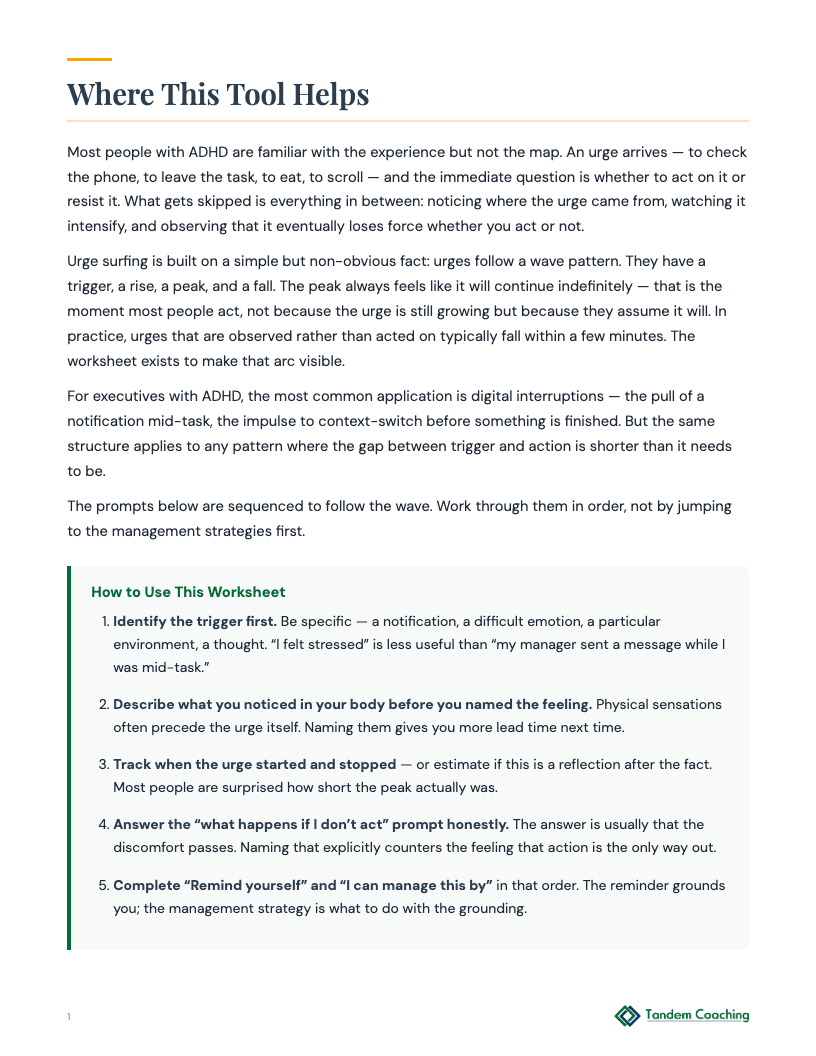
Pause and ride out digital urges before you click, so you can choose instead of react. ADHD coaching worksheet based on evidence-backed urge surfing.
Get This Tool
Free, print-ready PDF.
When to Use This Tool
A client acts on digital impulses before they've had a chance to notice and choose
A client wants to build the skill of observing an urge without automatically following it
A client is working on extending the gap between trigger and action in high-distraction moments
How to Introduce This Tool Plus
An urge follows a wave - trigger, rise, peak, fall. The peak always feels like it will last forever, which is when most people act. This worksheet maps the arc of one urge so you can see how short the peak actually is.
Coaching Tool Disclaimer
This tool is designed for coaching contexts, not clinical use. If you or your client is in crisis, contact the 988 Suicide and Crisis Lifeline (call or text 988) or Crisis Text Line (text HOME to 741741).
Browse All Pages
Tool Classification
Domain
ADHD
Type
Worksheet
Phase
Action
Reflection
Details
15 min
Between sessions
As-needed
Topics
Habits
Executive Function
Emotions
For the Coaching Practitioner
Plus
Coaching Scenarios
Plus
1 Mapping the Full Arc of a Distraction Urge ▶
Context
A client with ADHD who is a content strategist at a media company has been using phone-blocking apps for six months without sustainable results. She describes her urges as 'coming out of nowhere and then I've already checked.' She has never slowed the sequence down to observe it. The urge surfing worksheet introduces the concept that an urge has a shape - trigger, rise, peak, fall - and that the shape can be observed. The act of recording the arc once is the first intervention; the data it produces is the second.
How to Introduce
Frame the worksheet as an observational instrument rather than a behavior-change tool: 'This isn't asking you to resist anything yet. The only job this week is to catch one urge you acted on and map it afterward. Write down when it started, what triggered it, what the peak felt like, and when it passed. One completed arc tells us more than a week of willpower.' Position after-the-fact completion as fully valid for the first use - the retrospective map is where most clients begin.
What to Watch For
Watch for the trigger field being filled with 'nothing' or 'I don't know' - the absence of perceived trigger is itself data, but it often means the client hasn't looked far enough back. Ask: 'In the ten minutes before the urge arrived, what were you working on? Was anything about that task difficult, ambiguous, or emotionally heavy?' Also watch for the rise and peak fields being collapsed into a single entry - clients often skip the rise because it feels unremarkable. The rise is where intervention has the most leverage, and its features can only be identified if it is recorded separately.
Debrief
Start with the start/stop time field: 'How long was the full arc from trigger to fall?' Most clients are surprised - urges that feel permanent are typically six to twelve minutes. That duration data reframes the task from 'resist indefinitely' to 'wait twelve minutes.' Then ask: 'What does the peak field tell you about what the urge actually felt like at its strongest?' The peak description is the client's most accurate language for their own urge experience and should be used verbatim in future session work.
Flags
- Moderate
Client's completed worksheet shows the arc never reaching 'fall' - she reports the urge stays at peak intensity indefinitely until she acts, with no natural subsidence across multiple completed worksheets
Response: An urge arc that never descends naturally - that holds at peak until acted on regardless of elapsed time - suggests the urge may be serving a regulation function rather than a distraction function: 'The arc you're describing doesn't follow the typical pattern where urges peak and then naturally subside. When an urge stays at peak until acted on, it's often doing something more than distraction - managing anxiety, emotional discomfort, or something else that needs the relief. That pattern is worth exploring with a therapist who works with ADHD, because what we're describing may need a different kind of support than urge awareness alone can provide.'
2 EF-Interaction: Using the Arc as a Working Memory Anchor ▶
Context
A client with ADHD who is a financial analyst at a consulting firm understands cognitively that urges are temporary but cannot hold that knowledge in the moment when an urge is active. His working memory is consumed by the urge itself, and the belief that the urge will pass - which he endorses fully between sessions - is inaccessible during the urge. The worksheet creates an external record of completed arcs that functions as a working memory substitute: visible evidence that the urge has a fall, even when working memory cannot generate that belief in real time.
How to Introduce
Name the working memory gap explicitly before assigning: 'You know urges are temporary. The problem is that knowing something between sessions and being able to access it during an urge are two different cognitive tasks, and the second one requires working memory you don't have when the urge is running. The worksheet solves that by creating an external record. After you complete two or three arcs, you have visible evidence - times, durations - that the fall always came. That evidence is accessible when the belief isn't.' Have him review completed worksheets before entering his highest-urge work contexts.
What to Watch For
Watch for the client completing worksheets but not reviewing them before high-urge periods - the data is only useful as a working memory anchor if it is consulted. Build a specific review trigger: the last action before opening a high-priority project file is to look at the most recent completed worksheet and note the fall time. Also watch for the start/stop time field being left blank - that field is the primary mechanism of the working memory anchor. A worksheet without time data cannot provide duration evidence.
Debrief
After three completed arcs with time data: 'What is the range of durations across these three? What's the longest the urge held before falling?' The range gives the client a realistic estimate of what they are waiting through, not an optimistic one. Then ask: 'If you had known before the urge started that it would last at most twelve minutes, would that have changed anything?' The hypothetical surfaces whether the time knowledge is actually useful for this client, which determines whether the worksheet is functioning as intended or needs to be supplemented with a different anchor.
Flags
- Low
Client reports that reviewing completed worksheets immediately before high-urge work sessions produces no effect - he is aware that past urges fell but the current urge still feels permanent, and this persists after five completed worksheets
Response: When a well-implemented working memory anchor does not transfer to real-time urge management, the gap between intellectual knowledge and in-moment regulation may require a body-based rather than a record-based intervention: 'The data exists and you know it - the issue is that the knowledge isn't reaching the moment when you need it. That's a different problem than the worksheet was designed to solve. A body-based technique - a specific breath pattern, a physical anchor - sometimes bridges that gap better than cognitive evidence does. That kind of real-time regulation work is often developed more effectively with a therapist who specializes in ADHD.'
3 Identifying Trigger Type to Build a Structural Prevention Strategy ▶
Context
A client with ADHD who is a project director has completed three urge surfing practice sheets over two weeks and can name her urge pattern in general terms: she checks her phone when work gets hard. The worksheet adds specificity to that general pattern. By recording the trigger field across multiple completions, she will discover that 'hard' means something specific - either ambiguity in the next step, emotionally loaded content, or a task requiring sustained attention without feedback. That specificity is what converts awareness into a prevention design.
How to Introduce
Frame the worksheet as a trigger classification exercise: 'You already know urges happen when work is hard. Now we need to know what kind of hard. The trigger field is the most important column. This week, be as specific as possible: not 'hard task' but what specifically about it made it hard - was it unclear? Boring? Were you worried about getting it wrong? Three completed worksheets with specific trigger descriptions will tell us whether your urges cluster around one kind of difficulty or several.' Assign it with a focus on trigger specificity rather than arc completeness.
What to Watch For
Watch for the trigger field being populated with emotional states ('stressed,' 'anxious') rather than situational descriptions ('writing the introduction paragraph of a report I haven't started'). Both are useful, but the situational description identifies the structural intervention point. Ask in debrief: 'When you wrote anxious - what were you specifically doing at the time?' Also watch for the client treating completed worksheets as evidence of failure rather than as data. The worksheet is most useful when the client is curious about patterns rather than judging individual instances.
Debrief
Read the trigger fields across all completed worksheets: 'What category does each of these fall into? Ambiguous tasks? Tasks requiring feedback? Tasks with stakes?' Once a trigger category emerges, shift the conversation to structural design: 'If most of your urges are triggered by ambiguous next steps, the prevention strategy is making the next step explicit before you begin rather than managing the urge after it arrives.' The worksheet's primary output for this client is not urge tolerance but task architecture redesign.
Flags
- Low
The trigger field consistently lists interpersonal events - a message from a specific colleague, anticipation of a difficult conversation, a critical comment in a document review - and the urge intensity in those contexts is notably higher than for task-related triggers
Response: Urge triggers that cluster around interpersonal events with elevated intensity suggest the urge may be carrying emotional regulation load rather than distraction management: 'Your worksheet is showing something specific - the triggers that produce the strongest urges are interpersonal, not task-related. That's useful information because it means the urge isn't primarily about the work; it's about something in how those interactions land. The worksheet can help map that pattern, and it's also worth exploring with a therapist what's driving the intensity in those specific interpersonal moments, because that piece is likely outside what urge surfing alone can address.'
Tool Flow
Plus
Requires
- None - standalone tool
→
Produces
- mapped urge arc with specific trigger named
- management strategy for identified trigger
- observed peak duration for the urge wave
Pairs Well With
ADHD
Environment Context Log
Use this tracker to notice patterns in executive function and habits over time before drawing conclusions.
Why it pairsOnce the worksheet names a specific trigger, use this tracker to test whether it recurs reliably across different environments and days.
ADHDDaily Mood and Energy Log
ADHD adult who can't see patterns in their emotional or energy fluctuations across the week
Why it pairsOnce you have the urge arc mapped, this tracker reveals whether urge intensity consistently follows low-energy or emotionally reactive periods.
ADHDPaced Breathing Option
A client wants to use Paced Breathing Option as an optional reflection
Why it pairsUse this after the client maps their urge peak duration - the breath cycle fills that window with a physiological hold rather than passive observation.
This tool is part of a coaching pathway
Step 1 of 6 in A client acts on digital impulses before they've had a chance to notice and choose
Continue with Urge Surfing Weekly Log if that next job fits.
Next: Urge Surfing Weekly Log → Explore all pathways →Related Articles


Executive Function Strategies for ADHD Leaders: Working Memory, Impulse Control & Flexibility
Read article →
ADHD Coaching Certification: Which Path Actually Counts
Read article →
Coaching Session Blueprints: What ADHD-Informed Executive Coaching Really Looks Like
Read article →
Organize Your Success – ADHD Coaching to Master Organizational Skills
Read article →