Daily Mood and Energy Log
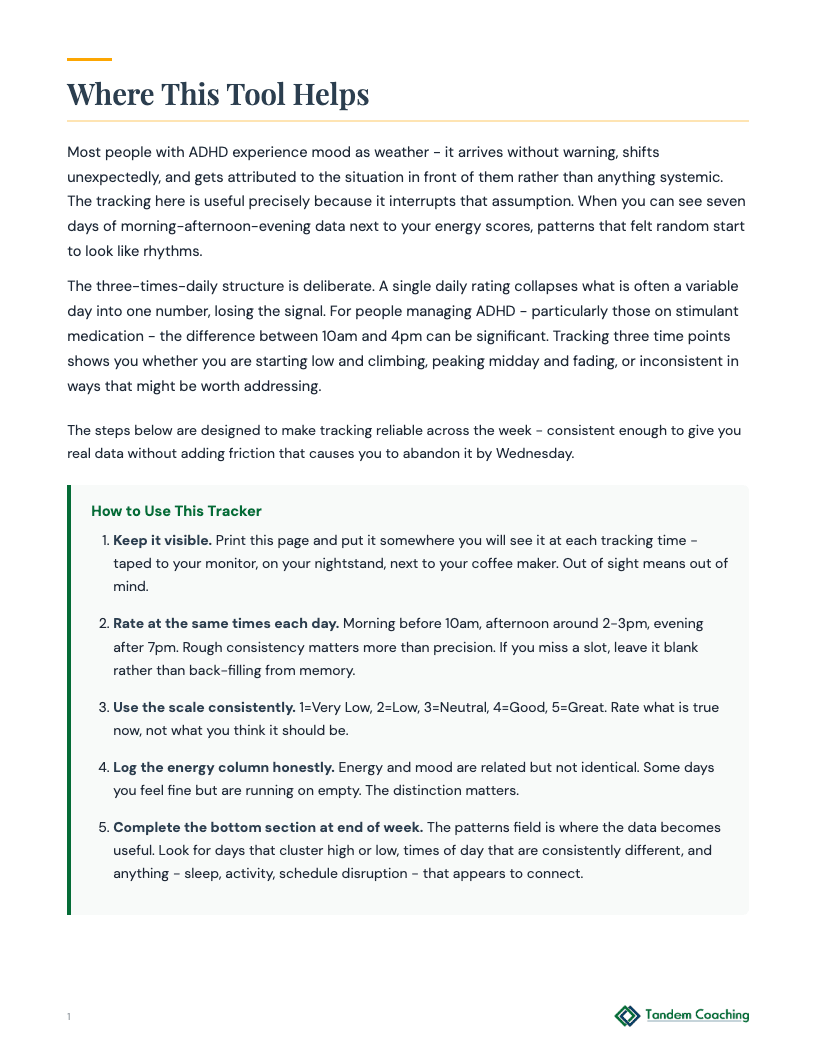
Log mood words, energy, and context separately without rating mood as good or bad or inferring a medication effect.
Get This Tool
Free, print-ready PDF.
When to Use This Tool
ADHD adult who can't see patterns in their emotional or energy fluctuations across the week
A client who loses track of how they felt earlier in the week
Person who wants data to bring to coaching sessions about daily functioning
How to Introduce This Tool Plus
Which mood words and energy observations describe the week without rating your mood as good or bad?
Coaching Tool Disclaimer
This tool is designed for coaching contexts, not clinical use. If you or your client is in crisis, contact the 988 Suicide and Crisis Lifeline (call or text 988) or Crisis Text Line (text HOME to 741741).
Browse All Pages
Tool Classification
Domain
ADHD
Type
Tracker
Phase
Reflection
Review
Details
5 min
Between sessions
Weekly
Topics
Emotions
Habits
Executive Function
For the Coaching Practitioner
Plus
Coaching Scenarios
Plus
1 Marketing director on stimulant medication experiencing afternoon performance crashes ▶
Context
Marketing director at a tech startup, diagnosed with ADHD six months ago and recently started on stimulant medication. Reports feeling great in morning meetings but struggling to maintain focus and decision-making quality after 3pm. Wants to optimize medication timing and work schedule.
How to Introduce
Frame this as medication optimization data, not mood tracking. 'Your afternoon crashes might be medication wearing off, natural circadian rhythm, or something else entirely. Three data points per day will show us the pattern.' Most clients on new medication expect linear improvement and get frustrated by variability. Normalize that medication response has patterns worth mapping.
What to Watch For
Completion consistency drops off midweek - classic ADHD pattern with new habits. If morning ratings are consistently higher than afternoon/evening, medication timing is likely the variable. If energy and mood ratings diverge significantly (high mood, low energy or vice versa), the client may be pushing through crashes rather than acknowledging them.
Debrief
Start with the afternoon column specifically. 'Read me Tuesday through Thursday afternoons.' Then ask: 'What time did you take your medication each day?' Look for the correlation between dose timing and the 2-3pm ratings. The question that opens this up: 'If you could redesign your schedule around this pattern, what would you move?'
Flags
Coaching scope: do not diagnose, interpret symptoms, or recommend treatment. Adapt or stop for distress and use licensed health or emergency support when appropriate.
2 Operations manager who insists their mood problems are purely situational ▶
Context
Operations manager at a manufacturing company, recently promoted from floor supervisor. Attributes daily frustration and energy dips to 'difficult people' and 'constant interruptions.' Resistant to the idea that internal patterns might be contributing to workplace friction.
How to Introduce
Position this as external factor tracking, not self-examination. 'Let's map when the difficult people and interruptions hit you hardest. If it's random, we'll see random data. If there's a pattern, we'll see that too.' Clients who blame external factors often resist mood tracking because it implies internal responsibility. Reframe as environmental data collection.
What to Watch For
Client fills in Notes column extensively but rates mood/energy quickly without reflection. This suggests they're focused on justifying ratings rather than noticing patterns. If ratings correlate more with time of day than with the external events described in Notes, the client is discovering something they weren't expecting.
Debrief
Start with the Notes column. 'Walk me through Monday's notes.' Then shift to the numbers: 'Your mood was a 2 Monday afternoon and a 2 Wednesday afternoon, but the situations you described were different. What was the same?' This moves from content to pattern without challenging their external attribution directly.
Flags
Coaching scope: do not diagnose, interpret symptoms, or recommend treatment. Adapt or stop for distress and use licensed health or emergency support when appropriate.
3 Freelance consultant tracking mood to improve client relationship management ▶
Context
Independent management consultant who works with multiple clients simultaneously. Reports that some client interactions leave them drained while others energize them, but can't identify the pattern. Wants to optimize their client mix and scheduling to maintain consistent performance.
How to Introduce
Frame as client portfolio optimization. 'Track your energy after different types of client work. If certain clients or project types consistently drain you, that's business intelligence.' This client is likely analytical and will appreciate the data-driven approach. Expect them to want to add columns for client names or project types.
What to Watch For
Client may try to correlate every rating with specific client interactions, missing broader patterns like day-of-week effects or cumulative fatigue. If Friday ratings are consistently lower regardless of client work, that's schedule design, not client chemistry. Look for whether they're rating the work or rating themselves doing the work.
Debrief
Start with the highest and lowest energy days. 'Thursday shows a 5 for energy, Tuesday shows a 2. Walk me through what was different about the work itself.' Then ask: 'What would happen if you scheduled your most demanding clients on your highest-energy days?' The conversation usually opens when you ask: 'Which pattern surprised you?'
Flags
Coaching scope: do not diagnose, interpret symptoms, or recommend treatment. Adapt or stop for distress and use licensed health or emergency support when appropriate.
4 Project manager returning from medical leave struggling with emotional regulation ▶
Context
Senior project manager at a healthcare organization, returning to work after three months of medical leave for stress-related health issues. Reports feeling 'emotionally fragile' and worried about maintaining professional composure in high-pressure situations with stakeholders.
How to Introduce
Position as readiness assessment, not emotional tracking. 'Before we build strategies for managing stakeholder pressure, let's get baseline data on your current capacity. This shows us your bandwidth patterns so we can design your re-entry sustainably.' Clients returning from stress leave often fear that tracking mood confirms they're not ready to return.
What to Watch For
Client may rate themselves higher than their actual experience to prove they're ready for full workload. Look for notes that describe difficult situations but mood ratings that don't reflect the difficulty. If morning ratings start high but deteriorate through the day consistently, they may be overcommitting early and paying for it later.
Debrief
Start with the pattern across the week, not individual days. 'Looking at the whole week, when was your emotional bandwidth highest?' Then move to capacity planning: 'Based on this data, what would a sustainable schedule look like for your first month back?' The key question: 'What would you need to say no to in order to protect these high-capacity windows?'
Flags
Coaching scope: do not diagnose, interpret symptoms, or recommend treatment. Adapt or stop for distress and use licensed health or emergency support when appropriate.
Tool Flow
Plus
Requires
- None - standalone tool
→
Produces
- 7-day mood and energy data grid rated 3x daily
- weekly patterns summary with identified triggers
- mood influence log noting external factors
Pairs Well With
ADHD
Paced Breathing Option
A client wants to use Paced Breathing Option as an optional reflection
Why it pairsOnce you've named trigger moments from the mood log, use this to give your client a go-to regulation response for each one.
WellnessEvent, Interpretation, and Options Log
Use this worksheet to explore mindset and emotions and turn the client’s observations into one optional next step.
Why it pairsOnce the mood tracker reveals when worry clusters through the week, this worksheet gives your client a ritual to contain it.
ADHDUrge Surfing Worksheet
A client acts on digital impulses before they've had a chance to notice and choose
Why it pairsThe named triggers in your client's mood log give you a specific urge arc to map and practice observing together.
Related Articles


ADHD Crisis Leadership: Why ADHD Leaders Are Good in Crisis
Read article →
ADHD & Emotional Intelligence in Leadership
Read article →
Remote vs In-Person ADHD Coaching: The Research
Read article →
Executive Function Strategies for ADHD Leaders: Working Memory, Impulse Control & Flexibility
Read article →