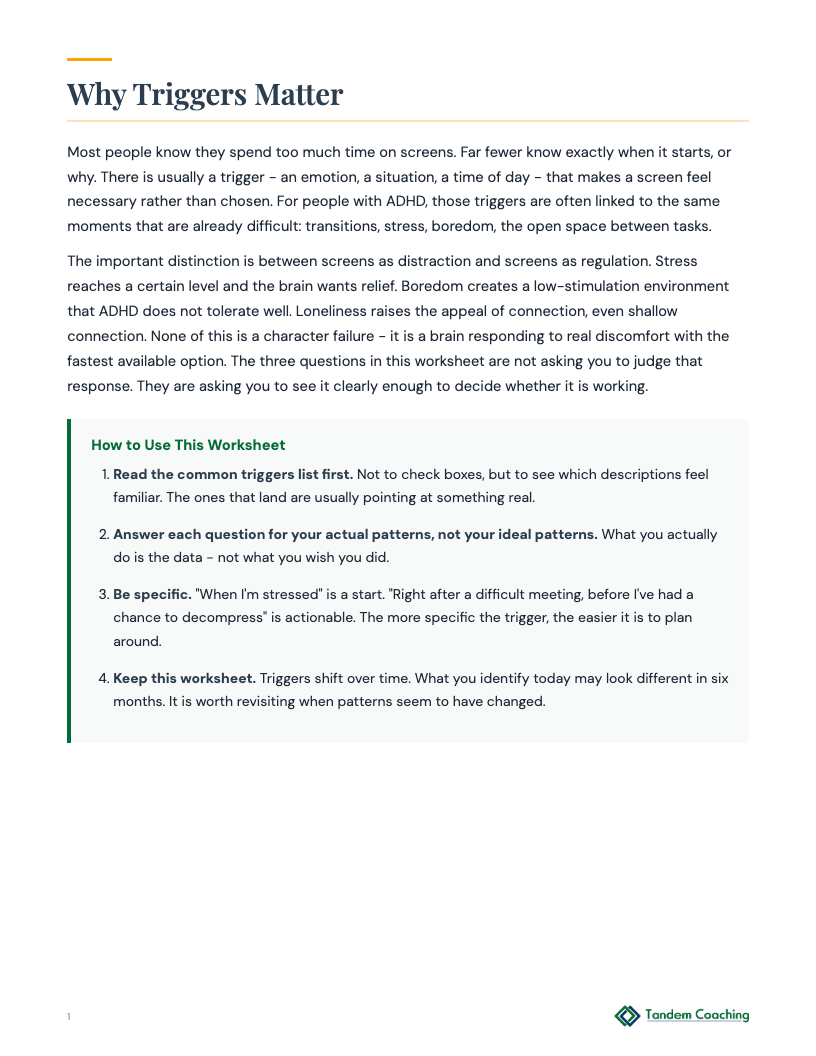
Screen Time Triggers Worksheet

Identify what triggers your automatic phone-checking and choose a practical response, using an ADHD-informed worksheet grounded in behavior tracking.

Worksheet · 15 min · Print-ready PDF · Free download

Get This Tool

Free PDF - professionally formatted, ready to print or fill digitally

Preview Worksheet · 15 min
Screen Time Triggers Worksheet - preview
When to Use This Tool
ADHD adult who reaches for their phone automatically and hasn't examined what's driving the behavior
A client who wants to understand which emotional states or situations are the real triggers for screen overuse
Person who has tried setting screen limits but keeps breaking them without understanding why
How to Introduce This Tool Plus

Before our next session, spend a few days noticing the moment right before you pick up your phone unnecessarily. This worksheet helps you map what's actually driving the impulse.

Browse All Pages
Interactive Preview Worksheet · 15 min
Tool Classification
Domain
ADHD
Type
Worksheet
Phase
Discovery Reflection
Details
15 min Between sessions As-needed
Topics
Habits Executive Function Emotions

For the Coaching Practitioner

Plus
Coaching Scenarios Plus
1 When the Client Cannot Name Their Triggers
Context

A client with ADHD who is a financial analyst knows their phone use interrupts work but cannot articulate why it happens. When asked, they say 'I just pick it up' or 'I don't even notice I'm doing it.' They have tried setting intentions not to use their phone but cannot identify what to intercept because the behavior feels automatic. Coaching focus is on building intentional behavior around distraction.

How to Introduce

Frame trigger identification as forensic work, not introspection: 'We're going to look at a specific episode - not your behavior in general, but one actual instance. Walk me through the last time you picked up your phone without meaning to. What were you doing right before?' The worksheet's value is in making this reconstruction systematic rather than leaving it as anecdotal conversation. Some clients resist the idea that there is a trigger because accepting that means accepting they are reacting to something rather than making free choices. Do not argue that point. Stay with the specific episodes: 'Whether or not there's a trigger, let's see what was happening right before.'

What to Watch For

Watch for the client's trigger entries being either too vague ('I was working') or too specific to generalize ('my coworker knocked on the door'). The useful trigger level is task-type - 'I was working on something that required sustained reading' or 'I was in the middle of a task that felt unclear.' If the entries are all situational, ask a category question: 'What do those situations have in common?' The pattern usually becomes visible within 4-5 specific episodes. Also watch for the client identifying external triggers (notifications, sounds, other people) while missing internal triggers (boredom with the current task, confusion, anxiety about what comes next).

Debrief

Start with the most frequently appearing trigger across the client's entries. Ask: 'What is it about [specific trigger] that sends you to your phone?' This question usually surfaces the function of the phone use - relief from boredom, escape from difficulty, social connection. That function is the coaching material, not the trigger itself. Once the function is clear, ask: 'Is there anything else that provides what the phone is providing in that moment?' This opens the conversation about alternative responses that is more useful than willpower-based avoidance.

Flags

Array

2 Mapping Task-Escape to Specific Work Categories
Context

A client with ADHD who is a program manager has a detailed understanding of when they use their phone at work but cannot figure out why some projects produce more escapes than others. They have noticed that they check their phone four times as often during certain types of work - specifically anything involving creating original content - versus routine administrative tasks. They want to understand the mechanism so they can address it rather than just managing the symptoms.

How to Introduce

Frame this as a specificity investigation: 'You already know the trigger category - content creation. This worksheet helps us get precise about what specifically within that category is producing the pull.' Walk the client through a recent content creation session and use the worksheet to reconstruct what happened: what was the task, what did the phone-reach feel like immediately before it happened, what emotion or internal state was present. The ADHD dimension here is that the trigger for phone use during difficult creative work is almost never external - it is internal task-demand avoidance, specifically the discomfort of not knowing what to produce next. Naming that mechanism before the client fills in the worksheet gives them a target to look for.

What to Watch For

Watch for the client conflating the trigger with the task itself - 'the trigger is content creation.' That is a category, not a trigger. Press for the specific internal moment: 'Right before you reached for your phone, what was happening in the task? Were you stuck on a specific sentence? Had you just finished a section and weren't sure what came next? Were you looking at something and feeling like it was not good enough?' The resolution of the trigger identification needs to be specific enough to build an interception strategy.

Debrief

After identifying the specific within-task trigger moment (usually: task transition, uncertainty about next step, dissatisfaction with what was just produced), ask: 'What would need to happen in that exact moment to give you something to do other than reach for the phone?' The answer is a micro-protocol - a specific if-then instruction the client can build. 'If I finish a section and don't know what comes next, I [write a placeholder sentence / look at my outline / set a 3-minute timer before touching my phone].' The trigger worksheet leads to the micro-protocol; do not end the session without building at least one.

Flags

Array

3 EF-Interaction: Using Trigger Data to Design Environmental Interventions
Context

A client with ADHD who is an operations manager has completed trigger identification work over two weeks and has an accurate list of their primary triggers: task transitions, low-stimulation tasks, anticipatory anxiety before meetings. They now want to move from knowing their triggers to actually doing something about them before they fire. The coaching conversation is about environmental design based on the trigger data.

How to Introduce

This scenario uses completed trigger data as its input. Frame the session as the design phase: 'Now that we know what fires the triggers, we can build the environment so fewer of them fire in the first place.' Walk through each identified trigger and ask: 'What would need to be true in your environment for this trigger to occur less often?' The ADHD-specific interventions are largely environmental rather than behavioral: task-transition triggers are reduced by planning the first action of the next task before ending the current one; low-stimulation triggers are reduced by structuring low-stimulation tasks in shorter blocks with designated breaks; anticipatory-anxiety triggers are reduced by building a pre-meeting ritual that addresses the anxiety directly rather than routing it through phone use.

What to Watch For

Watch for the client designing interventions that address every trigger simultaneously. ADHD clients often generate comprehensive plans in the session that have no realistic chance of being executed in their current daily structure. Apply the single-intervention rule: 'Of these three triggers, which one is costing you the most? Let's build one intervention for that one and hold the others.' Getting one intervention working consistently is more valuable than three interventions that collapse in the first week.

Debrief

At the next session, ask specifically about the single chosen trigger: 'Did the environmental change you made affect how often that trigger fired this week?' If yes, examine what made it work and whether it can be maintained without active effort (a sign the intervention is becoming a habit). If no, examine whether the environmental change was actually implemented or whether it got bypassed. The distinction between 'the intervention didn't work' and 'I didn't implement the intervention' is critical and often requires direct questioning to surface.

Flags

Array

Tool Flow Plus
Requires
  • screen time baseline showing when and how much
Produces
  • personal list of specific screen time triggers
  • emotions and situations linked to automatic screen reach
  • identified times of day where screen use becomes automatic

Pairs Well With

ADHD

External Triggers Tracker

ADHD adult whose focus breaks down in specific environments or situations

5 min Tracker
ADHD

ADHD Mood Tracker

ADHD adult who can't see patterns in their emotional or energy fluctuations across the week

5 min Tracker
ADHD

4-7-8 Breathing Technique

A client needs an immediate physiological tool for managing acute stress or reactivity

5 min Framework

This tool is part of a coaching pathway

Step 2 of 6 in A client acts on digital impulses before they've had a chance to notice and choose

Next: Monthly Screen Time Tracker → Explore all pathways →

Related Articles

Executive Function Strategies for ADHD Leaders: Working Memory, Impulse Control & Flexibility

Executive Function Strategies for ADHD Leaders: Working Memory, Impulse Control & Flexibility

Read article →
Peer Coaching Supervision: How to Set It Up and Know Its Limits

Peer Coaching Supervision: How to Set It Up and Know Its Limits

Read article →
Adaptive ADHD Leadership: Variable Focus & Energy Strategies

Adaptive ADHD Leadership: Variable Focus & Energy Strategies

Read article →
Emotional Intelligence on Overdrive – ADHD Coaching for Better Emotional Regulation in Leadership

Emotional Intelligence on Overdrive – ADHD Coaching for Better Emotional Regulation in Leadership

Read article →
The Truth About ADHD at Work: Myths, Misconceptions, and the Real Story

The Truth About ADHD at Work: Myths, Misconceptions, and the Real Story

Read article →
Coaching Session Blueprints: What ADHD-Informed Executive Coaching Really Looks Like

Coaching Session Blueprints: What ADHD-Informed Executive Coaching Really Looks Like

Read article →