Urge Surfing Weekly Log
Track your weekly urges and outcomes to see if urge surfing reduces impulsive ADHD behaviors, using a structured log grounded in CBT and mindfulness.
Get This Tool
Free, print-ready PDF.
When to Use This Tool
ADHD adult who wants to track whether their urge-surfing practice is working week to week
A client who notices patterns in when cravings peak but has no data to bring to the coaching conversation
Person building consistency with urge-surfing who needs a simple weekly record of attempts and outcomes
How to Introduce This Tool Plus
Bring this log to our next session - it captures when urges were strongest and what you noticed on the other side of surfing rather than acting.
Coaching Tool Disclaimer
This tool is designed for coaching contexts, not clinical use. If you or your client is in crisis, contact the 988 Suicide and Crisis Lifeline (call or text 988) or Crisis Text Line (text HOME to 741741).
Browse All Pages
Tool Classification
Domain
ADHD
Type
Tracker
Phase
Action
Review
Details
5 min
Between sessions
Weekly
Topics
Habits
Executive Function
Accountability
For the Coaching Practitioner
Plus
Coaching Scenarios
Plus
1 From Individual Urge Awareness to Cluster Pattern Detection ▶
Context
A client with ADHD who is a digital marketing manager has been using the urge surfing worksheet for three weeks. She can describe individual urges accurately and has surfed several successfully. But she is fighting each urge as if it is a new event rather than recognizing patterns in when and why they cluster. She does not yet know that her urges peak at 10am and 3pm, or that they are almost exclusively triggered by emails requiring a complex decision rather than by boredom. The weekly log converts individual experience into aggregate data.
How to Introduce
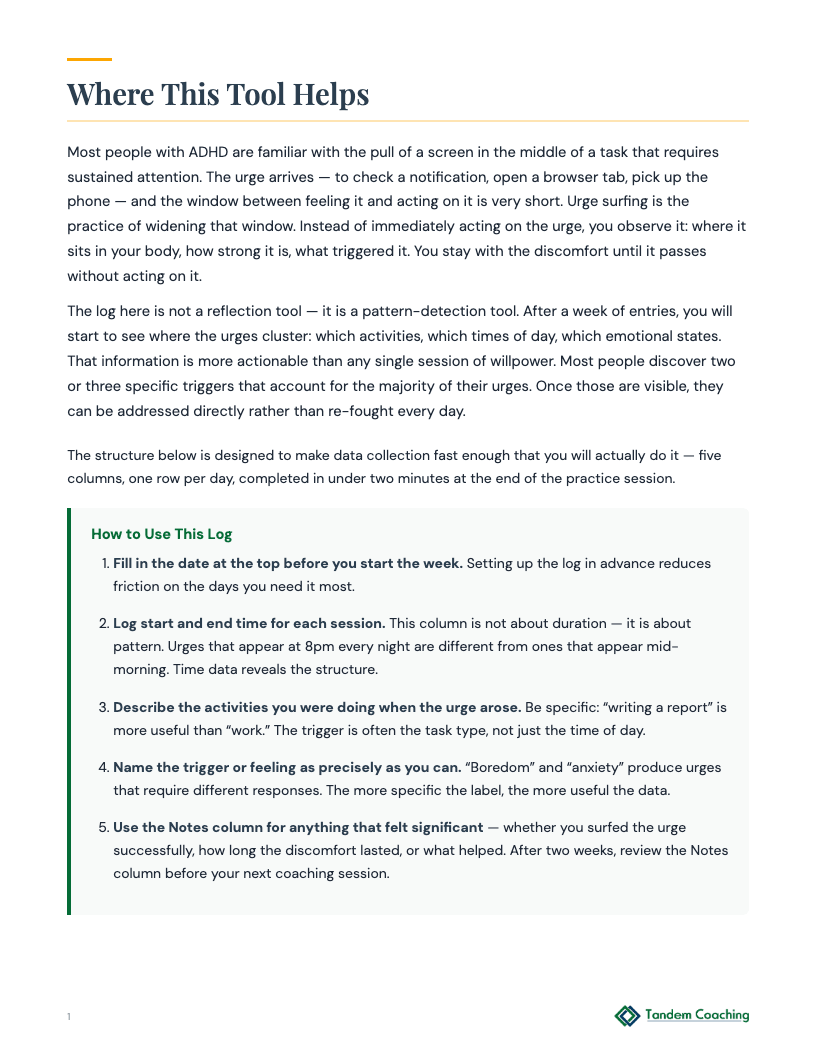
Frame the shift from worksheet to log: 'You've been mapping urges one at a time. Now we need to see what a week of them looks like in aggregate. The log is not a different practice - it is the data collection layer that goes on top of the worksheet. One row per day, two minutes at the end of each practice session. After one week, bring it in and we'll look at whether there's a time-of-day pattern and what the activity column tells us about trigger types.' Have her set up the log for the coming week before leaving the session - filling in the date field reduces the Friday-night setup friction that derails the week's data collection.
What to Watch For
Watch for the trigger or feelings column being filled with vague labels: 'stressed,' 'distracted,' 'tired.' The log's value is in specificity. Ask: 'When you wrote stressed on Tuesday - what specifically were you doing in the ten minutes before the urge?' The activity column and the trigger column together reveal the mechanism, but only when both are specific. Also watch for the client filling in the log retroactively at the end of the week from memory - the pattern data is less reliable when reconstructed from multiple days ago, especially the start/end time column, which requires in-the-moment or near-immediate recording to be accurate.
Debrief
After reviewing one complete week: 'Look at the activity column. Is there a task type that appears more than once?' The task-type cluster is almost always the first finding. Then look at the time column: 'Do the urges have a time-of-day pattern?' If they do, the coaching work shifts from urge-by-urge management to structural prevention - scheduling the highest-urge-risk task types at lower-risk times, or building environmental changes for the 10am window. The pattern data makes prevention possible; individual urge tracking only makes awareness possible.
Flags
- Moderate
Client's weekly log shows urges occurring more than ten times per day across multiple trigger types, and she reports that the frequency makes the logging itself feel overwhelming - she stopped logging by day three because there was too much to record
Response: Urge frequency high enough to make a two-minute daily log unmanageable is a signal that the practice is outpacing the tool: 'Ten or more urges a day is a lot to track, and I hear that the log became its own burden. Before we continue with the urge surfing practice, I want to step back and understand what's driving that frequency. That's worth a conversation with your physician - particularly if your ADHD treatment hasn't been recently reviewed. Urge frequency at that level can sometimes indicate the medication or timing needs adjustment, which would change what coaching alone can accomplish here.'
2 EF-Interaction: Logging as the Accountability Structure for Practice ▶
Context
A client with ADHD who is a technology project lead understands urge surfing conceptually and has attempted to practice it informally for a month without tracking. He reports that he is 'getting better at it' but cannot say what has changed, how often he is practicing, or whether his success rate differs by trigger type. The urge is real; the practice is unverifiable. The weekly log introduces the measurement structure that makes informal practice legible enough to improve.
How to Introduce
Name the accountability function of the log directly: 'Informal practice without tracking is invisible practice. You can't improve what you can't measure. The log isn't about judgment - it's about giving the informal work you're already doing a structure that makes it visible to both of us. Five columns, one row per day, two minutes. At the end of the week, we'll be able to see what 'getting better' actually means in specific terms.' Build the logging trigger into an existing routine: the moment he closes his laptop for lunch, he fills in the morning row. That specific anchor matters for ADHD clients - 'at the end of the day' is too vague to become automatic.
What to Watch For
Watch for the client completing the log for three days and then stopping - the classic ADHD engagement cliff. If this happens, do not treat it as a failure of the tool. Ask: 'What happened on day four?' The answer usually reveals a busy day that broke the anchor, followed by the guilt that prevents re-entry. Explicitly reset the rule: a partial week of data is more useful than no data, and Wednesday through Sunday is still six days of pattern information. Also watch for him reporting success ('I surfed three urges!') without the log capturing any details - the metric without the mechanism doesn't give the coaching conversation anything to work with.
Debrief
After the first week: start with the notes column. 'What did you write in notes when you surfed successfully?' The conditions that produced success are as valuable as the trigger patterns - sometimes more so. Then ask: 'What does the data tell you about the times you didn't surf?' If the failed surf attempts correlate with a specific time, task, or emotional state, the log has found the highest-priority coaching target. Comparing the successful and unsuccessful contexts builds a specific environmental strategy rather than a general recommendation to 'practice more.'
Flags
- Low
Client's log shows consistent successful urge surfing in low-stakes contexts but zero successful attempts in high-stakes contexts (before a client call, after a difficult message from leadership), and he reports that the urge intensity in high-stakes moments is qualitatively different - 'like a completely different thing'
Response: High-stakes urge intensity that the client describes as qualitatively different from low-stakes urges often indicates that the urge in those contexts is carrying emotional regulation rather than distraction management. Name the distinction: 'The log is showing us something useful - the practice that works in one context isn't transferring to another. The high-stakes urges you're describing sound like they may be driven by something emotional - anxiety, threat response - rather than boredom or distraction. That's a different coaching target. The urge surfing skill still applies, but we may need to look at what specifically is triggering the intensity before the client call or the leadership message.'
3 Using Two Weeks of Data to Build a Prevention Strategy ▶
Context
A client with ADHD who is a director of operations has completed two consecutive weeks of urge surfing logs and brought both to the coaching session. Across fourteen days of data, three patterns are visible: urges cluster Tuesday and Thursday afternoons, the activity column shows 'email backlog' on almost every high-urge day, and the notes column contains more failure entries on days with back-to-back meetings in the morning. The client has the data but has not drawn operational conclusions from it. The coaching conversation converts the log into a workday redesign.
How to Introduce
This scenario uses completed log data rather than introducing the tool for the first time. Bring both logs into the session physically: 'Let's read these together. I'm going to look at three columns - activity, time, and notes. You tell me what you see.' Letting the client read the pattern before the coach names it produces more ownership of the insight. After she has identified the email backlog trigger and the back-to-back-meeting correlation, the coaching question shifts to workload architecture: 'If Tuesday afternoon is consistently your highest-urge period and the trigger is the email backlog, what would have to change about how Tuesday is structured?'
What to Watch For
Watch for the client treating the log as a performance review rather than a design tool - becoming self-critical about failure entries rather than curious about patterns. Redirect from self-assessment to operational analysis: 'These entries are data, not a report card. Look at the Tuesday pattern - not whether you succeeded or failed, but what the conditions were.' Also watch for the client proposing a complex restructuring of her entire workday based on two weeks of data. Two weeks is enough to identify the highest-priority target; a single structural change to Tuesday afternoon should be the first experiment, not a complete schedule overhaul.
Debrief
After designing one structural change based on the log data: 'What is the one thing we are changing about Tuesday because of what this data showed?' Name the specific change (email backlog processed in a dedicated 30-minute block before 2pm, back-to-back morning meetings capped at two) and assign a third week of logging to test whether the change shifts the Tuesday afternoon pattern. The before/after comparison across three weeks of data is the evidence that a structural intervention worked, which gives the client something more durable than anecdotal confidence.
Flags
- Low
Two weeks of log data shows no variation - urges at the same intensity every day, every trigger labeled the same way, notes column nearly identical across entries - and the client reports she completed the log each day but doesn't feel like the practice is building anything
Response: Uniform log entries across two weeks either mean the practice has stalled at a surface level or that the data capture is too generic to reveal the actual pattern: 'Your entries are remarkably consistent, which could mean the urges genuinely are identical day to day, or it might mean we need to go deeper on one specific entry. Pick Tuesday from week one and walk me through that day in detail - hour by hour, what was happening, what the urge actually felt like.' The in-session verbal debrief of a single day often surfaces specificity the written log didn't capture, which can recalibrate what the client is noticing and recording.
Tool Flow
Plus
Requires
- urge-surfing practice already established
- named urge triggers from prior worksheet session
→
Produces
- weekly urge pattern data by trigger and time
- named trigger clusters driving most urges
- activity-to-urge correlation across seven days
Pairs Well With
ADHD
Work Habits Reflection
A client wants to use Work Habits Reflection as an optional reflection
Why it pairsOnce the log names which trigger clusters fire most often, this assessment shows which EF domain to strengthen first.
ADHDGoal Planning Practice Pack
A client wants to use Goal Planning Practice Pack as an optional reflection
Why it pairsUse the trigger clusters the log names to feed this worksheet's avoided-task breakdown and reward-pairing sequence.
ADHDWeekly Screen Time Summary
ADHD adult who has been logging daily screen use and wants to synthesize the week into patterns and reflections
Why it pairsWhen screen time surfaces as a trigger cluster, this summary connects urge peaks to specific app categories from that same week.
This tool is part of a coaching pathway
Step 2 of 6 in A client acts on digital impulses before they've had a chance to notice and choose
Use after Urge Surfing Worksheet. Then continue with Emotional Regulation Toolkit if that next job fits.
Next: Emotional Regulation Toolkit → Explore all pathways →Related Articles


Coaching Session Blueprints: What ADHD-Informed Executive Coaching Really Looks Like
Read article →
Remote vs In-Person ADHD Coaching: The Research
Read article →
Organize Your Success – ADHD Coaching to Master Organizational Skills
Read article →
ADHD and People-Pleasing: Why I Say Yes When I Should Say No
Read article →