Adapt your bio for each platform with a proven worksheet that clarifies your niche, credibility, and call to action without starting from scratch.
Free, print-ready PDF.
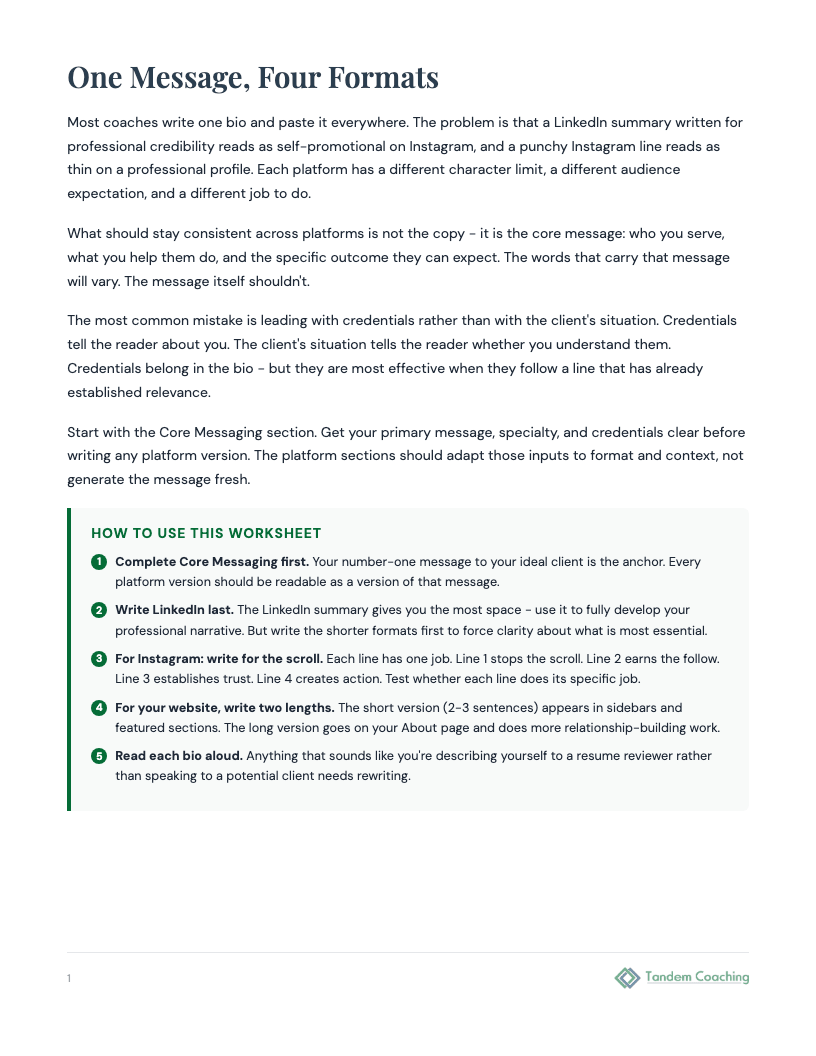
Your bio does different work on LinkedIn than it does on Instagram. This worksheet helps you write a version for each platform that actually fits what that platform needs to do.
A coach who completed her ICF training 14 months ago has a LinkedIn summary she wrote during the program - focused on her background in HR and her interest in coaching, without clear language about who she serves or what they get. She's been in practice for a year and has real clients and real results. The bio doesn't reflect any of that.
Give the worksheet as between-session work with one instruction: complete Core Messaging first, before opening any platform. 'Write your number-one message to your ideal client in two sentences. Not what you do - what happens for the client who works with you.' That single exercise usually surfaces the gap between how she thinks about herself (credentials and background) and how her work actually shows up for clients (the specific shift they experience).
In the Core Messaging section, watch whether her primary message is about herself or about the client. 'I'm a certified leadership coach with a background in HR' is about herself. 'If you've just moved into your first leadership role and you're not sure how to shift from doing to leading, I work with that specific transition' is about the client. The before/after distinction is the most common gap in coach bios.
Start with the Core Messaging statement she wrote. Ask: 'If your ideal client read that sentence, would they recognize themselves in it?' Then: 'Read your current LinkedIn headline.' Compare the two. The gap between the new core message and the existing headline is usually visible without coaching - just reading them in sequence. Then move to LinkedIn: 'What's the first sentence that should appear in your About summary?' Start there, not at the full summary.
If she can't write a specific core message - if every version is generic ('I help leaders grow' or 'I support teams through change') - the problem may be that she hasn't defined a niche yet rather than that she doesn't know how to write. Severity: low. The bio work is a mirror for the positioning work. If the message is vague, return to who she actually serves before trying to write the bio.
A five-year executive coach whose practice has evolved from general leadership coaching to specializing in first-time C-suite executives has a LinkedIn profile that still leads with 'leadership development' broadly. He gets inquiries from mid-level managers who aren't his target clients. His Instagram is inactive. His website bio is from three years ago. The bio worksheet gives him a platform-by-platform update plan.
Frame the rewrite as a positioning exercise, not a marketing task. 'Your current profile is attracting the wrong clients because it's describing a version of your practice that no longer exists. The goal of this worksheet is to get your public presence to match what you actually do now.' The credential-first instinct is strong in coaches with his experience - the worksheet structure (Core Messaging first) explicitly reverses that order.
In the LinkedIn section, watch whether the About summary he drafts leads with his specialty or with his history. The specialist framing - 'I work exclusively with leaders in their first two years of the C-suite' - is more efficient than the career narrative approach ('I spent 12 years in talent development before becoming a coach'). Both are true; only one works as an opening line for his target client.
After he drafts the LinkedIn headline, read it aloud: 'Does that tell a first-time C-suite leader that this profile is for them?' Then move to the Instagram section: 'You have 150 characters and four lines. Line one stops the scroll. What is one line that your ideal client would stop on?' For a specialist, the scroll-stopper is usually the precise description of the problem - not the credential. The credential goes in line three.
If he is resistant to narrowing his public positioning because he's worried about excluding potential clients, name the trade-off directly. Severity: low. A broad bio attracts broad inquiries, which require more filtering. A specific bio attracts fewer but more qualified inquiries. The question is which costs more - filtering time or specificity. For someone trying to exit mid-market work, specificity is almost always the better investment.
A career coach has 3,000 LinkedIn followers and posts several times a week. Her website bio is three generic sentences that haven't been updated in two years. She gets traffic from LinkedIn but poor conversion from her website because the website doesn't follow through on the promise of the LinkedIn presence. The worksheet can structure the website bio sections she's been avoiding.
Give with one instruction: skip Core Messaging and go directly to the website sections. 'You already have a working LinkedIn presence - your core message is implicit in what you post. The gap is your website. Let's build both the short bio (for sidebars) and the long bio (for About page) specifically.' For someone who already writes comfortably, the constraint of the 2-3 sentence short version is the productive challenge - not the blank page.
Watch whether her website bio draft reads like her LinkedIn voice or like a formal resume. Coaches who write naturally on LinkedIn often stiffen in website copy because they think it needs to sound more 'professional.' The most effective website bios sound like the person - not like a credentials list. If the draft is stilted, ask her to read her best recent LinkedIn post aloud, then try the bio again.
Compare the short website bio to her LinkedIn headline: do they make the same promise? Then: 'Would someone who clicked from your LinkedIn post to your website feel like they'd arrived at the same person?' If the LinkedIn version is warmer and more specific than the website version, the website is breaking trust rather than building it. The fix is usually to bring the LinkedIn voice into the website, not to formalize the LinkedIn voice.
If her website bio is generic because she hasn't decided who her ideal client is and doesn't want to exclude anyone, the bio work is downstream of a positioning decision she hasn't made. Severity: low. LinkedIn activity without website conversion is a leaky funnel - the bio can't fix the underlying positioning ambiguity. Name the root problem before spending more time on copy.
A coach is choosing brand colors and wants to understand what different colors communicate to potential clients
Coach BusinessA coach trying to define a consistent voice across platforms
Coach BusinessA coach who posts inconsistently because they don't know what to write about