ADHD Letter to Myself
ADHD adult who loses motivation mid-goal and needs something to reconnect with their why
Get This Tool
Free, print-ready PDF.
When to Use This Tool
ADHD adult who loses motivation mid-goal and needs something to reconnect with their why
A client who wants to create a self-compassion anchor for when ADHD symptoms derail progress
Person who is making a commitment and wants to write it to their future self as accountability
How to Introduce This Tool Plus
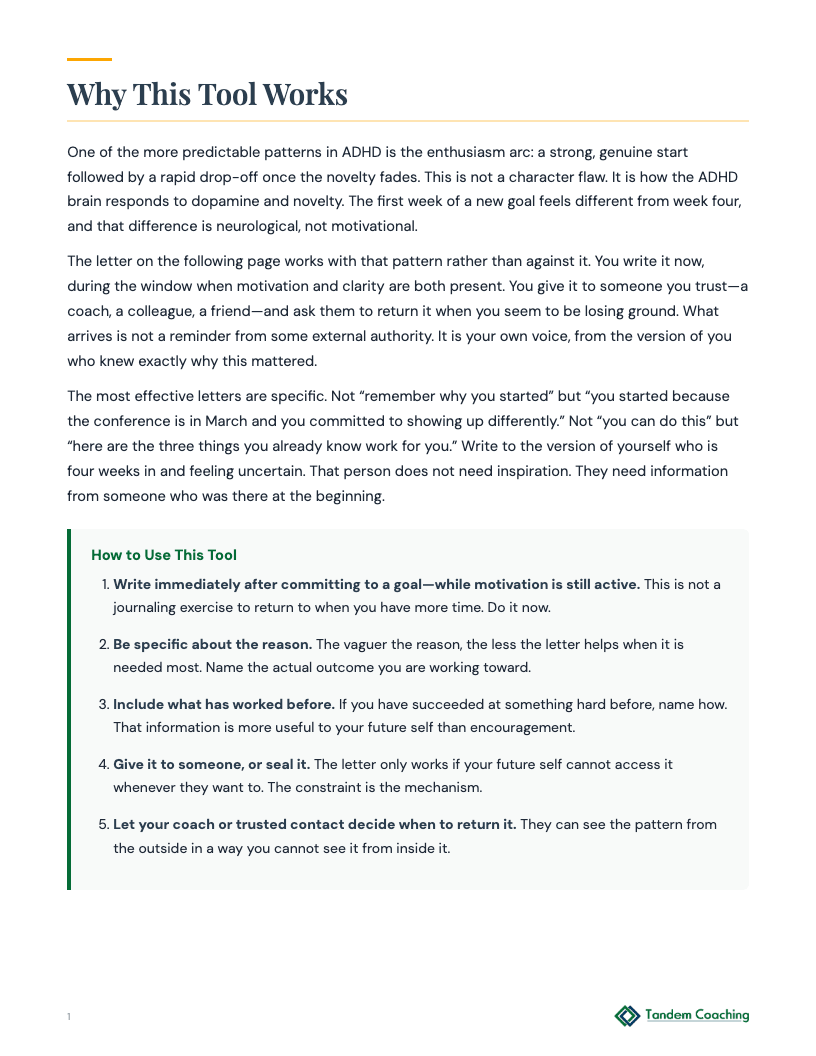
When motivation drops - which it will - having something written to yourself from when things were clear can be more powerful than any external accountability structure. This is a letter from the version of you who's committed right now.
Coaching Tool Disclaimer
This tool is designed for coaching contexts, not clinical use. If you or your client is in crisis, contact the 988 Suicide and Crisis Lifeline (call or text 988) or Crisis Text Line (text HOME to 741741).
Browse All Pages
Tool Classification
Domain
ADHD
Type
Worksheet
Phase
Action
Reflection
Details
15 min
Closing
As-needed
Topics
Mindset
Resilience
Identity
For the Coaching Practitioner
Plus
Coaching Scenarios
Plus
1 Senior engineer starting MBA while working full-time with ADHD diagnosis ▶
Context
A principal software engineer with ADHD just started an executive MBA program while maintaining their full-time role. They're three weeks in and already feeling the pull between coursework and work deadlines. They've attempted graduate school twice before without finishing.
How to Introduce
Frame this as insurance, not inspiration. 'You're in the honeymoon phase right now - coursework feels manageable, you're excited about the content. Write to the version of yourself in week 8 when you're behind on cases and questioning whether the MBA is worth it.' Most ADHD clients resist this because they believe this time will be different. Name that directly.
What to Watch For
Length and specificity are diagnostic. If they write three sentences about 'staying motivated,' they're not accessing the real reason. ADHD brains need concrete anchors. Look for specific outcomes: 'promotion to VP requires MBA' versus vague goals like 'career growth.' The letter should reference their previous attempts.
Debrief
Start with what they wrote about their previous attempts. 'You mentioned trying graduate school before. What was different about those times?' Then move to the specific outcome they named. The question that opens this up: 'When you read this letter in February, what will you need to remember about why you started in September?'
Flags
If they cannot name a specific reason beyond 'should have an MBA' or if the letter focuses entirely on not disappointing others, the external motivation may not sustain the ADHD executive function demands. Severity: moderate. Response: explore whether this is their goal or someone else's expectation.
2 Marketing director launching first product after being promoted from individual contributor ▶
Context
A newly promoted marketing director is leading their first major product launch. They've been an individual contributor for eight years and are now managing a team of five while coordinating with product, sales, and engineering. The launch is in four months and they feel overwhelmed by the scope.
How to Introduce
Position this as a message to your future self when the launch gets chaotic. 'Right now you can see the whole picture clearly. In six weeks, you'll be in the weeds and might lose sight of what success actually looks like.' Expect resistance from high achievers who think they won't lose perspective. The promotion itself is evidence they handle complexity well.
What to Watch For
Watch whether they write about the launch or about proving themselves as a manager. New managers often conflate the two. If the letter focuses more on 'showing I can do this job' than on 'delivering a successful launch,' they're managing their own anxiety rather than the project. The letter should include specific launch metrics.
Debrief
Start with what success looks like. 'You wrote about three different measures of success. Which one matters most to the business?' Then explore the management transition. The question that creates movement: 'What would you want to remember about your team's capabilities when you're tempted to do everything yourself?'
Flags
If the letter reads like a performance review self-assessment or focuses entirely on not failing, the client may be experiencing imposter syndrome that coaching alone won't resolve. Severity: low. Response: continue coaching but address the promotion transition directly in subsequent sessions.
3 Consultant who keeps starting business ideas but never follows through ▶
Context
An independent consultant has started four different business ventures in the past two years - a course, a mastermind, a software tool, and a certification program. Each began with enthusiasm and detailed planning but stalled within 6-8 weeks. They want to launch a fifth idea and insist this one is different.
How to Introduce
Frame this as pattern interruption, not motivation maintenance. 'You've started four businesses in two years. Each time felt different at the beginning. Write to the version of yourself who's about to abandon number five.' Expect significant resistance - they'll argue this idea is genuinely different. That argument is part of the pattern.
What to Watch For
If they write about this idea being 'the one' or focus on why previous attempts failed, they're not engaging with the pattern. The letter should acknowledge that week 6-8 will feel different and include specific strategies for that moment. Watch for blame of external circumstances in previous attempts rather than pattern recognition.
Debrief
Start with the pattern, not the current idea. 'You've been here four times before. What was happening in week 6 of each previous attempt?' Then move to what's different about their approach this time, not the idea itself. The question that opens this up: 'What would need to be true for you to still be working on this in month three?'
Flags
If they cannot acknowledge the pattern or if the letter reads like a business plan rather than a personal message, they may be using new projects to avoid deeper issues about completion or commitment. Severity: moderate. Response: explore what completion represents to them before proceeding with launch planning.
4 Executive returning from medical leave trying to rebuild professional momentum ▶
Context
A VP of operations returned from a six-month medical leave three weeks ago. They're physically cleared to work but struggling with energy management and confidence. Before the leave, they were known for high performance and long hours. Now they're questioning whether they can return to their previous level.
How to Introduce
Frame this as a bridge between who they were and who they're becoming. 'You're not trying to get back to your old self - that person worked in a way that may not be sustainable now. Write to yourself when you're comparing current performance to pre-leave standards.' The resistance will be about accepting limitations rather than overcoming them.
What to Watch For
The letter should acknowledge changed capacity without being defeatist. If they write about 'getting back to normal' or 'proving I'm still capable,' they're fighting the transition rather than navigating it. Look for specific accommodations they're willing to make and concrete definitions of success that fit their current reality.
Debrief
Start with what they wrote about their current capacity. 'You mentioned working differently now. What does that look like day to day?' Then explore what success means in this context. The question that creates movement: 'What would you want to remember about why you came back when you're tempted to prove you're unchanged?'
Flags
If the letter focuses entirely on returning to pre-leave performance levels or contains no acknowledgment of changed circumstances, the client may be setting themselves up for another health crisis. Severity: high. Response: pause and explore whether they've processed the medical leave experience before proceeding with performance goals.
Tool Flow
Plus
Requires
- active committed goal with defined outcome
- named strategies proven to work for this person
→
Produces
- future-self motivation letter with specific reasons
- documented strategies that have worked before
- sealed accountability artifact for coach or trusted contact
Pairs Well With
ADHD
Shame and Inner Critic Guide
A client consistently moves from mistakes to global self-condemnation rather than specific accountability
Why it pairsOnce the letter names what derails progress, this framework maps the shame patterns that typically override the client's self-compassion intentions mid-goal.
LifeBelief and Practice Options Map
Use this planner to organize mindset and habits into a client-owned sequence of possible next steps.
Why it pairsAfter the letter locks in proven strategies, this assessment reveals which mindset domains risk undermining the client's follow-through when progress stalls.
LifeConfidence Evidence and Learning Notes
Use this worksheet to explore identity and mindset and turn the client’s observations into one optional next step.
Why it pairsUse this after the letter to convert the client's documented strategy wins into a strengths inventory they can access between sessions.
This tool is part of a coaching pathway
Step 6 of 6 in A client acts on digital impulses before they've had a chance to notice and choose
Use after Conflict Resolution Planner.
Explore all pathways →Related Articles


Remote vs In-Person ADHD Coaching: The Research
Read article →
ADHD and People-Pleasing: Why I Say Yes When I Should Say No
Read article →
ADHD Coaching Certification: Which Path Actually Counts
Read article →
Group vs Individual ADHD Coaching: Which Works?
Read article →