See how your strengths are perceived at work and whether they stand out, using structured feedback and evidence-based reflection.
Free, print-ready PDF.
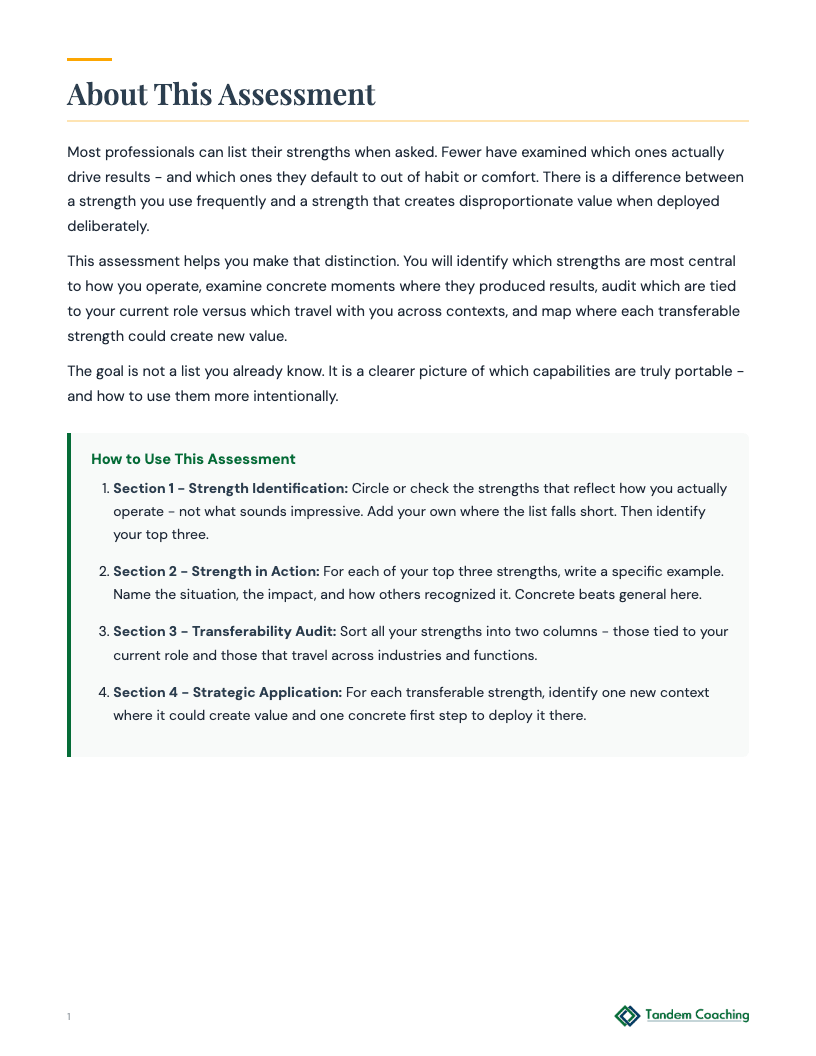
When you filled in the 'I Could Boost Them By' column — what specific action did you write that you're most ready to take, and what's been in the way of doing it already?
A client who is a senior marketing manager pursuing a VP role has passed initial screening but is underperforming in interviews. When asked about her greatest strengths, she gives competency-label answers ('strategic thinker,' 'collaborative leader') that interviewers hear from every candidate. She has not learned to convert her strengths into evidence statements that are specific, quantified, and portable. The four-section strength exploration worksheet - identifying strengths, naming evidence from experience, assessing portability, and planning strategic deployment - builds the structure her interview answers are missing.
Name the gap before assigning: 'Competency labels like strategic thinker don't differentiate you because every candidate uses them. What differentiates you is the evidence behind the label - a specific situation where that strength produced a specific outcome. This worksheet builds that evidence layer. For each strength you name, it asks you to write what you've actually done, not what you generally are. Bring it completed next week and we'll work through converting the evidence column into interview-ready statements.' Assigning it as interview preparation rather than self-reflection increases completion.
Watch for the evidence column being populated with role descriptions ('I led a team of eight') rather than outcomes ('I led a team of eight that achieved 140% of revenue target in the first year'). The evidence needs to name what changed as a result of the strength being deployed. Ask: 'For each piece of evidence you wrote - what did the situation look like before your strength showed up, and after?' The before/after framing produces the outcome language that competency labels lack. Also watch for the portability assessment identifying every strength as portable when the actual evidence is role-specific - the distinction matters for career transition contexts.
Start with the evidence column across all four strengths: 'Read me your strongest piece of evidence - the one you feel most confident about.' Then ask: 'Is that evidence specific enough that an interviewer could picture the situation, or is it still general?' The test is visual specificity - can the reader construct an image from the evidence? Then turn to the strategic deployment section: 'For your top strength, what's one context in your current role where you're underdeploying it?' The underdeployment question connects the worksheet to an action item in the current position, not just the job search.
Array
A client who is a director of operations at a manufacturing firm is exploring a career move to a technology operations role. She is uncertain whether her strengths will transfer and tends to dismiss her capabilities with 'that only works in manufacturing.' The portability assessment section of the worksheet directly challenges this assumption by distinguishing which strengths are role-specific (dependent on manufacturing-specific context) and which are genuinely portable (applicable in any operations environment). The distinction is foundational to building a credible case for sector transition.
Frame the portability column as the primary output for her transition context: 'The section I most want you to focus on is the portability column. For each strength, you'll rate whether it's specific to manufacturing or transferable to any operations context. The rating requires you to think carefully - not just whether the strength feels general, but whether someone in a technology operations role would recognize and value it. Bring three strengths rated as high portability along with their evidence, and we'll stress-test whether you're right.' The stress-test framing introduces productive skepticism without dismissing the exercise.
Watch for all strengths being rated as highly portable - this is the overcorrection from the client who has been dismissing her value. Ask about specific portability: 'You rated vendor relationship management as highly portable. If you were interviewing at a software company, how would you describe that skill in terms that an engineering-heavy operations team would recognize as valuable?' If she cannot translate it across sector language, the portability rating is too generous. Also watch for the 'I could boost them by' action column being left blank or filled with generic professional development intentions rather than specific leverage actions.
After stress-testing the portability ratings: 'Which three strengths survived the test - meaning, you can describe them in technology operations language and give evidence that would be recognizable to a sector-unfamiliar interviewer?' Those three are the career transition case. Then ask: 'Which strength, if you invested thirty days in developing it, would most increase your competitiveness for the role you're targeting?' The development investment question connects the worksheet to a concrete between-session action.
Array
A client who is a VP of customer success at a software company received 360-degree feedback that named two development areas: executive presence and cross-functional influence. He has been given generic development resources and is unclear how to build those capabilities. His coach recognizes that effective development plans start from existing strengths rather than deficit remediation. The strength exploration worksheet identifies what he is already doing well, how those strengths produce observable results, and specifically how each strength could be deployed to address the development areas rather than treating the gaps as if they were separate from his competency base.
Reframe the development context before assigning: 'The 360 named gaps. Most development plans start there and treat the gaps as things to fix from scratch. A more effective approach is to start from what you're already doing well and ask how those strengths can be leveraged toward the areas the feedback flagged. This worksheet builds that bridge - we identify your strongest current capabilities with evidence, then in our next session we'll map specifically how each strength contributes to developing executive presence and cross-functional influence.' That framing positions the tool as constructive rather than defensive.
Watch for the client completing the worksheet with strengths that are entirely disconnected from executive presence and cross-functional influence - if all named strengths are in individual contributor domains (technical analysis, detailed project management), the bridge the coach intends to build may not exist and the gap may require a different kind of development. Also watch for the 'could boost them by' column being filled with actions that are already recommended in the 360 development resources rather than actions that leverage the client's actual strengths. The development actions should flow from his strengths, not from generic leadership development templates.
After reviewing the completed worksheet: 'For each strength you named - what would it look like to deploy it in a situation where executive presence or cross-functional influence is required?' Walk through at least two concrete scenarios. Then ask: 'Which strength, if deployed more visibly in the specific contexts where cross-functional influence is needed, would most directly address what the feedback flagged?' That question produces the development hypothesis the plan will test over the next ninety days.
Array
A client feels successful but unfulfilled and wants to understand why
LifeClient is successful by external measures but cannot articulate why the work feels hollow
CareerA client feels stuck in their career but isn't sure what they actually want