Career Reflection Journal
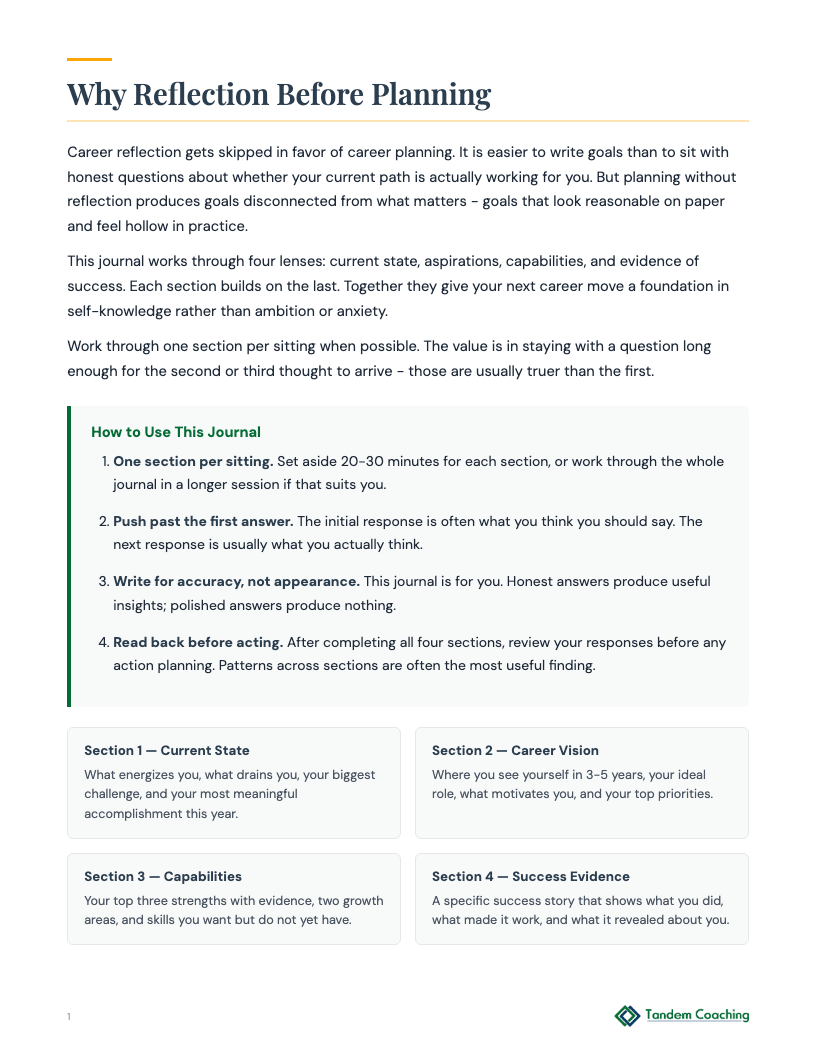
Clarify what you want next in your career when you feel stuck, using coach-led prompts grounded in proven reflection and goal-setting methods.
Get This Tool
Free, print-ready PDF.
When to Use This Tool
A client wants to use Career Reflection Journal as an optional reflection
A client wants to record their own observations without inferring a cause
A client wants to prepare questions or one safe next step for coaching or qualified support
How to Introduce This Tool Plus
What did you personally notice, what remains uncertain, and which question or optional next step feels useful?
Browse All Pages
Tool Classification
Domain
Career
Type
Worksheet
Phase
Discovery
Reflection
Details
45+ min
Between sessions
As-needed
Topics
Identity
Values
Career Transition
For the Coaching Practitioner
Plus
Coaching Scenarios
Plus
1 Client who is stuck in their career without understanding why ▶
Context
A client brings a situation related to career reflection journal and wants an optional, practical coaching reflection. Confirm the client's own words, context, goal, and preferred scope before using the tool.
How to Introduce
Offer the tool as an optional coaching reflection. Confirm the client's own language, goal, context, access needs, and whether qualified support is more appropriate.
What to Watch For
Keep observations client-owned. Do not infer a diagnosis, neurological mechanism, hidden motive, cause, treatment, or correct decision from a selection or rating.
Debrief
Ask what the client noticed, what remains uncertain, and whether one small experiment, additional question, or qualified referral would be useful.
Flags
Not therapy, diagnosis, medical, financial, or employment advice. Adapt or stop for distress; use licensed health or emergency support when appropriate.
2 Client jumping into career planning before doing honest self-reflection ▶
Context
A client brings a situation related to career reflection journal and wants an optional, practical coaching reflection. Confirm the client's own words, context, goal, and preferred scope before using the tool.
How to Introduce
Offer the tool as an optional coaching reflection. Confirm the client's own language, goal, context, access needs, and whether qualified support is more appropriate.
What to Watch For
Keep observations client-owned. Do not infer a diagnosis, neurological mechanism, hidden motive, cause, treatment, or correct decision from a selection or rating.
Debrief
Ask what the client noticed, what remains uncertain, and whether one small experiment, additional question, or qualified referral would be useful.
Flags
Not therapy, diagnosis, medical, financial, or employment advice. Adapt or stop for distress; use licensed health or emergency support when appropriate.
3 Client who works hard but doesn't know where their energy goes ▶
Context
A client brings a situation related to career reflection journal and wants an optional, practical coaching reflection. Confirm the client's own words, context, goal, and preferred scope before using the tool.
How to Introduce
Offer the tool as an optional coaching reflection. Confirm the client's own language, goal, context, access needs, and whether qualified support is more appropriate.
What to Watch For
Keep observations client-owned. Do not infer a diagnosis, neurological mechanism, hidden motive, cause, treatment, or correct decision from a selection or rating.
Debrief
Ask what the client noticed, what remains uncertain, and whether one small experiment, additional question, or qualified referral would be useful.
Flags
Not therapy, diagnosis, medical, financial, or employment advice. Adapt or stop for distress; use licensed health or emergency support when appropriate.
Tool Flow
Plus
Requires
- None - standalone tool
→
Produces
- client-owned observations
- uncertainty or context notes
- an optional question or next step
Pairs Well With
Life
Work-Purpose Context Map
Use this framework to structure a conversation about values and identity while keeping interpretation with the client.
Why it pairsUse only if the client finds the next tool relevant; confirm scope and do not treat selections or ratings as diagnostic or causal evidence.
CareerCareer Possibilities Reflection
Use this worksheet to explore values and identity and turn the client’s observations into one optional next step.
Why it pairsUse only if the client finds the next tool relevant; confirm scope and do not treat selections or ratings as diagnostic or causal evidence.
CareerCareer Values and Context Reflection
Use this assessment to take stock of values and career transition before the client chooses what deserves attention.
Why it pairsUse only if the client finds the next tool relevant; confirm scope and do not treat selections or ratings as diagnostic or causal evidence.
Related Articles


Need a Career Transition Coach? Read This Guide First
Read article →
Executive Coaching for Career Transitions: What Changes Your Trajectory
Read article →
Executive Career Pivot Strategy: Framework for Adjacent Moves
Read article →
Executive Career Reinvention: When Starting Over Makes Sense
Read article →