Productivity Practices Review
Identify where your time goes and why results lag with a structured, coach-led assessment grounded in proven productivity frameworks.
Get This Tool
Free, print-ready PDF.
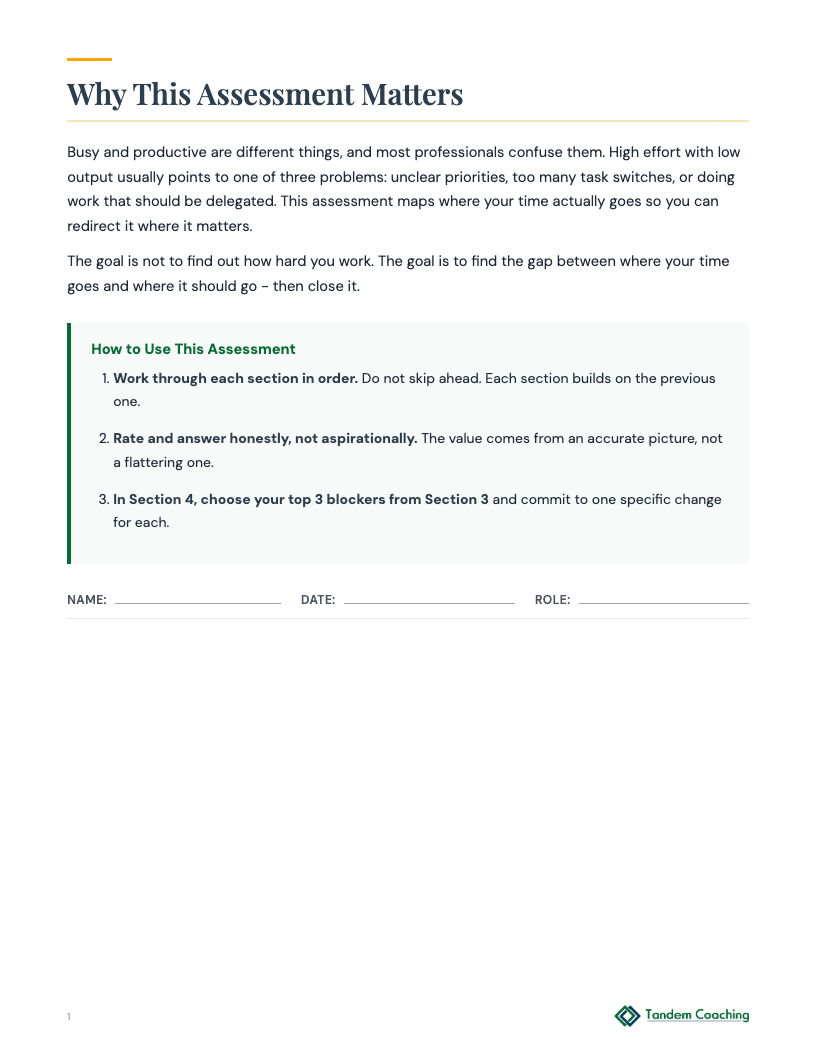
When to Use This Tool
A client feels busy all day but doesn't feel productive at the end of it
A client wants to identify the specific habits or patterns that are costing them time
A client is preparing to optimize how they work, not just what they work on
How to Introduce This Tool Plus
Which individual productivity practice or time leak deserves attention first, without turning the ratings into a total score?
Browse All Pages
Tool Classification
Domain
Career
Type
Assessment
Phase
Discovery
Action
Details
30 min
Between sessions
Monthly
Topics
Time Management
Habits
For the Coaching Practitioner
Plus
Coaching Scenarios
Plus
1 Client who equates busyness with productivity and can't explain the difference ▶
Context
A director-level client works long hours, is constantly in motion, and cannot point to measurable progress on their stated priorities. They experience themselves as highly productive and attribute their lack of progress to organizational factors — slow approvals, difficult stakeholders, competing demands. The self-narrative of busyness and the actual output record are significantly misaligned.
How to Introduce
Frame as a diagnostic rather than an assessment. 'Before we work on improving anything, let's find out where your time and attention are actually going. This takes about 30 minutes and will tell us more than an hour of discussion.' Expect pushback from clients who feel they already know the problem. 'Maybe — but let's see if the data confirms that. It usually surfaces something the discussion hasn't.'
What to Watch For
The time leak audit section is the most diagnostic for this client. Watch for whether the client's named 'time thieves' are all external — meetings they can't control, interruptions from others, bureaucratic processes. If the time leak audit has no self-originated leaks (email checking, task-switching, perfectionism, avoidance), the client may not have honest access to their own role in the time pattern.
Debrief
Start with the skill ratings, but don't linger. The more productive territory is the gap between the 'actual time' and 'ideal time' columns in the category analysis. Ask the client to read both numbers for each category aloud. Then: 'Where is the biggest gap, and what is that gap costing you?' The redesigned week is the end goal — but only if the diagnosis lands first.
Flags
If the skill ratings section has all scores of 7 or above and the time leak audit is sparse, the client may be performing the assessment rather than doing it. Severity: low. Ask them to revisit one section with a specific week in mind rather than their general sense of themselves. Specificity changes what surfaces.
2 Client who wants to optimize but has never identified their blockers ▶
Context
A professional who has read productivity books and tried various systems arrives in coaching wanting to 'finally figure out' why their system keeps breaking down. They've tried time blocking, prioritization frameworks, and app-based tools. Each works briefly and then stops working. The client attributes this to lack of discipline rather than to the blocker patterns underneath.
How to Introduce
The blocker checklist is the most useful section for this client. 'Before we design another system, let's find out what's actually breaking your current ones.' Walk through the tool section by section, positioning the blocker checklist as the diagnostic center: 'These aren't personality flaws — they're patterns. Identifying them is what makes the next system stick.'
What to Watch For
Watch for which blockers the client checks and how quickly they do it. Clients who check everything are not being more honest — they may be avoiding the specificity that makes a blocker actionable. If a client checks both 'perfectionism' and 'difficulty prioritizing' and 'tendency to take on too much,' ask which one comes first: 'If you had to identify the root, which blocker generates the others?'
Debrief
Start with the blocker the client identified as most significant. Ask for a specific recent example of when that blocker cost them time or progress. Then move to the optimization plan section: 'What is one thing you could do differently this week that would address that specific blocker — not all of them, just that one?' The client who wants to solve all blockers at once is usually solving none.
Flags
If the optimization plan section is filled with intentions ('I will be more disciplined,' 'I will focus better') rather than behavioral commitments ('I will close email between 9-11 every morning,' 'I will end every meeting by naming the one next action'), the tool has not done its work. Severity: low. Return to the plan section and convert each intention into a specific observable behavior.
3 Client returning to work after extended leave needing to reset habits ▶
Context
A professional returning from parental leave, medical leave, or career break faces a version of a productivity reset: their previous habits and systems no longer fit their current constraints or role. They feel pressure to perform at their prior level immediately while managing a genuinely different set of demands.
How to Introduce
Position this as a current-state map, not a comparison to prior performance. 'We're not measuring you against where you were before — we're finding out where you are now and building from there.' This framing matters for clients who are self-critical about the transition. The four sections — skills, time, blockers, optimization — together create a picture of the current baseline.
What to Watch For
Pay attention to the skill ratings: if a client rates themselves low on skills they would previously have rated highly (planning, energy management, focus), explore whether those ratings reflect genuine depletion or recalibration anxiety. Low ratings due to recalibration anxiety need a different response than low ratings due to genuine skill erosion.
Debrief
Start with the redesigned week rather than the time audit — this client benefits from forward-facing structure before dwelling on the gap analysis. 'Given what you know about your current situation, what does a sustainable productive week look like? Not your peak — just sustainable.' Build the week from their inputs, then test it against the blockers they identified.
Flags
If the client's skill ratings are uniformly low and they describe feeling overwhelmed, lost, or unable to concentrate in ways that feel different from normal adjustment stress, the return may be earlier than the client's system can handle. Severity: moderate. Explore whether additional support structures — beyond coaching — are in place before designing an optimization plan.
Tool Flow
Plus
Requires
- None - standalone tool
→
Produces
- individual productivity-practice observations
- time leak inventory with delegation flags
- three-blocker improvement plan with measures
Pairs Well With
Career
Productivity System Design
A client who's tried multiple productivity systems and none of them stick past the first week
Why it pairsThe assessment's named failure modes feed directly into this tool, so the system you build targets actual patterns instead of generic best practices.
CareerPriorities Evidence and Options Map
Use this framework to structure a conversation about time management and accountability while keeping interpretation with the client.
Why it pairsOnce you have the time leak inventory with delegation flags, use this to turn those flags into specific named assignments across urgency and importance.
LifeAnnual Goal Context Review
Use this tracker to notice patterns in accountability and time management over time before drawing conclusions.
Why it pairsThe three-blocker action plan needs a calendar - this tool sequences each blocker into a month so it gets a committed slot rather than lingering as intent.
This tool is part of a coaching pathway
Step 1 of 6 in A client feels busy all day but doesn't feel productive at the end of it
Continue with Productivity System Design if that next job fits.
Next: Productivity System Design → Explore all pathways →Related Articles

30-Day Executive Productivity Transformation Guide
Read article →
When Executive Coaching Does Not Work
Read article →
Managing Stress and Anxiety: Coaching Strategies for Leaders’ Well-Being
Read article →