Impact and Effort Rating Sheet
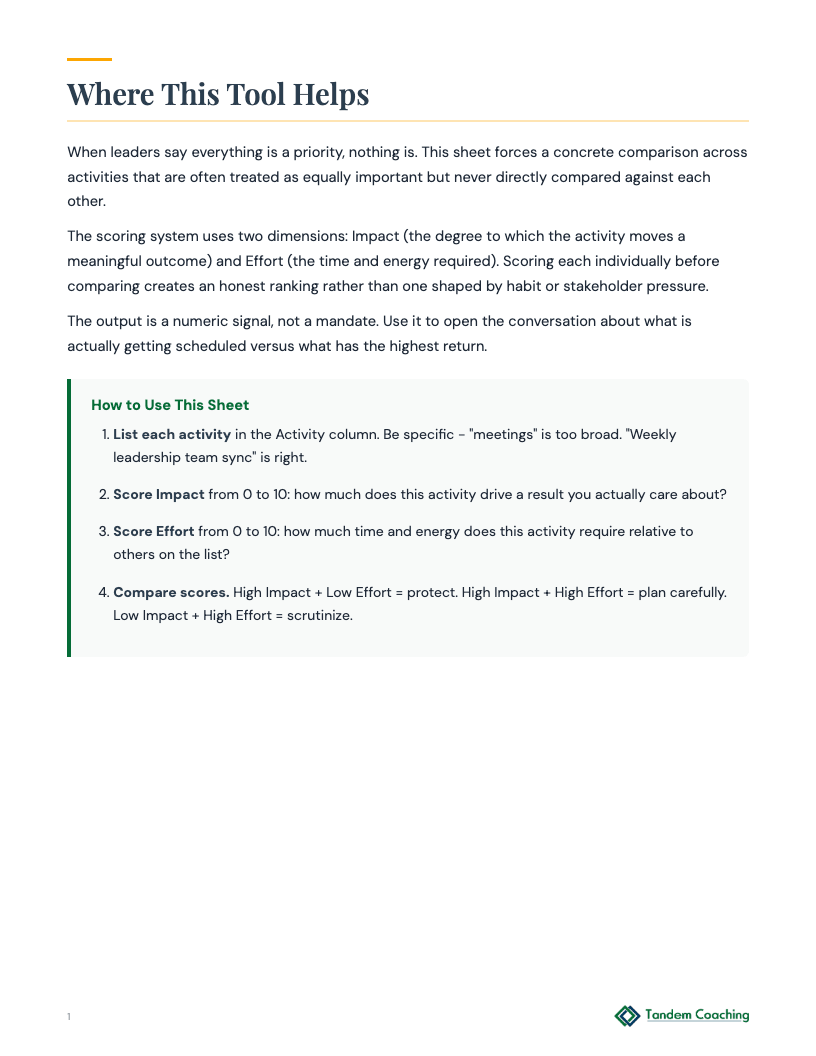
Compare personal estimates of impact and effort before using the visual Impact-Effort Matrix.
Get This Tool
Free, print-ready PDF.
When to Use This Tool
A client has too many goals and needs a structured way to choose where to focus
A client wants to score their options by impact and effort before committing
A client is in planning mode and wants to make prioritization explicit rather than intuitive
How to Introduce This Tool Plus
How did you estimate impact and effort, and which rating carries the most uncertainty?
Browse All Pages
Tool Classification
Domain
Life Coaching
Type
Worksheet
Phase
Goal Setting
Details
15 min
Between sessions
As-needed
Topics
Values
Accountability
For the Coaching Practitioner
Plus
Coaching Scenarios
Plus
1 The client paralyzed by too many equally important goals ▶
Context
Client has generated a rich list of goals — personally meaningful, professionally legitimate — and cannot proceed because every item feels equally urgent. Sessions circle the same territory because without a prioritization mechanism, the client has no way to decide where to put energy. The Priority Scoring Sheet's Activity/Impact/Effort table creates a structure for ranking that removes the subjective charge from the decision.
How to Introduce
Frame this as decision engineering, not priority-setting. 'You have a good list. The challenge isn't the list — it's picking from it. This tool gives you a way to score each goal against two variables and see what the math suggests. You can override the result, but you'll have made a more explicit choice.' Clients who are stuck in priority paralysis often resist structured tools because they fear the tool will tell them to deprioritize something that matters to them. Name it: 'The scoring doesn't make the choice for you. It makes the implicit explicit.'
What to Watch For
Watch for goals that score high on Impact but high on Effort — these require the most scrutiny. The client's willingness to accept high-effort, high-impact goals tells you something about their tolerance for sustained work versus quick wins. Also watch for goals that score low across all three dimensions — Activity, Impact, and Effort — but the client insists belong on the list. These are usually goals held out of obligation rather than genuine investment. They will not survive the first obstacle.
Debrief
After scoring, ask the client to read the top two or three goals by score. Then ask: 'Does the order feel right?' If it does not, explore why — the scoring surfaced something that conflicts with a value or assumption the client holds. That conflict is the coaching conversation. If the order does feel right but the client has been unable to act on it, the problem is no longer prioritization — it is the commitment mechanism.
Flags
- Low
Client scores every goal as maximum Impact and minimum Effort, producing a list where everything is tied at the top. This is either strategic optimism or an unwillingness to engage with genuine trade-offs.
Response: Name what you are seeing: 'Everything scored the same. That suggests either these are all equally critical, or the scoring isn't distinguishing between them. Let's try again with the constraint that only two goals can be high Impact.' The constraint forces real prioritization.
2 The client who commits to goals in session and abandons them between sessions ▶
Context
Client makes clear, articulate commitments during coaching sessions that do not survive the week. They report back with credible explanations — schedule disruptions, competing demands — but the pattern has repeated enough times that the explanation is no longer sufficient. The scoring tool creates an accountability for the original choice that makes it harder to abandon without examining why.
How to Introduce
Frame this as a commitment audit. 'Before we add any new goals to the list, I want to understand why the previous ones have not held. Let's score the goals we've been working on and see what the scores tell us about why they might be losing to your week.' This reframes the tool as diagnostic rather than generative. Clients who are serial commitment-makers resist this because it names the pattern they have been managing around. Name the resistance: 'I know it is more comfortable to start fresh. What I want to understand is what has been getting in the way of the goals we've already set.'
What to Watch For
After scoring existing goals that have been abandoned, watch for goals that score high on Impact but that the client rated as easier than the evidence suggests. The gap between the effort score the client assigned and the actual effort the goal required is the most diagnostic data point. Also watch for the client who consistently chooses goals that have high scores on paper but low personal stakes — goals that would be good to achieve but not devastating to leave incomplete.
Debrief
Start with the gap between the scores and the outcomes. 'You scored this goal as high impact, medium effort. It has not happened despite three weeks of trying. What does that tell us about the scores?' Then: 'What score would this goal need to get your consistent attention even when your week is difficult?' This reframe shifts from scoring as an assessment tool to scoring as a calibration tool.
Flags
- Moderate
Client has a documented history across multiple sessions of committing and not following through, accompanied by high self-criticism and a desire to keep trying. The commitment pattern and the self-criticism pattern are functioning together — each new commitment manages the shame from the previous failure temporarily.
Response: Step back from goal-setting entirely for one session. Explore the commitment-and-shame cycle directly. 'I want to set aside the goals for today and understand what happens for you in the gap between committing and not following through.' The cycle needs to be examined before another commitment is added to it.
3 The client who needs a shared prioritization language with a spouse or business partner ▶
Context
Client has goals that intersect significantly with another person's priorities — a life partner in discussions about relocation, a business partner in discussions about strategic direction — and wants a way to move from competing preferences to a shared framework. The scoring tool provides a structure that both parties can apply to the same goal list and compare results, which reveals disagreements about Impact and Effort that would otherwise surface as interpersonal conflict.
How to Introduce
Frame this as a shared calibration tool rather than a conflict resolution technique. 'What I'd like to try is having both of you score the same list independently and then compare where the scores differ. The differences are where the real conversation needs to happen.' This works best when the client has already tried and failed to reach alignment through direct negotiation. Some clients will be skeptical that a scoring tool will change anything. Name the skepticism: 'I'm not suggesting the scores will solve the disagreement. I'm suggesting they will show you what you actually disagree about, which is more useful than the conversation you have been having.'
What to Watch For
When reviewing the independently scored lists, watch for systematic differences rather than goal-by-goal differences — if one person consistently rates Effort higher across all goals, they may be carrying more of the implementation burden and know it. If one person consistently rates Impact higher, they may be more invested in the outcome. These systematic differences are more informative than the specific goal scores.
Debrief
Start with the goals where the scores are most different. 'You scored this as high impact, medium effort. Your partner scored it as medium impact, high effort. What's underneath that difference?' The scoring difference is not the conversation — it is the entry point into the conversation about values, capacity, and who carries what.
Flags
- Moderate
The scoring exercise reveals not a difference in priorities but a fundamental difference in life vision between the two parties — one wants to build a business, the other wants more time with family — that the goal-scoring exercise has surfaced but cannot resolve.
Response: Name what the exercise has revealed: 'What we're seeing is not a prioritization disagreement — it's a values disagreement. That's a different conversation and may require a different kind of support than coaching.' Consider whether couples therapy or business partnership mediation is more appropriate than coaching.
Tool Flow
Plus
Requires
- list of current tasks or projects being considered
→
Produces
- impact and effort scores per task
- prioritized task and project list
- quick-win and low-value task identification
Pairs Well With
Life
Four-Lens Situation Reflection
A client wants to use Four-Lens Situation Reflection as an optional reflection
Why it pairsAfter the sheet surfaces which tasks a client keeps deprioritizing, use R A R E to examine the specific situation where they avoided a high-impact item and named what got in the way.
LifeValues and Activity Context Map
Use this assessment to take stock of values and accountability before the client chooses what deserves attention.
Why it pairsThe scores reveal how a client allocates effort - use the audit to test whether that effort distribution actually matches the values they say guide their choices.
LifeYes / No / Maybe Reflection
A client wants to use Yes / No / Maybe Reflection as an optional reflection
Why it pairsOnce quick wins and low-value tasks are named, use this to surface where the client hasn't fully committed to acting on the priority list they just built.
Related Articles


Setting and Achieving Meaningful Goals: A Coaching Approach for Leaders
Read article →Top 10 Female Executive Coaches and Their Impact
Read article →
Life Coach Certification Online: What to Know Before You Enroll
Read article →Goal Setting and Accountability in Coaching: Turning Insight into Action
Read article →