PESTLE Analysis

Spot external Political, Economic, Social, Technological, Legal and Environmental forces shaping your industry using a proven strategic framework.

Framework · 45+ min · Print-ready PDF · Free download

Get This Tool

Free PDF - professionally formatted, ready to print or fill digitally

Preview Framework · 45+ min
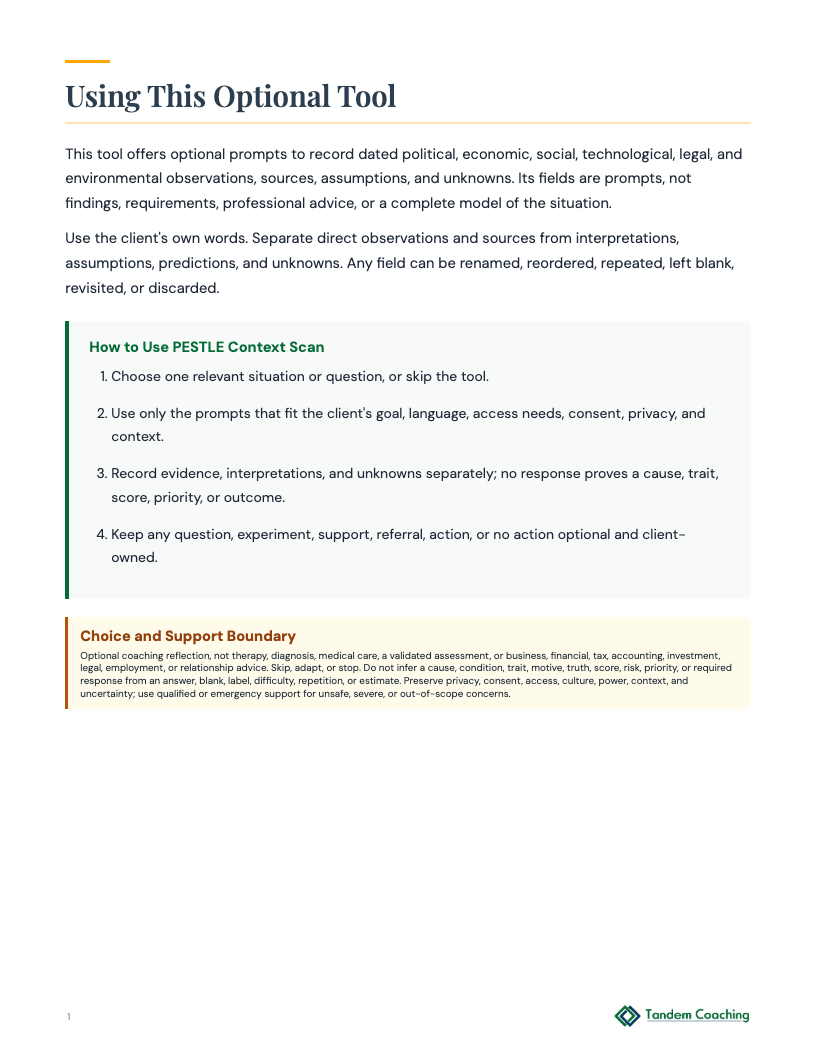
PESTLE Analysis - preview
When to Use This Tool
I focus on my industry but I miss forces in the broader environment that affect my business
I want to stress-test my strategy against political, economic, and social trends I might be ignoring
My planning is too internally focused and I want to widen the lens
How to Introduce This Tool Plus

Some clients find that a PESTLE analysis surfaces blind spots in their strategic thinking by forcing attention to political, economic, social, technological, legal, and environmental factors - would that kind of environmental scan be useful?

Browse All Pages
Interactive Preview Framework · 45+ min
Tool Classification
Domain
Executive
Type
Framework
Phase
Discovery
Details
45+ min Mid session As-needed
Topics
Leadership Accountability

For the Coaching Practitioner

Plus
Coaching Scenarios Plus
1 New GM entering an unfamiliar industry with no regulatory map
Context

A General Manager hired from consumer tech into healthcare services, 10 weeks into the role. The board brought them in for operational efficiency, but early decisions keep hitting regulatory and compliance friction they didn't anticipate. The client frames the problem as 'this organization moves too slowly' - they haven't yet considered that the environment itself constrains speed differently than their previous industry.

How to Introduce

Frame this as orientation, not strategy work. 'You keep running into walls you didn't expect. Before we build your 90-day plan, let's map the walls.' The resistance here is impatience - the client wants to act, not analyze. Name it directly: 'I know this feels like slowing down. It is. Fifteen minutes now will save you weeks of building plans that run into barriers you could have seen.' Position the PESTLE specifically as an industry translation exercise: 'You know consumer tech cold. This maps what's different about where you are now.'

What to Watch For

The Technological column will fill fast and with high confidence - that's the client's home territory. Watch the Legal and Political columns. If the entries are vague ('healthcare regulations,' 'government oversight'), the client is working from assumptions, not knowledge. Genuine engagement looks like naming specific regulations, pending legislation, or agency actions. If the client fills Economic with consumer-tech market dynamics instead of healthcare economics, they're still mapping their old industry onto the new one.

Debrief

Start with the column that took the longest. Not 'what was hard?' - that invites rationalization. Instead: 'Read me what you wrote in Legal.' Listen for specificity. Then ask: 'Who on your team could fill this column in five minutes?' That question shifts from 'I don't know this' to 'I haven't built the right information channels yet.' Follow with the cross-column connections: 'Where does a Political entry create a Legal constraint that changes what's possible in Technology?'

Flags

If the client cannot name a single specific regulation, policy, or legal constraint in their new industry after 10 weeks, this goes beyond normal onboarding gaps. The client may be operating without the advisory relationships the role requires. Severity: moderate. Response: explore whether the client has identified and connected with the domain experts (legal counsel, compliance, regulatory affairs) who should be informing their decisions. If those relationships don't exist, that becomes the coaching priority before any strategy work.

2 CEO who completes the tool in eight minutes with no gaps
Context

A CEO of a mid-market manufacturing company, coaching engagement focused on scaling the business. The client is experienced, articulate, and confident in their environmental read. They complete all six PESTLE columns quickly and thoroughly - no hesitation, no sparse areas. The completed tool looks textbook-perfect, which is the problem.

How to Introduce

This client won't resist the tool. They'll comply efficiently and produce something that looks complete. The framing needs to pre-empt that: 'I want you to do this exercise, but with a constraint. For each entry, write one thing your board would agree with, and one thing your board would push back on. I want the entries that make you uncomfortable, not just the ones you'd put in a strategy deck.' If the client asks why, be direct: 'You know your environment well. I want to find the places where your confidence might be covering a blind spot.'

What to Watch For

Speed and uniformity are the signals. If all six columns have 4-5 entries each, written in similar language, at similar specificity - the client is producing from a well-rehearsed mental model. That model may be accurate, but it's not generating new information. Look for absent entries: no mention of workforce demographic shifts in Social, no mention of supply chain environmental regulations, no mention of emerging competitors from adjacent technology. The tell is not what's wrong - it's what's missing that someone in this industry should be tracking.

Debrief

Do not start with the content. Start with the process. 'You filled this in fast. When was the last time one of these factors actually surprised you?' If the answer is 'it's been a while,' that's the conversation. Then go to each column and ask: 'What would your newest board member add to this column?' or 'What would your head of operations add that you didn't?' The goal is to surface what the CEO's seniority filters out - the signals that reach other levels of the organization but not the top.

Flags

A CEO who sees no gaps in their environmental awareness after years in one industry may have substituted pattern recognition for active scanning. This is not a coaching problem in itself - it's how expertise works. Severity: low. Response: if the client's business results support their read, the completed tool is a confirmation, not a concern. If the business is stalling or facing unexpected disruptions, the too-clean PESTLE becomes evidence that the client's model needs updating, and that's a productive coaching direction.

3 VP of Strategy discovers their risk register ignores half the PESTLE categories
Context

A VP of Strategy at a financial services firm, in coaching because the CEO questioned the rigor of their last strategic plan. The client is competent and data-driven but has been producing strategy documents that over-index on Economic and Technological factors because those are what the executive committee responds to. The client expects this exercise to confirm their thoroughness.

How to Introduce

Position the PESTLE as a completeness check, not a new framework. 'You build strategy documents for a living. This isn't teaching you something new - it's testing whether the inputs you're using cover the full field.' The resistance will come after completion, not during. When the Social, Environmental, and possibly Political columns turn out sparse, the client's instinct will be to explain why those factors are less relevant to financial services. Pre-frame: 'Some columns will fill faster than others. The interesting part isn't what you know - it's comparing where you spend attention against where you don't.'

What to Watch For

The Economic and Technological columns will be dense and specific - these are the client's professional territory. Watch the Social column: if 'workforce expectations' is absent or treated as an HR issue rather than a strategic input, the client is segmenting topics by department rather than by impact. Watch Environmental: financial services leaders often assume this column is irrelevant to their industry. If the entry is blank or says 'not applicable,' that's where the coaching conversation lives - ESG regulation, climate risk in lending portfolios, and carbon disclosure requirements are reshaping financial services.

Debrief

Put the completed tool next to the client's most recent strategic plan (or its table of contents). Ask: 'Which of these PESTLE factors appear in your strategy document, and which don't?' Let the client make the comparison themselves. Then: 'If you added the missing factors, which one would change a recommendation in your current plan?' This moves from abstract completeness to concrete strategic impact. The question that typically creates movement: 'If your CEO did this exercise independently, where would your columns differ from theirs?'

Flags

If the client dismisses entire columns as 'not relevant to our industry,' explore whether this reflects accurate prioritization or habitual filtering. In financial services, every PESTLE column has direct strategic implications. Severity: low to moderate. Response: if the client can articulate why a column has low impact with specific reasoning, that's sound judgment. If the dismissal is reflexive ('we're not a manufacturing company, environmental doesn't apply to us'), the filtering itself is the blind spot to work on.

4 Founder preparing for Series B where investors will probe market risk
Context

A startup founder (Series A, 85 employees) preparing for a Series B raise in the next 6 months. The coaching engagement is focused on executive presence and investor readiness. The founder is strong on product and technology but has been caught off-guard in investor conversations by questions about regulatory risk, labor market shifts, and macroeconomic headwinds. The client wants to 'not look stupid' in the next round of meetings.

How to Introduce

Frame as investor preparation, not strategic planning. 'Investors will probe exactly the areas where you're least prepared. This exercise maps those areas before they do.' The founder's resistance will be scope: 'I don't have time for a full environmental scan, I need to focus on the product.' Address that head-on: 'This isn't about becoming an expert in trade policy. It's about knowing enough to answer the question instead of deflecting it. Thirty minutes now will change how you show up in those rooms.' The PESTLE is useful here because it gives the founder a structured vocabulary for topics they currently handle ad hoc.

What to Watch For

The Technological column will be over-specified - the founder will write their product roadmap into it rather than external technology trends. That's telling: the client sees technology as something they build, not something that happens to them. In Political and Legal, watch for the difference between 'I know this is a risk' and 'I know the specific regulation.' Vague entries like 'data privacy laws' signal that the founder has heard the phrase but hasn't done the reading. Genuine preparation looks like naming specific bills, enforcement actions, or regulatory bodies.

Debrief

Start with the columns that have one or two entries. 'An investor asks you about political risk to your business. Read me your answer from what you wrote.' If the client can't expand beyond what's on the page, the exercise exposed the gap it was meant to expose. Then shift to cross-column: 'Which of these factors, if it changed in the next 18 months, would affect your unit economics?' This is the question investors actually ask, reframed through the PESTLE output. The founder needs to leave the session with 3-4 factors they can speak to fluently, not mastery of all six columns.

Flags

If the founder has no entries in Legal and the startup handles user data, health information, or financial transactions, this is a business risk beyond coaching scope. Severity: moderate to high. Response: the coaching conversation should name the gap directly, but the fix is operational - the founder needs legal counsel reviewing regulatory exposure, not more coaching sessions on the topic. Note whether the startup has in-house or retained legal counsel. If not, that becomes an urgent recommendation.

5 Division president whose completed PESTLE reveals they've stopped looking outward
Context

A division president at a large industrial company, 4 years in role. Coaching engagement was initiated by the CHRO after a 360 flagged 'strategic myopia' - the leader's team describes them as operationally excellent but disconnected from market shifts. The client doesn't agree with the 360 feedback and frames the problem as 'my team doesn't understand how I think about strategy.'

How to Introduce

Do not frame this as addressing the 360 feedback - the client will defend against that framing immediately. Instead: 'Before we look at the 360 data, I want a baseline. Map the external factors that are shaping your division's next 18 months.' The tool becomes a mirror the client builds themselves, before any external feedback enters the conversation. If the client asks what this has to do with the 360, redirect: 'We'll get there. First I want to see how you read the environment right now, in your own terms.'

What to Watch For

The diagnostic signal is whether the entries describe current conditions or describe the conditions from when the client first took the role. A leader who has stopped scanning externally will write entries that were accurate 2-3 years ago but miss recent shifts. Compare what's written against what's happened in their industry recently: if major regulatory changes, market entrants, or technology disruptions are absent, the client's environmental model is frozen. Also watch for entries that are actually internal operational items disguised as external factors ('need to upgrade our ERP system' in the Technology column instead of 'AI-driven predictive maintenance adopted by 3 of our 5 competitors').

Debrief

Start by asking: 'When did each of these entries become relevant to your business?' If most answers are 'a couple of years ago' or 'it's always been true,' that's the data point. Then: 'What changed in your industry in the last 12 months that isn't on this page?' The gap between the PESTLE output and recent industry shifts becomes a concrete, non-defensive way to show the client what their 360 raters are seeing. The client didn't stop being strategic - they stopped updating their inputs. That reframe moves from character ('you're myopic') to behavior ('your scanning frequency dropped').

Flags

If the completed PESTLE contains almost exclusively internal factors reframed as external ones, the client may have lost the boundary between their division and its environment. This is common in long-tenured divisional leaders whose identity has fused with their business unit. Severity: moderate. Response: continue coaching, but recognize that the 360 feedback about strategic myopia may reflect a deeper pattern of insularity. Explore whether the client's information sources have narrowed over time - fewer industry events, fewer external relationships, fewer inputs from outside the division. If so, the coaching work is about rebuilding external orientation, not just completing a worksheet.

Tool Flow Plus
Requires
  • defined scope for analysis (product line, market, or business unit)
Produces
  • six-factor external environment scan
  • named cross-column strategic implications
  • identified blind spots in leader's environmental monitoring

Pairs Well With

Executive

Operational Systems Audit

I want to audit how well my business actually operates across all major functions

45+ min Assessment
Executive

Business Vision Planner

I'm so deep in day-to-day operations I've lost sight of where I'm actually taking this business

45+ min Worksheet
Executive

Strategic Goals Planner

My 12-month goals don't connect to any longer-term vision and I want to fix that

45+ min Planner

Related Articles

Leadership Development and Succession Planning: The System

Leadership Development and Succession Planning: The System

Read article →
The Benefits of Virtual Executive Coaching

The Benefits of Virtual Executive Coaching

Read article →
AI Career Disruption by Industry: Executive Impact Guide | 2026

AI Career Disruption by Industry: Executive Impact Guide | 2026

Read article →
Coach Formation Bias: Your Own Blind Spots in Team Coaching

Coach Formation Bias: Your Own Blind Spots in Team Coaching

Read article →
Executive Coaching for Tech Leaders: The Transition Most Coaches Miss

Executive Coaching for Tech Leaders: The Transition Most Coaches Miss

Read article →
8 Top Executive Coaching Trends Future Leaders Should Know

8 Top Executive Coaching Trends Future Leaders Should Know

Read article →