Map the people who can support you and how to reach out, so you’re not carrying everything alone. Built from relationship coaching practice.
Free, print-ready PDF.
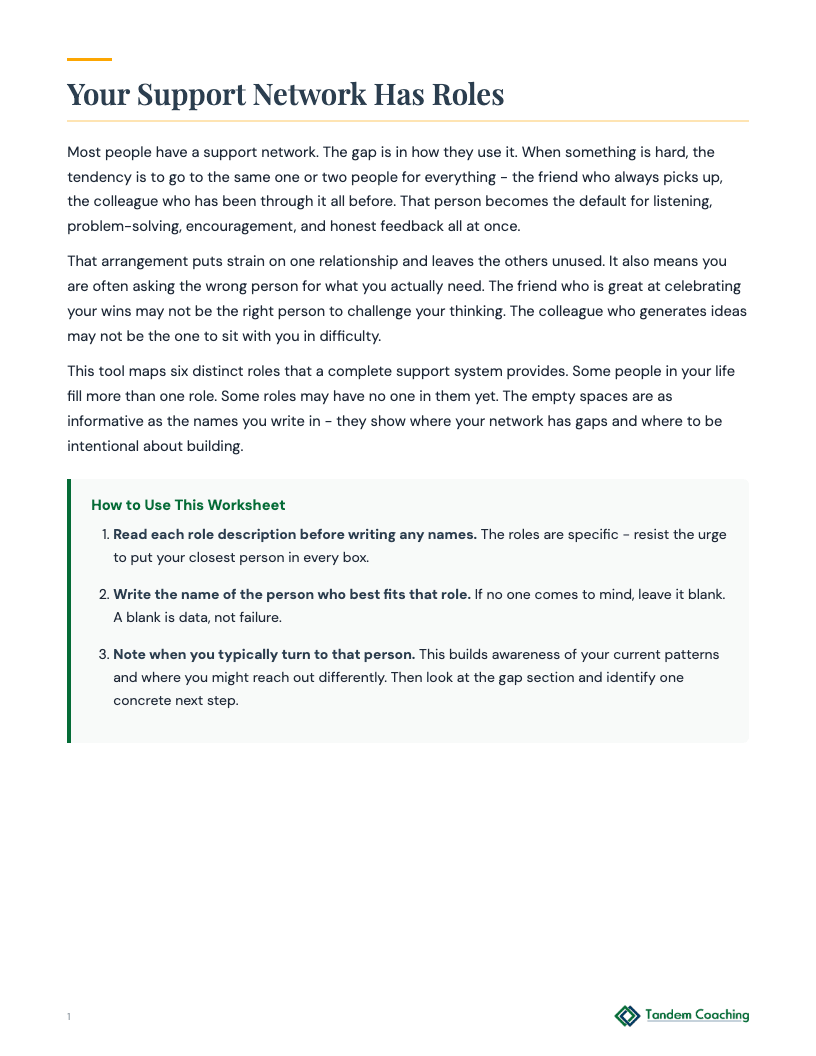
Some clients find it useful to map out who in their life plays which support role - listener, challenger, cheerleader, and so on - would that kind of relationship inventory be a valuable exercise?
Your client was recently promoted to SVP and finds the role lonelier than expected. Below them: six direct reports they now manage. Above them: a CEO who is remote and not particularly available. Peers at their level: two other SVPs they barely know. The informal network they relied on for honest input, grounding, and celebration has stayed behind at the VP level. They describe feeling like they moved up and lost their people. Every conversation now carries a power dynamic they did not have before.
Frame this as a structural question, not a personal one. 'When you moved into this role, the composition of your support network changed whether or not you did anything to change it. Let's look at what the network actually contains now versus what it needs to contain.' The resistance pattern to name: leaders who are focused on performing in a new role often treat relationship-building as something to get to later. Name that the six roles on the cards are not optional additions - they describe what a complete support system does, and some of those functions may be genuinely empty right now.
Watch whether the Challenger card gets left blank or filled with a direct report. A direct report cannot be an honest challenger - the power dynamic prevents it. If your client writes in a subordinate for Challenger or Truth-Teller, note it without judgment and ask who holds that role laterally or above. Also watch whether the entire card set ends up full of personal relationships with no professional peers - a network skewed entirely toward personal support is a common post-promotion gap that leaves leaders without anyone who understands the specific pressures of their level.
Look at the gap section first. Ask your client to read what they wrote and then ask: 'How long have you been without someone in that role?' That question surfaces how chronic the gap is versus how new. Then ask: 'In your previous role, who filled that slot?' That often identifies the specific person or type of person to look for. The useful follow-up: 'What would it take to have one conversation this month with someone who could occupy this role?'
If your client's support network maps as essentially empty across the professional domains - no challenger, no truth-teller, no grounding force at the work level - and if they are navigating a genuinely high-stakes period (new role, board relationship, organizational change), name that directly. Severity: low. Response: this tool is exactly right, but build speed - the gap section should translate into a specific outreach action before the next session.
Your client is a founder who has been running their company for four years. When you ask who they talk to when things are hard, they name one person - their co-founder and closest friend. That person is their Listener, Challenger, Cheerleader, Brainstormer, Grounding Force, and Truth-Teller all at once. The co-founder recently told your client directly that they feel overwhelmed by the emotional weight of being the person who knows everything. The pattern has been expensive for the relationship. Your client recognizes the problem but has not built any alternative.
Frame the six-role structure as load distribution, not replacement. 'The goal is not to move your co-founder out - it is to stop putting everything on one relationship. When one person holds all six roles, the relationship gets deformed by the weight.' The resistance pattern: founders often have one anchor relationship that predates the company, and the idea of deliberately spreading support across other people can feel like a dilution of that relationship's value. Name this framing explicitly - distributing support actually protects the primary relationship.
Watch whether your client can name anyone for the roles they have not been using. If the Challenger card goes blank even after reflection, the gap is real and structural - not situational. Also watch the Brainstormer card specifically: founders who have been siloed often have no one outside the co-founder with whom they think out loud. That gap compounds decision quality over time. Note if any card gets filled with a paid advisor (lawyer, accountant) - those are not support relationships in the same sense and should be flagged gently.
After all six cards are filled (or not), ask your client to step back and look at the completed set. 'If you took your co-founder's name off every card where you wrote it - what's left?' That question makes the dependency visible in a concrete way. Then ask: 'Which of these empty roles would have the most impact on how you are leading right now, if you actually filled it?' That prioritizes where to start. The specific next step: one outreach action, not a plan to build a full network.
If the co-founder's stated overwhelm is recent and the relationship is showing visible strain, this is a time-sensitive issue. A support network that has been unintentionally destructive to the primary business relationship needs attention before the relationship damage compounds. Severity: moderate. Response: continue with the tool, but also name explicitly that addressing the co-founder conversation directly may be as important as building the broader network.
Your client is well-connected - they know hundreds of people, attend three professional associations, have a strong LinkedIn network, and can get a meeting with almost anyone. What they do not have is anyone who tells them hard truths about how they are showing up as a leader. The 360 feedback they brought to coaching was positive across the board, which your client described as 'not quite right.' When asked who in their network would give them honest critical feedback, they pause for a long time and come up empty. Breadth has crowded out depth.
Frame this as distinguishing the network's surface area from its load-bearing capacity. 'You have a wide network. What we're looking at here is the structural question - which relationships in that network are actually load-bearing when it comes to your growth?' The resistance pattern: clients with large networks often conflate connection count with support quality. Some use network activity as a substitute for the deeper relationships that challenge them. Name that the Truth-Teller card is often the hardest to fill, and that its absence is usually invisible until it is needed.
Watch the Truth-Teller and Challenger cards specifically. If your client names someone for those cards with obvious uncertainty - 'I guess maybe...' or a long pause - probe the entry. 'When is the last time this person said something to you that you did not want to hear?' If no recent example surfaces, the card may be aspirationally filled rather than accurately filled. This is not a failure; it is a finding.
Start by asking your client to read the Truth-Teller entry aloud and then answer: 'Would this person tell you if you had a blind spot that was affecting your leadership? And would you hear it from them if they did?' Both questions matter. A potential truth-teller who your client would not receive criticism from is not actually filling the role. The closing question: 'What would you need to do to make this relationship safe enough for that kind of honesty to happen?'
If your client's lack of a truth-teller is connected to a pattern of surrounding themselves with deferential relationships - and if this is visible in how they build teams, select advisors, and maintain friendships - this is not just a network structure issue. Severity: low. Response: the tool is appropriate, but note whether the absence of challenge is a structural gap or a preference, and explore that distinction.
My client is going through something hard and seems to be handling it completely alone
RelationshipsI know which relationship situations I struggle with but I haven't figured out what to do differently
LifeA client who's spinning on a problem they can't solve and needs to separate what's in their control from what isn't
Step 1 of 6 in I feel like I'm navigating everything alone and I'm not sure who I can turn to
Next: Empathy Practice Worksheet → Explore all pathways →