Turn your mindset breakthroughs into a clear, step-by-step life plan with milestones and accountability, grounded in your coaching insights.
Free, print-ready PDF.
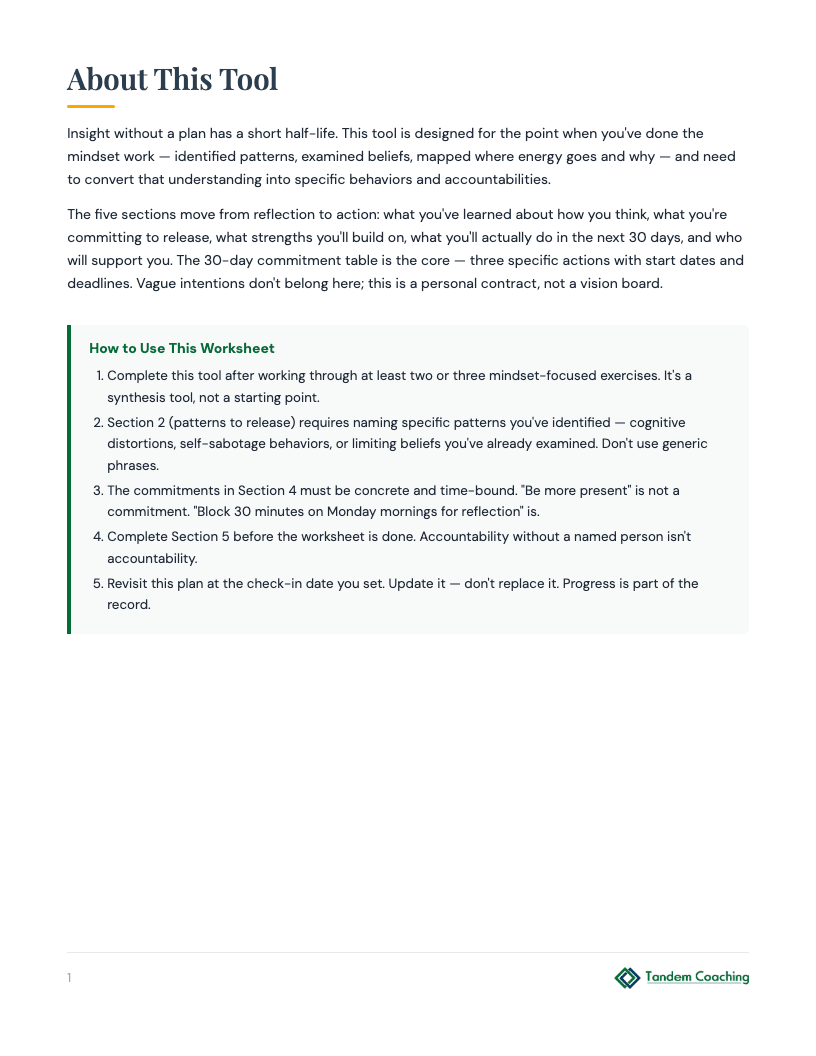
Look at your three 30-day commitments — what would need to be true for each one to actually happen, and who in your life will know you've made these commitments?
A manager who has been in coaching for six months and has developed real fluency with her patterns - she can name her avoidance behaviors, her confidence barriers, her self-limiting narratives with precision. But that fluency has become its own form of stalling: she names the patterns rather than working them. The action plan is the first tool in the engagement that forces her to translate insight into specific 30-day commitments.
Name the purpose of the tool directly. 'You've done the insight work. This exercise is different - it doesn't ask what you know about yourself. It asks what you're committing to do differently in the next 30 days. The Insights section may feel familiar. The 30-Day Commitments section is where the engagement has been heading.' The resistance here is insight fluency: she's comfortable talking about patterns but less comfortable committing to specific behavioral changes. Name it: 'Naming a pattern and committing to change it are two different things.'
Watch the 30-Day Commitments section specifically. If she populates it with statements that sound like insights ('be more aware of my avoidance when X happens') rather than behaviors ('when I notice avoidance, I'll name it out loud to my team before acting on it'), she hasn't crossed from insight to commitment. Also watch the accountability field: clients who know their patterns but resist changing them often leave accountability blank or list themselves as the only check.
Start with one commitment. 'Read me this one. If I were observing you for the next 30 days, what would I see you do differently?' If she restates the insight: 'That's the pattern. What's the behavior?' Then look at accountability: 'Who besides you will know whether this happened?' The question that creates movement: 'Which of these commitments are you most likely to do and which one are you most likely to rationalize away - and what would you need to put in place now to make the second one harder to skip?'
A client who has been in coaching for six months with strong insight capacity but persistent difficulty committing to behavioral change may have a specific aversion to the accountability and vulnerability that behavioral commitments carry. Insight is private; behavior is visible. If this pattern is clear, name it as the central work of the remaining engagement rather than continuing to build insight. Severity: moderate. Response: use the action plan to establish specific, observable commitments and introduce a brief accountability check-in structure between sessions.
A director who has done significant work examining his limiting beliefs, stress responses, and avoidance patterns. He has a detailed picture of what gets in his way. When the action plan asks him to name his strengths - the qualities he brings that support growth - he struggles. He has been in an extended problem-orientation and cannot easily shift to an asset-orientation.
Frame the Strengths section as equal in importance to the Patterns section. 'We've spent time on what gets in your way. This section asks about what you bring - the qualities and capabilities that have carried you through the hard things. Both matter for the action plan: the commitments need to be built on what you have, not just on what you're fixing.' The resistance is modesty or deficit-habituation: six months of pattern examination can make strengths feel less salient. Name it: 'You know your limitations very well. Let's see if you know your strengths as well.'
Watch whether the Strengths section produces generic language ('I'm hardworking,' 'I care about my team') or specific observations ('I maintain clarity under ambiguity,' 'I repair relationships quickly after conflict'). Generic strengths are as abstract as generic insights - they don't inform behavioral commitments. Also watch whether the strengths he names connect to the commitments he makes: a well-built action plan draws on strengths to address patterns.
Start with Strengths. 'Read me the first one. Give me a recent example of that quality in action.' Specificity requirement: if he can't give an example, the strength is aspirational rather than observed. Then connect: 'Looking at your commitments, which strength would you draw on most to follow through on this one?' That connection makes the action plan feel resourced rather than just corrective. The question that creates movement: 'Which strength have you been underusing in the area you're working on?'
A director who cannot name his strengths specifically after six months of coaching may have a wellbeing or self-regard pattern that the coaching engagement hasn't examined directly. If the Strengths section remains empty or generic after prompting, treat that as signal - not a strengths inventory problem but a self-concept question worth exploring. Severity: low. Response: continue with the action plan and name the asset-orientation gap as something to address in the final sessions.
A senior leader who is engaged, capable, and produces high-quality work in sessions. The action plan is well-constructed: specific commitments, real accountability structures, meaningful connections between insight and behavior. Then between sessions, nothing happens. The plan sits untouched. This is a between-session engagement problem, not a quality-of-plan problem.
Before completing the action plan, address the between-session pattern directly. 'We're going to build this plan together. Before we do, I want to name something: you generate strong work in our sessions and the follow-through has been inconsistent. The plan we build is only as useful as what happens after you leave. What would need to be true about how this plan is structured for you to actually use it?' That question surfaces the between-session friction before the plan is built rather than after.
Watch the accountability field specifically. Clients with between-session disengagement often list vague accountability structures ('check in with myself') or none at all. The plan needs an external accountability element - a person, a date, a specific check-in. Also watch whether the commitments she writes are genuinely doable in 30 days or aspirational in scale: aspirational commitments fail faster than specific ones, and fast failure accelerates disengagement.
Start with accountability. 'Who, specifically, is going to know whether these commitments happened?' If the answer is only her: 'What's the earliest commitment on this plan, and what would make it visible to someone else?' Then test the scale of the commitments: 'The first commitment here - walk me through what it would take to do that by next Thursday. Is it doable?' The question that creates movement: 'What's the smallest thing on this plan that, if done this week, would signal to you that this time is different from the previous cycles?'
A coaching client who consistently produces quality work in-session but disengages between sessions may be experiencing the coaching relationship as a performance context rather than a development context - she engages when she's being witnessed and disengages when she isn't. This is worth naming explicitly, not as a judgment but as a pattern with implications for what kind of accountability structure will actually work. Severity: moderate. Response: restructure the between-session component and consider a brief mid-cycle check-in format.
My client keeps going back and forth on a decision and can't move forward
LifeI tend to shut down after setbacks rather than learning from them
LifeI want to reflect on my behavior and understand where I'm owning my part and where I'm deflecting