Marketing Audit Worksheet
I have marketing activities running but I'm not sure which ones are actually working
Get This Tool
Free, print-ready PDF.
When to Use This Tool
I have marketing activities running but I'm not sure which ones are actually working
My marketing plan is really a list of things I want to do rather than a clear strategy
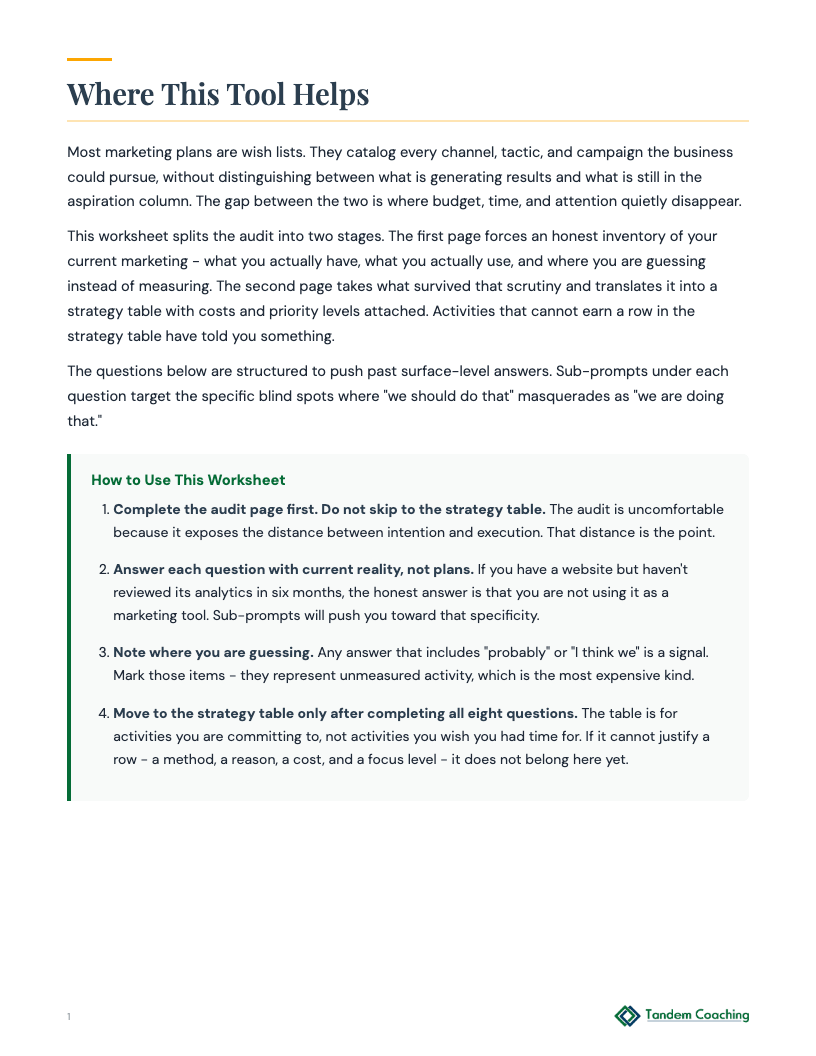
I need to get honest about where my time and budget are going in marketing versus what's producing results
How to Introduce This Tool Plus
Some clients find it useful to audit their current marketing honestly before planning next steps - separating what they're actually doing from what they intend to do tends to surface the real priorities quickly - would that kind of structured audit be a useful exercise?
Browse All Pages
Tool Classification
Domain
Executive
Type
Worksheet
Phase
Discovery
Review
Details
45+ min
Between sessions
As-needed
Topics
Leadership
Accountability
For the Coaching Practitioner
Plus
Coaching Scenarios
Plus
1 A business owner whose marketing plan is a commitment statement rather than a strategic document ▶
Context
A service business owner who produces a marketing plan each January that reads as a list of intentions: 'be more consistent on LinkedIn,' 'send monthly emails,' 'attend more events.' The plan has no measurement, no budget allocation, and no channel strategy. It signals effort without enabling diagnosis. The 8-question audit will likely surface that she's been making the same plan for several years.
How to Introduce
Frame the audit as a performance review of the current plan, not planning for the next one. 'Before we talk about what you'll do this year, let's look at what you've been doing - and more specifically, where the time and money have actually gone. Eight questions. The uncomfortable ones are usually the most useful.' The resistance will be forward-orientation: she'd rather talk about what's next than examine what didn't work. Name the pattern directly: 'If we skip the audit, this year's plan will look like last year's plan.'
What to Watch For
Watch Questions 3 and 4 (time and budget allocation). Clients who have never tracked marketing spend by channel often cannot answer these precisely - they know the total but not the breakdown. Blank or vague answers to these questions are diagnostic: the plan has been running without measurement infrastructure. Also watch the strategy table at the end: if she populates it with the same channels as last year without any examination of which ones produced results, the audit hasn't landed.
Debrief
Start with Question 2 (which activities generated the most leads) and Question 3 (where time went). 'These two together - where effort went versus where results came from - are usually where the gap lives. What do you see?' Then move to the strategy table: 'Based on the audit, what would you stop doing, and what would you do more of?' The question that creates movement: 'If you had to cut your marketing activity by half and keep only what's demonstrably working, what would you keep?'
Flags
A business owner who produces a marketing plan annually without measurement infrastructure cannot learn from execution. If the audit reveals she has no data on lead source, channel performance, or cost per client, the immediate coaching priority is to build that tracking before planning the next cycle. Severity: low. Response: name the measurement gap explicitly and establish tracking as a prerequisite to meaningful planning.
2 A founder who is resistant to the audit because he believes marketing is about relationships, not systems ▶
Context
A professional services founder who has built his business entirely through referrals and relationship. He dismisses structured marketing as transactional and believes his approach - being genuinely helpful to his network - can't be audited. He hasn't named which relationships are producing business, how frequently, or what he's doing to cultivate them systematically.
How to Introduce
Meet him where he is. 'Your view is that marketing is relationships. I'm not going to argue that. What the audit asks is: which relationships are working, what are you doing to build them, and how much of your time goes there? Relationship marketing can be just as structured as channel marketing - the question is whether yours is deliberate or ambient.' That framing keeps his identity intact while introducing the possibility that his approach could be more intentional.
What to Watch For
Watch Question 1 (target audience definition) and Question 5 (differentiation). Relationship-based marketers often have an implicit sense of who they serve but cannot state it precisely - this matters because it determines whose relationships they invest in. Also watch Question 6 (competitive analysis): clients who believe relationships are everything often haven't looked at how their competitors are positioned, which means they may be competing on the wrong dimension.
Debrief
Start with Question 1. 'Describe your ideal client specifically enough that I could find ten of them in a room.' If the answer is vague: 'Who in your current client base would you clone - and what makes them different from the clients who've been less valuable?' Then move to Question 5: 'Your differentiation in the relationship model - what do you offer that makes someone choose you over a referral to a colleague?' The question that creates movement: 'If your three best relationship sources stopped referring tomorrow, what's the plan?'
Flags
A founder who is entirely dependent on relationship referrals with no systematic marketing beyond that faces significant concentration risk. If the audit reveals that 80% of business comes from two or three referral relationships, that's not a marketing strategy issue - it's a business resilience issue that should be named directly. Severity: moderate. Response: complete the audit, then name the concentration risk and introduce the strategy table as a deliberate diversification exercise.
3 A professional who fills the strategy table with activities she's already doing rather than adjustments based on audit findings ▶
Context
A consultant who engages with the 8-question audit thoughtfully, identifies real gaps - her content isn't converting, her networking isn't targeted, her email list has stalled - and then populates the strategy table with the same channels and activities she audited. The audit produced insight; the table produced the same plan. The gap between diagnosis and adjustment is where she needs coaching.
How to Introduce
Name the purpose of the strategy table explicitly before she completes it. 'The table is supposed to be shaped by what the audit just told you. If the audit found that LinkedIn isn't producing leads, the table shouldn't have LinkedIn producing leads. We're looking for adjustments, not transcription of the current plan.' The resistance here is comfort with familiar channels: even when they're not working, they feel manageable. Unknown channels feel risky. Name the tradeoff: 'Doing what's not working is also a risk - it just feels less visible.'
What to Watch For
Watch whether the strategy table diverges from her current activity at all. If the channels in the table are identical to the ones she described in Questions 3 and 4, she hasn't used the audit. Also watch whether the 'success metric' column of the table has specific numbers or vague intentions ('increase engagement'). Clients who are not yet comfortable with measurement will fill the metrics column with activity measures (posts per month) rather than outcome measures (qualified leads per quarter).
Debrief
Compare the audit findings to the table explicitly. 'The audit said LinkedIn isn't converting. The table has LinkedIn as a primary channel. Walk me through that decision.' Let her explain it. If the explanation is comfort-based, name it: 'You know that channel. That's different from it working.' Then focus on one cell in the table: 'If you added one channel you've never tried and removed one that isn't producing, what would change?' The question that creates movement: 'What would this table look like if you built it entirely from what the audit told you, without defaulting to what you know?'
Flags
A consultant who cannot translate audit findings into adjusted strategy may be in a risk-avoidance pattern where channel changes feel more threatening than continued underperformance. If this is consistent with how she responds to other performance data, name the pattern. Severity: low. Response: continue with the strategy table, and introduce a 90-day trial of one new channel as a contained experiment rather than a permanent commitment.
Tool Flow
Plus
Requires
- existing marketing activities and channels to audit
→
Produces
- honest inventory of active marketing activities
- prioritized marketing strategy table with costs
Pairs Well With
Life
Decision Evidence and Options Grid
Use this framework to structure a conversation about accountability and time management while keeping interpretation with the client.
Why it pairsOnce the audit surfaces which activities to cut or scale, use this to move your client from identified options to a committed choice with a deadline.
LifeSWOT Analysis (Guided)
A client wants to use SWOT Analysis (Guided) as an optional reflection
Why it pairsThe audit's honest inventory becomes raw material here - map your client's working channels as strengths and the gaps as weaknesses before setting direction.
ExecutivePESTLE Context Scan
Use this framework to structure a conversation about leadership and accountability while keeping interpretation with the client.
Why it pairsAfter auditing what the client controls, this surfaces external forces - regulatory shifts, economic trends - that explain why some channels are underperforming.
Related Articles


How to Create a Leadership Development Plan That Drives Real Change
Read article →
Executive Presence in Virtual Meetings: Where the Gaps Get Harder
Read article →
Executive Coaching Tools: The Assessments and Frameworks That Drive Results
Read article →
Leadership Development and Succession Planning: The System
Read article →