Stop brute-forcing every weakness; map which limits to accept, bypass, or train with a structured coaching framework grounded in behavioral science.
Free, print-ready PDF.
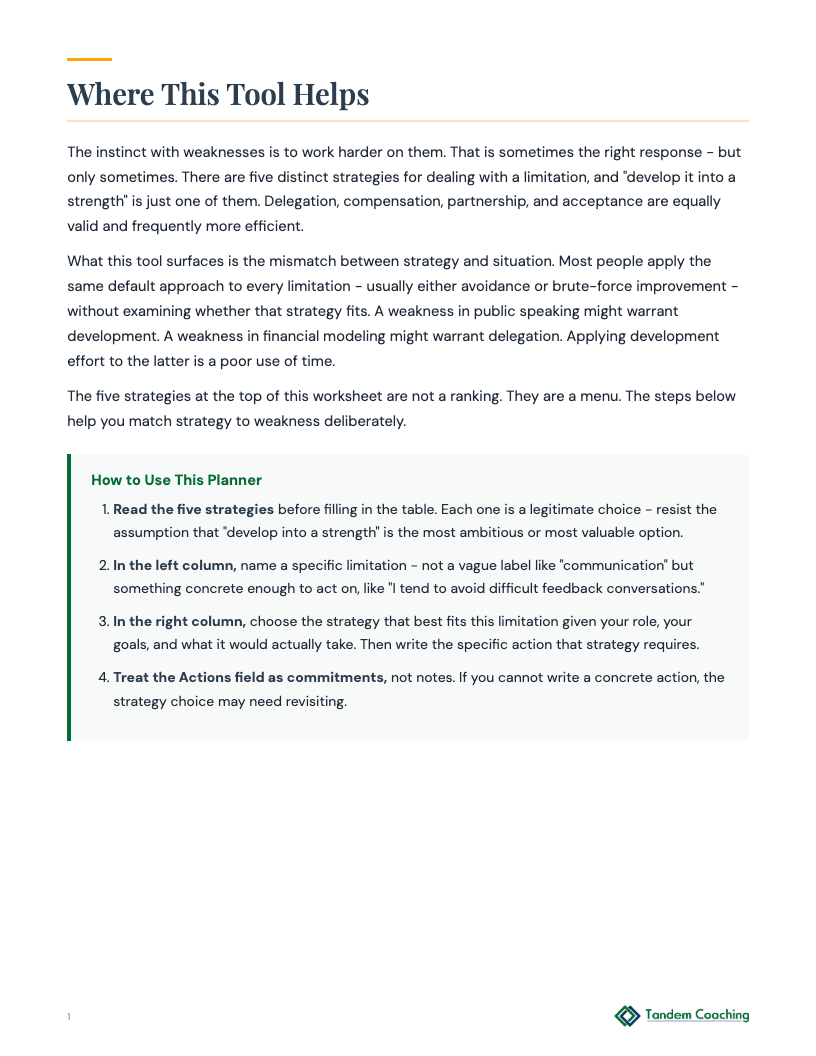
When you reviewed the five strategies, which one do you rely on almost exclusively — and which one have you rarely considered but might actually fit something on your list?
A manager on a high-growth product team consistently explains missed targets, missed promotions, and missed opportunities through external factors: budget cuts, reorganizations, a manager who didn't advocate for him. In coaching he presents these accurately — the external factors are real — but never examines whether his own response to those constraints contributed to outcomes. He wants coaching on 'navigating organizational politics.'
Frame this as a strategy expansion tool, not a self-blame exercise. 'Before we talk about how to navigate constraints, I want to map what you actually do when you hit one. This worksheet looks at five strategies for working with limitations — not around them, but with them. Let's see which of these you're already using and which ones aren't in your repertoire.' The resistance to watch for: clients who have built a coherent narrative around external attribution often experience limitation-response analysis as a challenge to that narrative. Name it neutrally: 'We're not questioning whether the constraints are real. We're looking at what room exists inside them.'
The five strategies each represent a different relationship to limitation: reframing it, working within it, redefining what success looks like within it, building capability around it, or accepting it and adjusting the goal. Notice which strategies the client documents in detail versus which ones he completes minimally or skips. Thin or blank entries in the 'redefine' and 'accept' categories often signal the client hasn't yet distinguished between 'the constraint is unfair' and 'therefore I have no options.'
Start with the strategy section he completed most thoroughly. 'Walk me through this one.' Then ask about the thinnest section: 'What would have to be true for this strategy to be worth trying in your current situation?' The goal is not to get him to adopt a strategy he's dismissed but to surface the belief that makes it unavailable to him.
If the client's response to every strategy is 'that won't work here' and he can articulate a specific reason for each — the organization is too political, the leadership won't support it, etc. — the beliefs about this environment may be functioning as a closed system. Severity: low to moderate. Continue coaching but consider whether the assessment of the environment matches what you're hearing across multiple sessions, or whether the narrative is filtering evidence.
A director of operations has a history of strong initiative: she starts projects with significant energy, builds initial momentum, and then either hands them off prematurely or quietly stops tracking them when they hit bureaucratic or interpersonal friction. Her 360 feedback uses the words 'lacks follow-through.' She disagrees with this characterization and believes the projects she ended were correctly deprioritized. She wants coaching on 'strategic prioritization.'
Use the five-strategy framework as a test rather than a prescription. 'I want to look at one of the projects you ended — not to relitigate the decision, but to map what strategies you actually had available when it got difficult. We'll use this framework to see which ones you tried and which ones weren't in play.' The resistance here is usually around the framing of 'follow-through' — clients who've been labeled this way often experience any examination of the pattern as confirming the label. Be explicit: 'This isn't about your follow-through. It's about your options map when you hit friction.'
Watch how she applies the strategies to the specific stopped project. Does she apply multiple strategies to earlier phases — when the project was moving — and fewer to the friction point? If strategy options contract when friction appears in the narrative, that's the coaching signal. Also watch whether the 'reframe' strategy shows up as genuine reframing versus rationalization of the decision to stop.
Start with: 'At the moment you decided to step back from this project, which of these five strategies had you tried?' Then: 'Which ones did you consider and reject? What made them seem unlikely to work?' This mapping usually reveals either a genuine strategic assessment or a premature foreclosure. The question that opens the distinction: 'What would have needed to be different for you to try [strategy X] here?'
If the client cannot identify any moment in the stopped project where she attempted to work with the friction rather than around it — if the narrative goes directly from 'encountered obstacle' to 'deprioritized' — this pattern may be more rigid than situational. Severity: low. Continue coaching, but make the pattern itself explicit: 'I notice the narrative goes from friction to deprioritization without a problem-solving phase in between. Is that accurate?'
A first-time director, recently promoted from a senior individual contributor role, is six months into a mandate to improve cross-functional collaboration in a function known for siloes. He has tried several approaches — working group, shared OKRs, scheduled syncs — and reports that none of them are working. He describes the situation as intractable and is considering requesting a reassignment. His manager believes the constraints are real but the options haven't been exhausted.
This tool is most useful here when framed as an options inventory rather than a mindset exercise. 'You've tried three things. This framework gives us a way to look at whether all five categories of response to a constraint have been explored or whether the approaches you tried were all in the same category.' This is important framing: it positions the tool as analytical rather than therapeutic, which is usually more accessible to clients who are in problem-solving mode.
Watch which of the five strategies his attempted approaches fall into — most first-time leaders in this situation try variations of the same strategy (usually working within the constraint through structure: meetings, frameworks, processes) without exploring the others. If all three of his attempts are in the same category, that's a concrete and non-threatening observation to surface. Also watch whether he can apply the 'redefine' strategy — the ability to redefine what success looks like inside the constraint is a capability that often develops with more leadership experience.
Map his three attempts to the strategy framework first: 'Looking at the five strategies, which category does the working group fall into? The shared OKRs?' Once mapped, the gap is visible without interpretation: 'You've tried three things, all in the same category. What's in the categories you haven't tried?' This sequence avoids the evaluation problem — you're not saying his attempts were wrong, just that they were similar.
If the client's conclusion that the situation is intractable is accompanied by strong statements about the people involved — specific colleagues who are 'unwilling to change,' 'playing politics,' or 'not bought in to the mission' — explore the interpersonal dynamics before proceeding. Severity: low. The tool is still appropriate, but the constraints he's working with may include relationship dynamics that the five-strategy framework won't address on its own.
Client talks about wanting to grow but responds to setbacks with fixed patterns of self-protection
LifeA client whose distress about a situation is being driven by their interpretation of it, not the situation itself
WellnessI know I overreact sometimes but I can't predict what sets me off