ABCDE Model Worksheet
Identify the beliefs driving your distress and reframe them with the evidence-based ABCDE method from cognitive behavioral therapy.
Get This Tool
Free, print-ready PDF.
When to Use This Tool
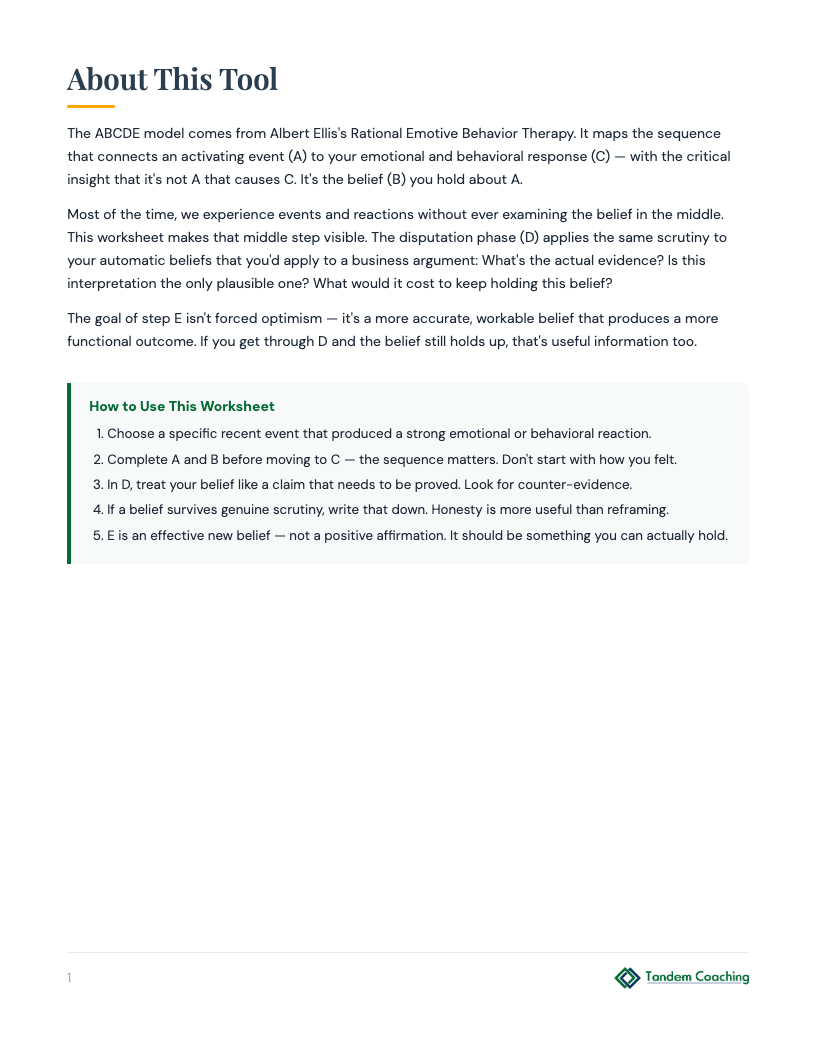
A client whose distress about a situation is being driven by their interpretation of it, not the situation itself
Someone who knows the Ellis REBT model but needs a structured format to apply it to a real situation
A professional who reacts strongly to adversity and wants a cognitive tool for processing it differently
How to Introduce This Tool Plus
Pick a specific situation where your emotional reaction felt out of proportion or where your thinking afterward kept looping. That's the starting point for the A in this model.
Coaching Tool Disclaimer
This tool is designed for coaching contexts, not clinical use. If you or your client is in crisis, contact the 988 Suicide and Crisis Lifeline (call or text 988) or Crisis Text Line (text HOME to 741741).
Browse All Pages
Tool Classification
Domain
Life Coaching
Type
Framework
Phase
Action
Reflection
Details
30 min
Between sessions
As-needed
Topics
Mindset
Resilience
For the Coaching Practitioner
Plus
Coaching Scenarios
Plus
1 VP who replays every critical conversation as evidence of incompetence ▶
Context
A VP of Operations has been with the company eight years and recently took on a broader portfolio. She describes a recurring pattern: after difficult conversations with the CEO or board members, she replays them for days, extracting every moment where she stumbled or was contradicted. She believes her problem is preparation — she thinks if she had better data going into those meetings, the conversations would go differently.
How to Introduce
Frame this as a diagnostic tool rather than a therapy exercise. 'We're going to trace one specific conversation from what happened to what you concluded from it — not to feel better about it, but to see where the interpretation is doing work that the facts can't support.' The resistance here is usually in the D step: clients who are high-performers often treat their own harsh self-assessment as a form of rigor. Name it: 'You may find yourself defending your original conclusion. That's useful information — watch for it.'
What to Watch For
Pay attention to what the client writes in B (Belief). High performers often write factual-looking statements that are actually interpretations: 'I was unprepared' reads as fact but is a judgment. If B and A are nearly identical — same language, same events — the client hasn't yet separated the activating event from their story about it. The D step is where avoidance appears most visibly: vague disputes ('maybe it wasn't that bad') vs. specific evidence-based challenges ('I prepared the appendix they referenced, so preparation wasn't the variable').
Debrief
Start by reading A and B aloud side by side. Ask: 'What's the difference between these two?' If the client struggles to name one, that's the work. Then move to E — not as a feel-good reframe but as a test: 'What would you actually do differently this week if you held the new belief instead of the original?' A vague E means the D step isn't complete.
Flags
If the client's B step contains language that implies stable, global self-assessment — 'I'm not suited for this level,' 'I've always struggled with this' — the activating event is functioning as confirmation of a pre-existing belief about identity, not just a situational judgment. Severity: moderate. Continue coaching but probe the history of that belief before moving to disputation. Disputing a core identity belief without grounding work can feel invalidating.
2 Senior manager whose catastrophic thinking shuts down risk-taking before proposals are made ▶
Context
A senior manager on a technology product team has a pattern his director has named: he generates solutions in private but rarely brings them forward. When asked why, he says the ideas need more development. In coaching, he describes an immediate sequence after generating any idea: a rapid mental simulation of everything that could go wrong, followed by the conclusion that the risks outweigh the opportunity. He thinks his problem is a lack of creative confidence.
How to Introduce
Position this as a process-mapping tool rather than a self-assessment. 'We're going to slow down what happens between the moment you have an idea and the moment you decide not to bring it forward. You already know the endpoint — we're looking at what happens in between.' The resistance in this scenario is typically in the C step: the client experiences the emotional consequence (anxiety, deflation) as a reasonable response to the actual risk, not as a product of the belief. Help him see C as output, not input: 'Your feeling that the idea is too risky may be the consequence, not the evidence.'
What to Watch For
Watch whether the client can name a specific B (Belief) or whether he describes C (Consequence) as if it were B. 'I felt like it would fail' is a consequence; 'Ideas that aren't fully developed will be rejected and that reflects on my judgment' is a belief. If B and C blur together throughout the exercise, the client is working from an automated sequence he has rarely examined. The D step will likely feel unfamiliar — he may resist challenging beliefs that have functioned as protective.
Debrief
Start with C. 'Walk me through what you felt and did the last time you didn't bring something forward.' Then trace backward to B. The question that opens this: 'What did you tell yourself about the idea in the moment before you set it aside?' From there, move to D — not 'was the belief wrong' but 'what would you need to believe about your idea to bring it to your director?'
Flags
If the client's beliefs in B cluster consistently around judgment by others — 'they'll think I'm not ready,' 'they'll question whether I should be in this role' — the risk-avoidance may be driven by identity threat rather than assessment of the idea. Severity: low to moderate. The coaching work remains appropriate, but the underlying concern about role legitimacy is worth naming explicitly in a future session.
3 Director processing a public failure and unable to move past the narrative he has constructed ▶
Context
A director of customer success was the sponsor of a platform migration that went significantly over timeline and damaged a major client relationship. Six months later, he is still describing the event in nearly identical terms every time it comes up — the same sequence, the same moments of failure, the same conclusion about what it revealed about his leadership. His manager has told him the team has moved on; he has not.
How to Introduce
This is a good fit when the client is stuck in the C step — the emotional consequence has become the story rather than a response to it. Frame accordingly: 'I want to look at this situation with a specific structure. Not to relitigate it, but because when the same story comes up consistently in the same form, it usually means one of the beliefs underneath it hasn't been examined yet.' The resistance is often named as loyalty to the people who were affected: 'I owe it to them to acknowledge what happened.' Name that: 'We can hold accountability and examine the belief at the same time — one doesn't require abandoning the other.'
What to Watch For
Notice whether the B step the client writes reflects beliefs about capability ('I made a poor judgment call on the resourcing') or beliefs about character ('I'm the kind of leader who lets people down'). The distinction matters for D: a capability belief can be disputed with evidence; a character belief requires a different kind of examination. Also watch E: if the client's new effect is 'I would feel less guilty' rather than 'I would do something differently,' the work hasn't produced a behavioral change — it has produced emotional relief, which is not the tool's purpose in a coaching context.
Debrief
Start with B, not A. 'Before we look at the event itself, what have you concluded about yourself as a result of it?' Let the client write without editing. Then examine each belief in B with a single question per belief: 'What's the strongest case against this?' Avoid moving to D until B is fully named — clients often jump to disputation before they've articulated the belief clearly.
Flags
If the client's B step contains beliefs about being 'fundamentally' something — a fundamentally poor decision-maker, fundamentally unsuited to lead large projects — and these beliefs predate this event, the current situation may be activating a deeper pattern that has been stable for years. Severity: moderate. Continue coaching, but note the pattern and assess whether the ABCDE work is reaching the level the client needs or whether a more sustained exploration of the underlying belief system is warranted.
Tool Flow
Plus
Requires
- named belief driving a disproportionate reaction
- basic familiarity with cognitive A-B-C sequence
→
Produces
- belief disputation record with evidence for and against
- accurate replacement belief grounded in evidence
- predicted emotion and behavior shift from new belief
Pairs Well With
Life
Confidence Evidence and Learning Notes
Use this worksheet to explore identity and mindset and turn the client’s observations into one optional next step.
Why it pairsOnce a distorted belief is replaced, this builds the evidence inventory that keeps the accurate belief from reverting.
LifeCuriosity Noticing Walk
A client wants to use Curiosity Noticing Walk as an optional reflection
Why it pairsAfter the cognitive work of disputation, this moves the client from analysis into open-ended observation to prevent re-entrenching the same patterns.
LifeSetback Learning Action Plan
A client wants to use Setback Learning Action Plan as an optional reflection
Why it pairsWhen the distorted belief was triggered by a specific setback, this converts the corrected belief into a concrete do-differently action plan.
Related Articles


Sylvia Hewlett’s Executive Presence Model: What It Gets Right, Where It Falls Short
Read article →
Do You Have to Tell Clients You Use AI? Standard 2.5 in Practice
Read article →
Information Processing: The Perceptual System Your Client's Formation Installed
Read article →
AI Augmentation vs. Substitution: Where the Line Is in Your Coaching
Read article →