Career Vision Worksheet

Clarify the career you want beyond your current role with a coach-tested worksheet that turns your experience into a clear target.

Worksheet · 30 min · Print-ready PDF · Free download

Get This Tool

Free PDF - professionally formatted, ready to print or fill digitally

Preview Worksheet · 30 min
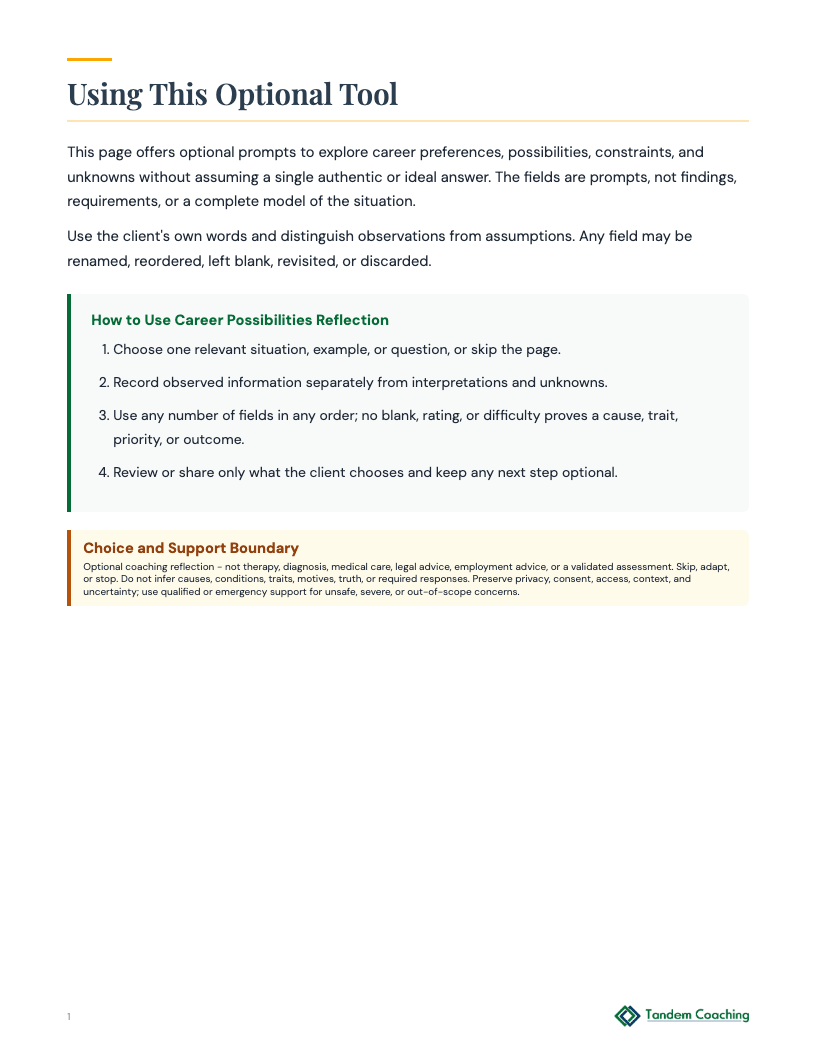
Career Vision Worksheet - preview
When to Use This Tool
A client knows their current job well but has never clearly named what career they actually want
Someone answering seven questions about what they love, avoid, do naturally, and dream about
Getting an unconstrained vision on paper before applying any realistic filters to it
How to Introduce This Tool Plus

When you take away what you think is realistic — what does your career actually want to look like?

Browse All Pages
Interactive Preview Worksheet · 30 min
Tool Classification
Domain
Career
Type
Worksheet
Phase
Discovery
Details
30 min Between sessions
Topics
Values Identity Career Transition

For the Coaching Practitioner

Plus
Coaching Scenarios Plus
1 The 20-year marketing veteran who has never once asked himself what he actually wants
Context

A 47-year-old VP of marketing at a specialty retail company has been in the industry for over twenty years. He's good at the work. He chose it partly by accident and mostly by momentum — an early job that turned into a career track before he examined whether it was the right one. He came to coaching because he 'feels like something is missing' but cannot name what. He has never completed an exercise like this worksheet because every career decision he's made has been in response to an opportunity, not a vision. The seven questions produce the first written answer he's ever given to the question of what he actually wants, unconstrained by what's available.

How to Introduce

Frame this as a first draft, not a final answer. 'You've built a career by responding to what showed up. This worksheet does something different — it asks you to describe what you'd design if options weren't the filter. Seven questions, each one asking you to look at a different angle of what work means to you: what you love, what you avoid, what comes easily, what you dream about. I want you to answer without editing for feasibility. The realistic filter comes later — not in this exercise.' The resistance this scenario invites is the 'what's the point' deflection: he may have trained himself not to want things he can't have. Name it: 'Some people skip this because the gap between the vision and the current reality feels painful. I want you to stay with the discomfort long enough to write all seven answers.'

What to Watch For

Watch for his answers to the 'activities to avoid' section to be more vivid and specific than his answers to the 'what you love' section — this is common with clients who have been in misaligned roles for a long time. They know what they hate before they can access what they love. The contrast between those two sections is itself useful coaching data. Also watch for his natural strengths section to describe things he's been rewarded for professionally rather than things he does easily that others struggle with. The distinction matters: rewarded strengths may be different from natural strengths, and the gap between them often explains the 'something is missing' feeling.

Debrief

Start with the unconstrained vision. 'Read me the description of your ideal career — the version where nothing is a constraint.' Then ask one question: 'Of everything you wrote, what surprised you most?' The surprise is usually the place where the authentic answer broke through the habitual answer. Then: 'What percentage of your current role overlaps with the vision you just described?' That arithmetic is the coaching opening. Close with: 'You said you didn't want to filter for feasibility. Now that it's written — what part of this is actually more feasible than it first looks?'

Flags

Array

2 The client who answers every career question with what she thinks the coach wants to hear
Context

A 33-year-old project manager at a government contracting firm has been in coaching for six sessions. She is cooperative, articulate, and agreeable. She has not once said anything surprising. Every answer fits a narrative of a motivated professional moving toward clarity. Her coach suspects she has been producing content for the coaching relationship rather than investigating herself. The Career Vision Worksheet — specifically the 'what I naturally avoid' and 'what I dream about' sections — is assigned not as a career exercise but as a diagnostic: if she fills all seven questions with professionally appropriate content, the pattern is confirmed and worth naming.

How to Introduce

Frame this as a private document. 'This worksheet is for you, not for me. I want you to write it as if I'm not reading it — answer the questions for yourself, not for a coach. Specifically, the last two questions — what you dream about doing, and what you most want to avoid — those are the ones I want you to answer honestly, even if the answer doesn't make you look ambitious or together.' The instruction signals that safety answers are being explicitly declined. If she still produces them, that's useful information. If she doesn't, the authentic answers are the starting point for real coaching work.

What to Watch For

Watch for the 'what I dream about' section to contain either a specific, somewhat embarrassing aspiration (writing, art, owning a bakery, working internationally) or to be conspicuously vague. The specific and embarrassing answer is the honest one — guard against the temptation to rush past it just because it's unexpected. Also watch for the 'activities to avoid' section: if she lists only task-level preferences ('I don't like administrative work') rather than environment or relationship preferences, she's still operating at the surface. The deeper avoidance patterns — isolation, performance pressure, ambiguity, authority conflict — are what this section is designed to surface.

Debrief

Don't start with what she wrote. Start with the process: 'When you were filling out the dream section — did you write what first came to mind, or did you revise it?' If she revised it, ask what the first version said. The edit is often the real answer. Then go to the natural strengths section: 'You listed these three things. Which one did you almost not write because it seemed too obvious or too modest?' That question often produces the most accurate self-knowledge in the worksheet. Close with: 'Looking at all seven sections together — what does this tell you about what you actually want that you haven't said out loud yet?'

Flags

Array

3 The burned-out physician considering a complete career pivot with no idea where to start
Context

A 51-year-old internal medicine physician at a large health system has reached the end of his capacity for clinical work. He has not left yet — he has too much financial, credential, and identity investment in medicine to exit lightly — but he came to coaching in crisis. He cannot envision staying and cannot envision leaving. He has never asked what career he would want if medicine were not the container, because medicine has been the container for thirty years. The Career Vision Worksheet is assigned not to resolve the crisis but to create the first written answer to a question he has never asked himself.

How to Introduce

Frame this as a beginning, not a solution. 'You've been in a system where the question 'what do you want your career to be?' stopped being available to you in your early twenties — the track answered it before you could. This worksheet opens the question back up. Seven prompts. I'm not asking you to decide anything or leave anything. I'm asking you to write what you notice when you look at each question without medicine as the frame.' The 'what I dream about' and 'what I do naturally that others struggle with' sections are the most useful for this client — they often surface transferable capabilities he has been using as a physician but has not seen as separable from the medical context.

What to Watch For

Watch for his natural strengths to include diagnostic pattern-matching, communication in high-stakes situations, and complex systems navigation — all of which are transferable far outside medicine and may already be in demand in healthcare adjacent industries, consulting, or executive coaching. If those appear, name them as transferable explicitly. Also watch for the 'what I dream about' section to be the hardest question for him — he may have genuinely suppressed non-medical ambition for so long that the question feels alien. That suppression is worth naming without forcing an answer. A blank answer to this question is itself useful data.

Debrief

Start gently. 'Walk me through what writing this was like. Where did you get stuck?' The experience of filling it out often tells you more than the content at this stage. Then go to natural strengths: 'You listed these things as things that come easily to you. Do any of them exist only in medicine — or could you see them in a different context?' That question tests whether he's identified role-specific skills or transferable capabilities. Close without pressing for a decision: 'This isn't a plan yet. What does it feel like to have written this down — even if nothing is resolved?'

Flags

Array

Tool Flow Plus
Requires
  • None - standalone tool
Produces
  • unconstrained ideal career written description
  • named natural strengths others struggle with
  • identified career activities to avoid
  • raw career vision statement for coaching

Pairs Well With

Life

Ikigai

Client is successful by external measures but cannot articulate why the work feels hollow

30 min Framework
Life

Ikigai Discovery

A client feels successful but unfulfilled and wants to understand why

45+ min Framework
Career

Career Reflection Journal

A client feels stuck in their career but isn't sure what they actually want

45+ min Worksheet

This tool is part of a coaching pathway

Step 1 of 6 in A client knows their current job well but has never clearly named what career they actually want

Next: Networking Strategy Planner → Explore all pathways →

Related Articles

AI Opportunity Evaluation Framework for Executives | 3 Filters

AI Opportunity Evaluation Framework for Executives | 3 Filters

Read article →
Executive Career Reinvention: When Starting Over Makes Sense

Executive Career Reinvention: When Starting Over Makes Sense

Read article →

Executive Job Automation Risk: The PURPOSE AUDIT™ Framework

Executive Job Automation Risk: The PURPOSE AUDIT™ Framework

Read article →
Chief AI Officer Career Path: Is CAIO Right for You?

Chief AI Officer Career Path: Is CAIO Right for You?

Read article →
Executive Transition Runway Calculator | How Long Can You Really Last?

Executive Transition Runway Calculator | How Long Can You Really Last?

Read article →
4 Executive Career Paths in the AI Era | TRANSITION BRIDGE™ Framework

4 Executive Career Paths in the AI Era | TRANSITION BRIDGE™ Framework

Read article →