
Hopes & Dreams - Part Two
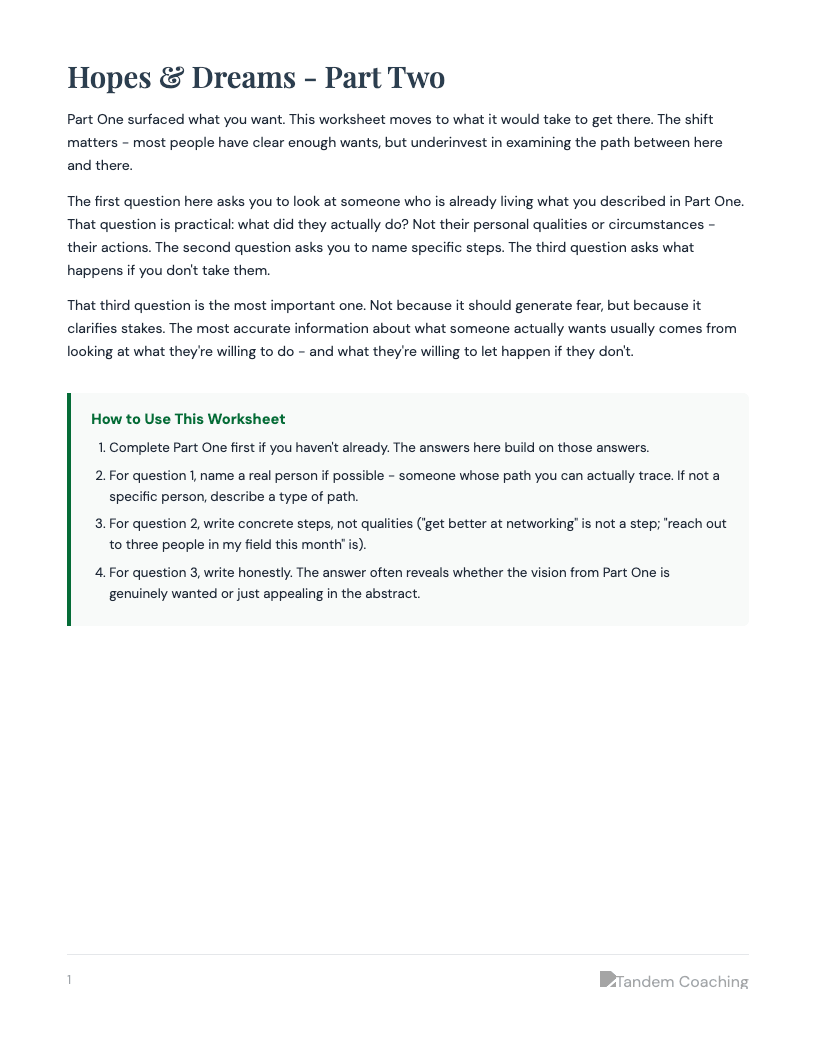
Clarify what success looks like 5 years from now with guided prompts and structured reflection used in life coaching sessions.
Get This Tool
Free, print-ready PDF.
When to Use This Tool
A client wants to define what success looks like in 5 years
Exploring the cost of staying where you are
Building a model of someone who already has what you want
How to Introduce This Tool Plus
What does your life look like if nothing changes from today — and what would it look like if it changed in exactly the way you hope?
Browse All Pages
Tool Classification
Domain
Life Coaching
Type
Worksheet
Phase
Goal Setting
Action
Details
30 min
Mid session
As-needed
Topics
Accountability
Identity
Mindset
For the Coaching Practitioner
Plus
Coaching Scenarios
Plus
1 The mid-career client who has stopped imagining forward ▶
Context
Client is competent, professionally stable, and has quietly stopped projecting a future they want. They manage well, perform well, and have internalized the next step on an established path — promotion, another role in the same sector — without examining whether it is a path they chose or one they fell into. The 'who's living your dream' question is designed to restore imaginative permission.
How to Introduce
Frame this as a reference point exercise, not vision work. 'I want to borrow someone else's life for a few minutes — not to copy it, but to use it as a mirror. Who do you look at and think: that is what I want? It doesn't have to be rational or realistic. Just someone who has something you want.' Clients at this career stage often resist because naming admiration feels like dissatisfaction, which feels like ingratitude. Name the resistance: 'Noticing what you want doesn't mean rejecting what you have. It means giving yourself full information.'
What to Watch For
If the client cannot name anyone — 'I don't really compare myself to others' — watch whether this is genuine equanimity or defended contentment. The distinction shows up in other answers: genuine equanimity tends to coexist with clear forward direction; defended contentment tends to coexist with vagueness about what comes next. Also watch the five-year cost of inaction section: clients who minimize or skip the cost are signaling that the status quo feels safer than the dream, regardless of what they have written above.
Debrief
Start with the model they identified. 'What specifically does [person] have that you want? Not their life — the specific thing.' Force precision here because admiration is often bundled: the client admires three different things about the same person and confuses them. Once specific, ask: 'Which of these steps have you already taken and stopped? Which haven't you started?' The debrief centers on the gap between the model and the client's current path.
Flags
- Low
Client identifies a model whose life represents a fundamentally different set of values or circumstances than the client's — a different family structure, a different country, a different economic position — and cannot separate what they genuinely want from the fantasy of a different life entirely.
Response: Acknowledge the aspiration and help the client extract the transferable elements: 'What is it about [model's life] that appeals to you that could exist in your actual life?' This moves from fantasy to actionable direction.
2 The client who has postponed personal ambitions through successive life stages ▶
Context
Client has a clear picture of what they wanted before each major life stage — before children, before the career pivot, before the relocation — and has been progressively deferring it. The dream is not gone; it is in a holding pattern with increasingly distant timelines. The cost of inaction question is the intervention that makes deferral visible.
How to Introduce
Frame this as an inventory, not a plan. 'I want to understand what you've been carrying forward — the things you've told yourself you'll do when the timing is better. Not to pressure you, but to get a clear picture of the cost of waiting.' Clients in this pattern often resist by listing the legitimate reasons why now is not the right time. Acknowledge them, then redirect: 'Those reasons are real. The question I'm asking is separate from them — what has waiting cost you so far?'
What to Watch For
Watch the five-year cost of inaction section. Clients who are genuinely at peace with deferral write low-stakes costs — 'I might miss the optimal timing.' Clients who are not at peace write high-stakes costs — 'I will have spent another five years on something I don't care about.' The emotional charge in the language is diagnostic. Also watch for clients who fill in the steps section with the same steps they wrote five years ago and have not taken.
Debrief
Start with the cost of inaction they wrote. Read it back to them: 'You wrote [exact words]. Is that accurate?' If they confirm it, ask: 'How much longer is that cost acceptable?' That question puts a timeline on a decision the client has been treating as open-ended. The answer — even a vague one — creates an accountability that was not previously present.
Flags
- Moderate
Client's cost of inaction section includes language about health ('if I wait much longer my health won't allow it') or relationship impact ('my children will be gone and I will have worked for something I didn't want'). These are irreversible loss framings, not lifestyle trade-offs.
Response: Name the irreversibility: 'What you've written suggests this is time-sensitive in a way that some goals aren't. Does that change the urgency for you?' The client may be ready to act but have been treating this as negotiable. The coaching question is whether they want to treat it as a constraint or a catalyst.
3 The client who cannot distinguish their dream from someone else's ▶
Context
Client describes a compelling future picture — significant success in a particular domain, specific lifestyle markers — but when examined, the picture was assembled from external sources: a parent's expectation, an industry's definition of success, a peer group's visible aspirations. The tool's question 'who is living your dream?' surfaces the borrowed nature of the dream when the client names someone they have been told to admire rather than someone they genuinely do.
How to Introduce
Frame this as a source check before a goal check. 'Before we plan toward this, I want to understand where it came from. Not whether it's the right goal, but whose voice is loudest when you imagine it.' This is a delicate introduction — clients who have been working toward an externally defined dream often feel implicitly criticized when the source is named. Frame it as curiosity, not diagnosis: 'I ask because goals rooted in someone else's picture are harder to sustain through the difficult parts.'
What to Watch For
The person the client identifies as living their dream is diagnostic. If they name a parent, a mentor, or a figure explicitly endorsed by their family or culture — rather than someone they discovered independently — the borrowed quality of the dream is more likely. Also watch the steps section: steps the client finds genuinely energizing tend to be described with specificity; steps they feel they should take are often described in the passive voice or with hedging language.
Debrief
After completing the tool, ask: 'If no one who matters to you would ever know whether you pursued this, would you still want it?' The answer to that question tells you more than anything written on the worksheet. The debrief then moves from whether the goal is theirs to what happens if it is partially theirs — which elements are authentic and which are borrowed.
Flags
- Moderate
Client reveals during the exercise that the dream they have been working toward for years was originally someone else's — and shows signs of grief or disorientation at recognizing this.
Response: Slow down and acknowledge what just happened. 'That's a significant thing to recognize. I don't want to rush past it.' The coaching work that follows is not about finding a new goal quickly; it is about sitting with what has been discovered before moving forward. This may require multiple sessions.
Tool Flow
Plus
Requires
- articulated hopes and aspirations from Part One
→
Produces
- role models and their specific actions
- concrete steps toward desired life
- five-year cost-of-inaction statement
Pairs Well With
Life
Yes / No / Maybe Reflection
A client wants to use Yes / No / Maybe Reflection as an optional reflection
Why it pairsFeed the five-year concrete steps into YES/NO/MAYBE to surface which aspirations the client owns versus is still quietly ambivalent about.
LifeGoal Meaning and Outcome Notes
Use this worksheet to explore accountability and mindset and turn the client’s observations into one optional next step.
Why it pairsUse this after Part Two to convert role model actions and concrete steps into measurable goals with explicit success criteria.
LifeSWOT Analysis (Guided)
A client wants to use SWOT Analysis (Guided) as an optional reflection
Why it pairsMapping the client's actual strengths against the role models they named reveals which concrete steps are already within reach.
This tool is part of a coaching pathway
Step 6 of 6 in A client feels busy all day but doesn't feel productive at the end of it
Use after ADHD Letter to Myself.
Explore all pathways →Related Articles


Coaching Session Blueprints: What ADHD-Informed Executive Coaching Really Looks Like
Read article →
Team Coaching for Remote and Hybrid Teams: What Changes, What Does Not
Read article →Goal Setting and Accountability in Coaching: Turning Insight into Action
Read article →
ICF Team Coaching Competencies: What They Look Like in Practice
Read article →