Whole-Person Goal Reflection
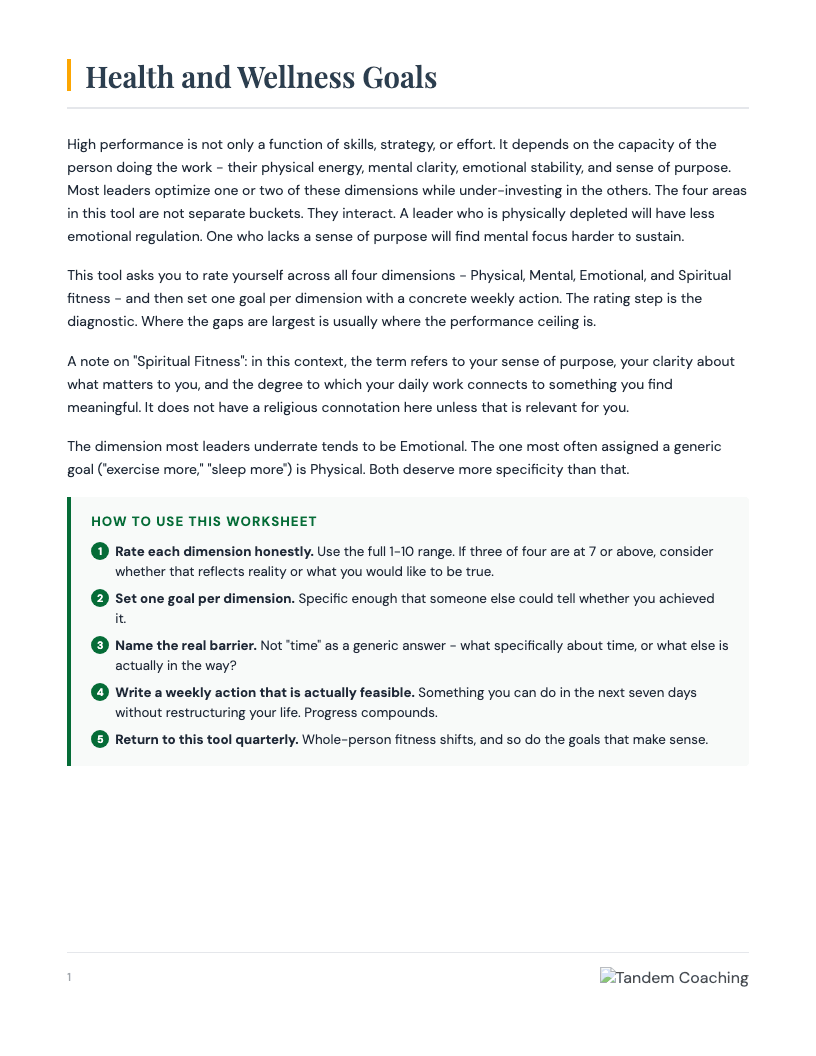
Reflect across four optional whole-person dimensions and choose one concrete action without calculating a health score.
Get This Tool
Free, print-ready PDF.
When to Use This Tool
A client who keeps putting their health on the back burner because work always feels more urgent
Someone who knows what they should be doing for their health but hasn't made it stick
A high-performer whose physical energy has become a limiting factor on their performance
How to Introduce This Tool Plus
Which optional dimension feels useful to explore, and what small action fits your actual health context?
Coaching Tool Disclaimer
This tool is designed for coaching contexts, not clinical use. If you or your client is in crisis, contact the 988 Suicide and Crisis Lifeline (call or text 988) or Crisis Text Line (text HOME to 741741).
Browse All Pages
Tool Classification
Domain
Wellness
Type
Worksheet
Phase
Goal Setting
Action
Details
30 min
Between sessions
Monthly
Topics
Self-Care
Habits
For the Coaching Practitioner
Plus
Coaching Scenarios
Plus
1 The high-performer whose physical decline is becoming a professional liability ▶
Context
Client is performing at a high level professionally but energy, sleep, and physical health have eroded enough to affect cognitive performance — slower thinking, shorter fuse in meetings, less capacity for strategic work. They intellectually accept the connection between physical health and professional performance but have not acted on it. Framing health as a performance variable is the entry point that bypasses their usual resistance.
How to Introduce
Frame this as a performance audit, not a wellness intervention. 'I want to look at four dimensions that directly affect your capacity at work — physical, mental, emotional, and spiritual. We're going to rate each one and then figure out which is creating the biggest drag on the others.' Clients in this category will engage with ratings and leverage analysis more readily than with 'taking care of yourself.' The spiritual dimension often stops them — name it: 'For some people, spiritual means faith. For others, it's purpose or meaning. Use whatever frame fits your life.'
What to Watch For
Watch for clusters of low ratings in physical and mental while emotional and spiritual are rated higher. This pattern often means the client is sustaining themselves on meaning and connection while the physical infrastructure is deteriorating. Also watch for clients who rate all four areas 6-7 — close enough to feel fine, low enough that the cumulative effect is significant. The flat distribution can mask systemic underinvestment.
Debrief
Start with the lowest-rated dimension and ask the client to read the goal they wrote for it. Then: 'What's the single barrier that has kept this at [rating] despite wanting it to be higher?' Do not move to action planning until the barrier is specific. 'I don't have time' is not specific — 'I haven't protected a block before 7am because I'm afraid of falling further behind on email' is specific.
Flags
Coaching scope: do not diagnose, interpret symptoms, or recommend treatment. Adapt or stop for distress and use licensed health or emergency support when appropriate.
2 The client who knows what to do but has never made it stick ▶
Context
Client has accurate knowledge about health — sleep hygiene, exercise, nutrition, stress management — and has attempted to implement changes multiple times without sustained success. The problem is not information; it is execution. The four-dimension structure creates an opportunity to examine the pattern of failed attempts rather than producing another plan.
How to Introduce
Frame this as a pattern analysis before building a new plan. 'You've tried a version of this before. Before we build another approach, I want to understand the pattern of what has worked temporarily and what has never worked. The four dimensions will help us find the gaps.' Clients with this history resist this framing because they want the new plan to be different enough from the old ones that failure feels less likely. Name the resistance: 'I know you want to get to the plan. What I want to do first is understand why the previous plans stopped.'
What to Watch For
Watch the barrier field for each dimension. Clients in this pattern often write external barriers — 'work schedule,' 'family demands,' 'travel.' These are real, but they are also barriers that have been present during the periods when health habits have worked. The question is what was different then. Also watch for emotional dimension barriers — clients often can articulate physical barriers accurately but describe emotional barriers in abstract terms ('stress') rather than specific ones ('I eat impulsively after difficult conversations with my manager').
Debrief
After reviewing all four dimensions, ask: 'Which of these has worked before, even briefly?' Focus there first. Understanding what worked and why it stopped is more actionable than starting fresh. Then: 'What was different about the period when that was working?' The answer usually reveals a structural support — a gym buddy, a fixed schedule, a project that happened to create accountability — that can be deliberately recreated.
Flags
Coaching scope: do not diagnose, interpret symptoms, or recommend treatment. Adapt or stop for distress and use licensed health or emergency support when appropriate.
3 The client who placed health on hold during a major professional push ▶
Context
Client deliberately deprioritized health — sleep, exercise, social connection, any form of renewal — during a high-stakes professional period (a product launch, an acquisition, a critical hiring phase). The professional push has ended or is ending, and they are now looking at significant health deficits across multiple dimensions without knowing where to start.
How to Introduce
Frame this as a triage assessment, not a comprehensive rebuild. 'You spent the last [period] prioritizing one thing. Now we're going to look at what that cost across four dimensions — not to judge the tradeoff, but to understand what needs the most attention first.' Some clients will want to rebuild everything at once. Name that pattern: 'If you try to fix all four at the same time, you will likely succeed at none of them. We're going to prioritize.'
What to Watch For
The spiritual/meaning dimension often reveals the most after a sustained professional push. Clients who were highly motivated during the push sometimes find that when it ends, the purpose that sustained them is gone — and the health deficits are the visible symptom of a deeper depletion. Watch for the spiritual rating dropping lower than the physical rating; that inversion is significant. Also watch weekly action fields that are identical to what the client was doing before the push — they may be planning to return to baseline rather than actually recovering.
Debrief
Start by asking which dimension has been depleted the longest. Recovery typically requires starting there, even if another dimension looks worse on paper. Then ask: 'What is the minimum that would make a difference in [lowest dimension] in the next two weeks?' The minimum viable action is usually the correct entry point for a client restarting after depletion. Full programs can come later.
Flags
Coaching scope: do not diagnose, interpret symptoms, or recommend treatment. Adapt or stop for distress and use licensed health or emergency support when appropriate.
Tool Flow
Plus
Requires
- None - standalone tool
→
Produces
- four-dimension wellness self-ratings
- one goal per fitness dimension
- named barrier per dimension
- weekly action per dimension
Pairs Well With
Wellness
Weekly Well-Being Context Log
A client wants to use Weekly Well-Being Context Log as an optional reflection
Why it pairsOnce the client has set dimension-specific goals, this converts those commitments into weekly behavior data you can review and adjust together.
Wellness30-Day Self-Care Challenge
I want to build a self-care routine but I need something to tell me what to do each day
Why it pairsUse this after a client names their wellness goals but still needs day-by-day structure to stop deprioritizing their own health.
WellnessWeekly Well-Being Practices Check-In
A client wants to use Weekly Well-Being Practices Check-In as an optional reflection
Why it pairsThe eight-behavior grid shows whether the mental wellness goal the client committed to is actually translating into consistent daily practice.
This tool is part of a coaching pathway
Step 1 of 6 in A client who keeps putting their health on the back burner because work always feels more urgent
Continue with Conflict Resolution Planner if that next job fits.
Next: Conflict Resolution Planner → Explore all pathways →Related Articles


Unlocking Agile Leadership: 5 Key Strategies for Coaching High-Performance Teams
Read article →
Unlocking the True Potential: Coaching the Person, Not Just the Problem
Read article →
ADHD Productivity: 9 Work Strategies That Stick
Read article →
Identity Architecture: How Career Shapes Who Leaders Become
Read article →