A client knows what they want but fear keeps stopping them from moving forward
Free, print-ready PDF.
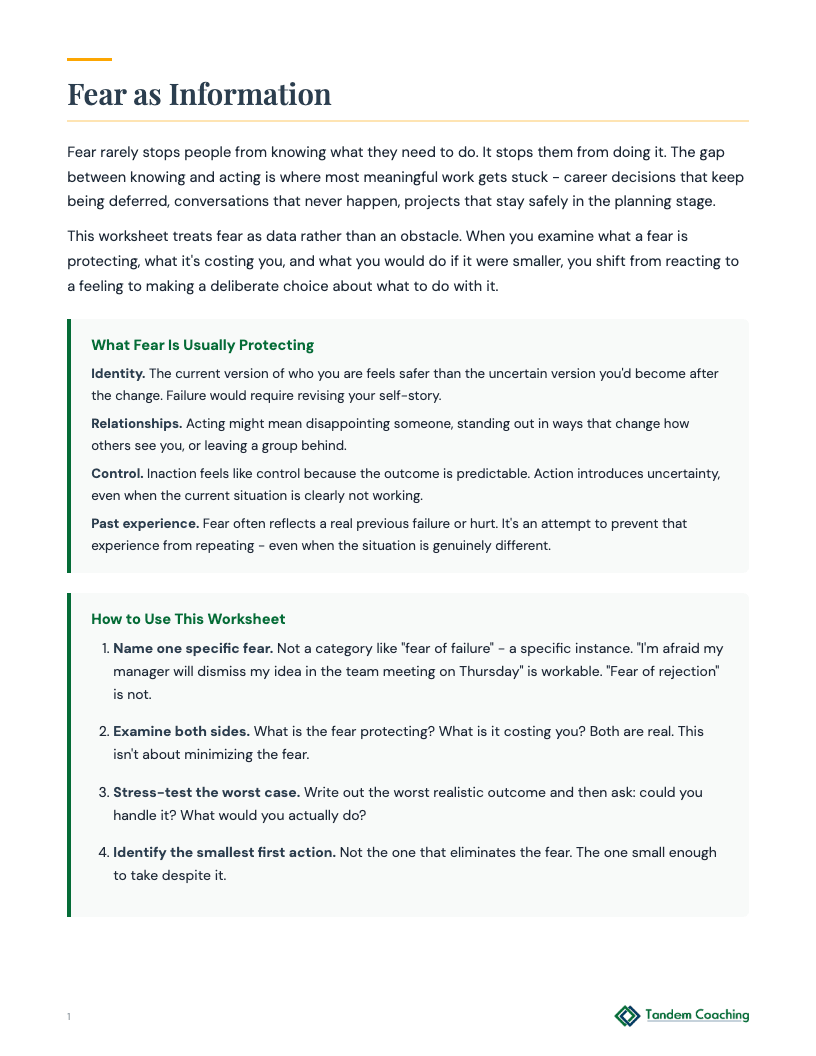
There's something you've been holding back on - what would it be worth looking at what's actually underneath that hesitation?
A client has been talking about a specific career move - starting a practice, applying for a director-level role, leaving a stable job to pursue something meaningful - for 12 to 24 months. They can articulate the goal clearly but find a new reason each quarter for why now is not the right time.
The delay pattern is the first thing to name before introducing the tool. 'You've been planning this move for two years. Before we make another plan, let's look at what's actually in the way.' Clients who have been postponing something for a long time tend to have well-rehearsed rational explanations - timing, finances, family, the economy. The anatomy breakdown asks them to get specific about the fear underneath those explanations. Start there rather than with the action step.
The worst-case stress-test is where the most important work happens. If the client's worst case is vague ('everything falls apart') or catastrophic beyond what the evidence supports, neither response is real engagement. A useful worst-case is specific and survivable: 'I spend six months on the job market at my current salary, then accept a role at my current level.' Watch whether the survivability assessment is honest or whether the client is performing confidence.
Start with the anatomy breakdown, not the action. Ask them to read the fear they named aloud - clients rarely do this, and hearing it spoken often changes its weight. Then move to the worst-case section: 'Is this actually what you're afraid of, or is it something else?' The stated fear is often a proxy for a deeper one. The first action step should be small enough to be genuinely non-negotiable. If they need a week to find time for it, it is too large.
If the client's worst-case scenario includes significant financial loss, health impact, or damage to primary relationships - and those risks are real, not catastrophized - the tool should not be used to minimize those concerns. Severity: moderate. Distinguish between fear that is disproportionate to actual risk (coaching territory) and fear that is an accurate read of real stakes (requires decision-making support, possibly advisors, not just mindset work).
A first-time VP or director has stepped into a high-visibility role and is experiencing significant anxiety about being found out as not ready. They are over-preparing, avoiding decisions, and second-guessing actions they would have taken confidently at the previous level.
Position the tool as a way to examine a specific fear rather than the general anxiety pattern. 'Pick one thing you've been avoiding or over-thinking. Not all of it - just one.' The anatomy breakdown is useful here because new leaders often conflate several fears: fear of public failure, fear of disappointing others, fear of the role revealing something true about their limits. Separating them is more useful than treating them as one thing.
In high-visibility roles, the worst-case stress-test often hits a wall: 'I can't be honest about the worst case because if I say it out loud it feels like inviting it.' That's magical thinking and worth naming gently. Also watch whether the smallest first action is directed at a real task or at more preparation. 'Make a list of everything I need to know' is not an action toward the fear - it's a continuation of avoidance.
Start with whether the anatomy breakdown names the fear accurately. Many leaders at this level are not afraid of failure itself - they're afraid of what failure would mean about them as a person. That distinction matters because the coaching strategy is different. Then move to the action step: ensure it is public-facing rather than preparatory. Doing something visible is what changes the pattern.
If the client's fear description and worst-case are primarily centered on others' judgment - what peers will think, what their manager will believe about them - and this is accompanied by hypervigilance about how they're being perceived in meetings, the pattern may be more about identity and self-worth than leadership readiness. Severity: moderate. Name what you're observing and explore whether the coaching focus should shift.
A client has developed a service offering, product, or business concept and has been in 'almost ready' mode for months. The work is substantially complete but they keep finding things to refine before launch. They describe the delay in terms of readiness but the timeline has stretched past any reasonable preparation period.
The perfectionism-as-protection pattern is common in pre-launch paralysis. Before introducing the worksheet, establish what 'ready' would actually mean: 'If the thing you keep refining were perfect tomorrow, would you launch it?' If the answer is hesitant, the problem is not readiness. Position the worksheet as a way to examine what launching would actually risk - because until that is specific, the brain will keep finding refinements to make instead.
The survivability assessment is critical in this scenario. Entrepreneurs often have a catastrophic worst-case that is genuinely unlikely but very vivid: public ridicule, financial ruin, proof that they were wrong to believe in the idea. Watch whether they can distinguish between 'this doesn't work and I learn something' and 'this fails and I'm revealed as fundamentally flawed.' The second version is not about the business.
Start with the gap between what they said the fear was at the start of the exercise and what they wrote in the anatomy section. The two are often different. Then focus the debrief on the smallest first action - specifically, is it a public commitment or another private preparation? The distinction is everything. A launch that starts with one real customer conversation is more valuable than another month of refinement.
If the client has already been through a failed launch or business failure in the past and this hesitation has a specific traumatic quality to it - visceral, not just analytical - the fear may be grounded in a prior experience that hasn't been processed. Severity: moderate. Continue with the tool but be prepared to shift focus if the emotion around the prior failure surfaces. Don't push past that moment to get back to the action step.
Client talks about wanting to grow but responds to setbacks with fixed patterns of self-protection
LifeA client whose distress about a situation is being driven by their interpretation of it, not the situation itself
WellnessI know I overreact sometimes but I can't predict what sets me off
Step 6 of 6 in ADHD adult who is newly diagnosed and wants structured space to name which challenges are most affecting their daily life
Explore all pathways →