Emotional Vocabulary Reference
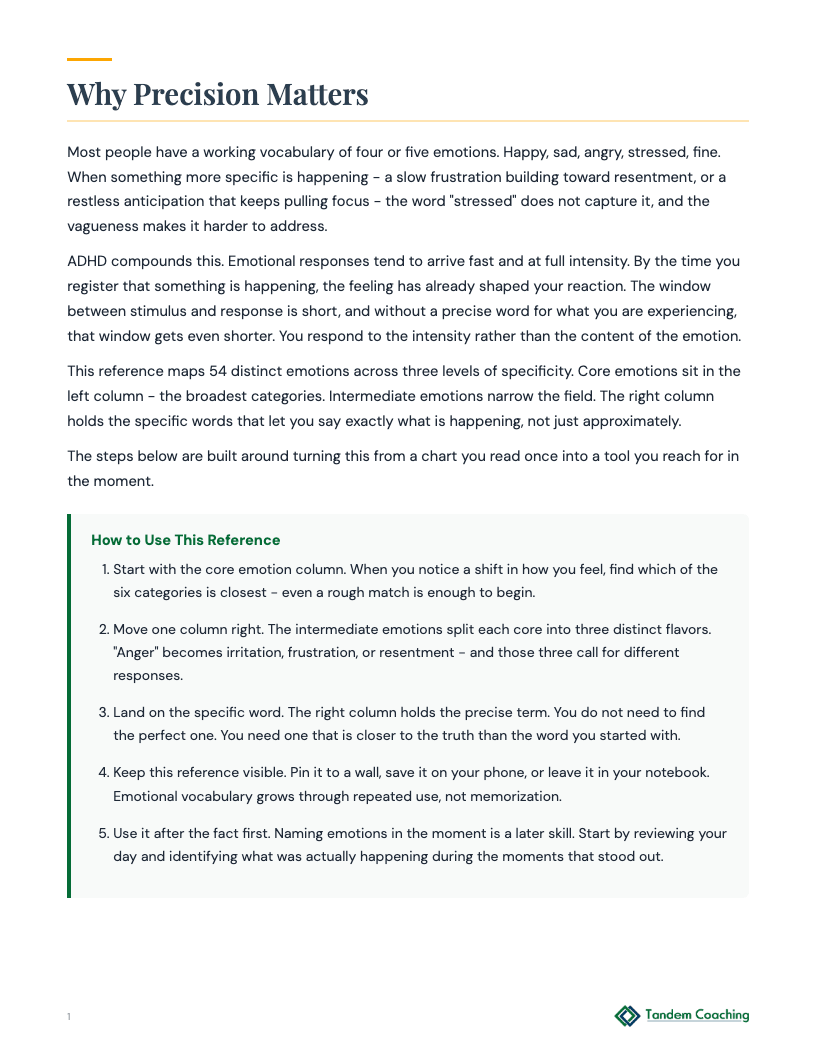
Use a six-category word list as an optional starting point for naming feelings without inferring a cause.
Get This Tool
Free, print-ready PDF.
When to Use This Tool
A client wants more words for describing a recent emotional experience
A client wants an optional vocabulary aid for reflection or communication
A client wants to add context to feelings noticed in a work situation
How to Introduce This Tool Plus
Which word feels closest to your experience, and what would you add or change so it fits better?
Coaching Tool Disclaimer
This tool is designed for coaching contexts, not clinical use. If you or your client is in crisis, contact the 988 Suicide and Crisis Lifeline (call or text 988) or Crisis Text Line (text HOME to 741741).
Browse All Pages
Tool Classification
Domain
ADHD
Type
Framework
Phase
Discovery
Reflection
Details
5 min
Opener
As-needed
Topics
Emotions
Identity
Communication
For the Coaching Practitioner
Plus
Coaching Scenarios
Plus
1 Team lead choosing words for a tense code-review moment ▶
Context
A recently promoted lead wants more precise language for what they personally noticed during a difficult code review.
How to Introduce
Offer the table as optional vocabulary, not an assessment. The client may choose several words, add their own, or decide that none fit.
What to Watch For
Keep descriptions client-owned and leave uncertainty visible. Do not infer a cause, sequence, diagnosis, or another person's internal state from a selected word.
Debrief
Ask which word felt useful, what context was present, and what additional language would make the description more accurate.
Flags
Coaching scope: do not diagnose, interpret symptoms, or recommend treatment. Adapt or stop for distress and use licensed health or emergency support when appropriate.
2 Marketing director reflecting on strong feelings during a presentation ▶
Context
A director wants an optional vocabulary aid for feelings noticed before, during, and after an important presentation.
How to Introduce
Offer the table as optional vocabulary, not an assessment. The client may choose several words, add their own, or decide that none fit.
What to Watch For
Keep descriptions client-owned and leave uncertainty visible. Do not infer a cause, sequence, diagnosis, or another person's internal state from a selected word.
Debrief
Ask which word felt useful, what context was present, and what additional language would make the description more accurate.
Flags
Coaching scope: do not diagnose, interpret symptoms, or recommend treatment. Adapt or stop for distress and use licensed health or emergency support when appropriate.
3 Operations manager checking whether an emotion label fits ▶
Context
A manager has been using the word 'anger' and wants to consider whether another word or added context better describes a recent deadline conversation.
How to Introduce
Offer the table as optional vocabulary, not an assessment. The client may choose several words, add their own, or decide that none fit.
What to Watch For
Keep descriptions client-owned and leave uncertainty visible. Do not infer a cause, sequence, diagnosis, or another person's internal state from a selected word.
Debrief
Ask which word felt useful, what context was present, and what additional language would make the description more accurate.
Flags
Coaching scope: do not diagnose, interpret symptoms, or recommend treatment. Adapt or stop for distress and use licensed health or emergency support when appropriate.
4 Finance leader reflecting during organizational change ▶
Context
A finance leader wants language for their own experience during a merger without assuming what team members feel.
How to Introduce
Offer the table as optional vocabulary, not an assessment. The client may choose several words, add their own, or decide that none fit.
What to Watch For
Keep descriptions client-owned and leave uncertainty visible. Do not infer a cause, sequence, diagnosis, or another person's internal state from a selected word.
Debrief
Ask which word felt useful, what context was present, and what additional language would make the description more accurate.
Flags
Coaching scope: do not diagnose, interpret symptoms, or recommend treatment. Adapt or stop for distress and use licensed health or emergency support when appropriate.
Tool Flow
Plus
Requires
- None - standalone tool
→
Produces
- optional emotion-word reference
- client-selected or self-supplied words
- context notes for later discussion
Pairs Well With
Relationships
Difficult Conversation Context and Safety Options
Use this planner to organize communication and emotions into a client-owned sequence of possible next steps.
Why it pairsUse selected words as optional prompts, confirm them with the client, and do not infer causes, diagnoses, or another person's internal state.
RelationshipsPerspective Hypotheses Worksheet
Use this worksheet to explore communication and emotions and turn the client’s observations into one optional next step.
Why it pairsChoose this worksheet for a different angle on emotions and communication; use it only if that separate job fits the client.
ADHDAnger Context and Safety Reflection
Use this worksheet to explore emotions and identity and turn the client’s observations into one optional next step.
Why it pairsUse selected words as optional prompts, confirm them with the client, and do not infer causes, diagnoses, or another person's internal state.
Related Articles


Adaptive ADHD Leadership: 7 Strategies That Work
Read article →
ADHD Mentorship: Support Networks That Work
Read article →
Leading With ADHD: Executive Leadership Strategies That Work
Read article →
ADHD Productivity: 9 Work Strategies That Stick
Read article →