ADHD Task Priority Matrix
Separate true urgency from noise so you stop treating everything as a crisis. A proven priority framework that reduces ADHD overwhelm and burnout.
Get This Tool
Free, print-ready PDF.
When to Use This Tool
ADHD adult who treats every task as equally urgent and burns out from the pressure
A client who needs a decision-making framework to sort what to do now versus later versus never
Person whose to-do list is too long and who has no system for deciding what actually matters
How to Introduce This Tool Plus
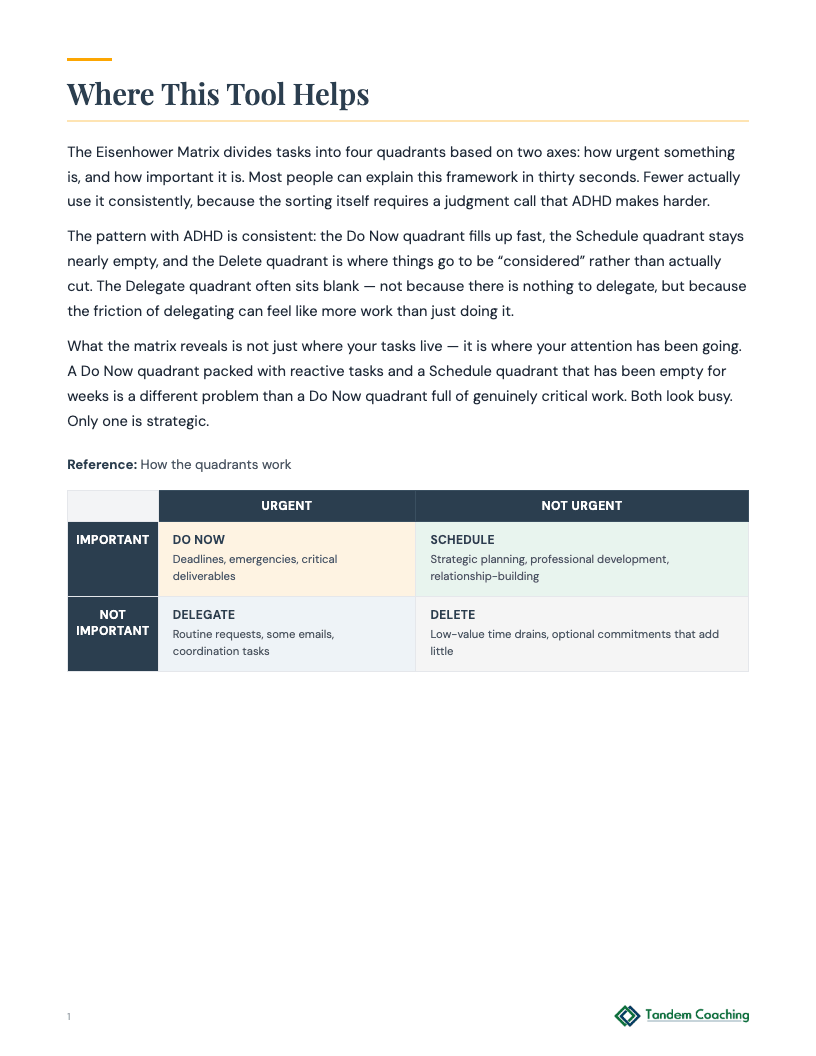
Which tasks belong in do, schedule, delegate, or delete, and where does attention feel hardest to redirect?
Browse All Pages
Tool Classification
Domain
ADHD
Type
Framework
Phase
Goal Setting
Action
Details
15 min
Mid session
As-needed
Topics
Executive Function
Time Management
Accountability
For the Coaching Practitioner
Plus
Coaching Scenarios
Plus
1 Senior director in reactive firefighting mode who can't distinguish urgency from importance ▶
Context
A Senior Director of Product at a mid-size SaaS company, diagnosed ADHD in adulthood, referred to coaching after a 360 flagged 'too deep in the weeds' from three direct reports. The client describes their problem as 'too much on my plate.' The actual pattern is that they respond to urgency signals - Slack pings, escalations, same-day requests - because the activation energy from urgency is the only thing that reliably initiates task engagement. Strategic work (which is important but not urgent) never generates enough activation to start.
How to Introduce
Frame this as a diagnostic, not a productivity tool. 'Before we talk about what to take off your plate, I want to see where your attention has actually been going this week. Not where it should go - where it went.' The resistance here is speed: this client will try to fill the matrix from memory in four minutes because the exercise itself feels low-urgency. Slow them down by requiring the brain dump step first - everything out of their head onto paper before any sorting begins. The matrix works for this client specifically because it separates the urgency judgment from the importance judgment. They've been conflating the two, and the physical separation on the page forces the distinction.
What to Watch For
Count the items in Do Now versus Schedule. If Do Now has twelve items and Schedule has two, that ratio IS the diagnosis - the client is living in reactive mode and calling it productivity. Watch for how they sort ambiguous items: if everything that could go in Schedule ends up in Do Now with a justification ('well, it's kind of urgent because...'), the urgency bias is running the sort. Genuine engagement looks like at least one item moving FROM Do Now to Schedule during the exercise - a visible reclassification. Performative completion looks like a clean, fast sort with no items moved between quadrants after initial placement.
Debrief
Start with Schedule. Read back what's there. Then ask: 'How long has each of these been in your system without getting started?' The gap between when something was identified as important and when it gets attention is the cost of the urgency pattern. Then move to Do Now and ask the client to mark which items were already on fire when they arrived versus which ones the client could have prevented by working on them when they were still in Schedule. That question - 'which of today's fires were last month's Schedule items?' - typically produces a visible reaction because it connects the two quadrants causally.
Flags
If the Delete quadrant is completely empty after a genuine attempt, explore whether the client's task load is actually unsustainable or whether they cannot psychologically release commitments. An empty Delete with a packed Do Now may indicate a boundaries issue rather than a prioritization issue. Severity: moderate. Response: continue coaching, but shift the next session toward exploring what the client believes happens if they say no to something - the story underneath the overcommitment.
2 Operations executive who fills the matrix fluently but nothing changes week to week ▶
Context
A VP of Operations at a logistics company, working with a coach on workload and stress management. The client has used the Eisenhower Matrix before - they can explain the framework, have read the books, and sort tasks quickly and neatly. Previous coaching engagement ended because the client felt they 'already knew this stuff.' The referral notes mention the client is working 60-hour weeks despite describing themselves as 'highly organized.' The tool isn't new to them. Their relationship to it is.
How to Introduce
Do not introduce the matrix as something to learn. This client will dismiss it. Instead, frame it as an audit of the gap between knowing and doing. 'You've used this before, so I'm less interested in how you sort and more interested in what happens after the sort. Fill this out for your actual week - then we'll compare it to last week's calendar and see how closely your real time matched your intended quadrants.' The resistance pattern here is intellectual mastery as avoidance: the client uses fluency with the framework to avoid the discomfort of confronting why they don't follow through. Naming that directly - 'You clearly know how to sort. The question is what keeps the sort from changing your behavior' - prevents the exercise from becoming another performance of competence.
What to Watch For
Watch for a matrix that looks textbook-perfect - items distributed across all four quadrants in reasonable proportions, clean handwriting, strategic items properly placed in Schedule. That polished output is the tell. Ask the client to pull up their calendar from the past week and mark which quadrant each block of time actually served. If 80% of calendar time went to Do Now items and Schedule items got zero calendar time, the matrix is aspirational, not operational. The distance between the sorted matrix and the lived calendar is the coaching conversation.
Debrief
Start with the calendar comparison, not the matrix. 'Show me a Schedule item that actually got calendar time this week.' If nothing did, stay there. The question that opens this up: 'What would have to be true for your Tuesday afternoon to protect a Schedule item instead of absorbing another Do Now item?' This moves from the abstract ('I should prioritize better') to the structural ('My calendar has no defended time for non-urgent work'). If the client deflects to external causes ('meetings get scheduled over my blocks'), ask who schedules those meetings and whether the client has ever declined one to protect strategic work time.
Flags
If the client produces a perfect matrix for the third time with no behavioral change between sessions, the tool is no longer serving the coaching. The presenting issue (workload) may be masking a deeper pattern: the client may need the 60-hour weeks for identity or status reasons and the 'too busy' narrative protects them from examining that. Severity: moderate. Response: pause the tool and explore directly what the client's relationship to being busy is. 'If you actually cleared your schedule to 45 hours, what would you do with the time?' - the answer (or the avoidance of the answer) redirects the work.
3 Newly promoted VP who hasn't recalibrated what counts as important at their level ▶
Context
A VP of Engineering promoted from Director eight months ago at a Series C startup. Coaching engagement started because the client's skip-level reports describe feeling micromanaged. The client's perspective: 'I'm just making sure things don't fall through the cracks.' The actual pattern is that the client's definition of 'important' hasn't shifted from individual contributor and director-level concerns (code reviews, sprint planning, architecture decisions) to VP-level concerns (hiring pipeline, cross-functional alignment, technical strategy). They are doing their old job at a higher altitude.
How to Introduce
Frame the matrix around the level shift, not time management. 'I want you to fill this out twice. First pass: sort your tasks from this week the way you naturally would. Second pass: sort them again, but as if your best VP-of-Engineering mentor were looking over your shoulder - someone who's been in this role for five years. I'm curious where the two sorts disagree.' The resistance will show up as defending the first sort: 'But that architecture review IS important at this level.' The second-pass framing creates enough distance for the client to see the gap without feeling judged for the first sort.
What to Watch For
Look at what the client puts in the Do Now quadrant on both passes. If the first pass puts 'review pull request for the auth service' in Do Now and the second pass moves it to Delegate, the client can see the level distinction but hasn't internalized it. If the second pass looks identical to the first, the client genuinely cannot see what VP-level Important looks like yet - that's a different coaching conversation (role clarity, not prioritization). Also watch whether the client puts any relationship-building or cross-functional items anywhere on the matrix at all. Their absence is as diagnostic as their placement.
Debrief
Put both matrices side by side. Start with the items that moved between passes. 'What made you move this one?' The reasoning reveals whether the client understands the level shift intellectually or has started to feel it. Then look at the second-pass Do Now: 'If your CEO looked at this quadrant, would they agree these are VP-level urgent-and-important items?' This externalizes the judgment - it's not the coach saying 'that's director work,' it's the client evaluating against their organizational context. The question that tends to create movement: 'What's in your direct reports' Do Now quadrants that's also in yours?'
Flags
If the client cannot generate a meaningfully different second-pass matrix - both sorts are nearly identical - the issue may go beyond prioritization into role identity. The client may not have a mental model of what VP-level work looks like because no one modeled it for them or because the organization doesn't actually expect VP-level behavior (startup cultures sometimes promote titles without shifting scope). Severity: low. Response: continue coaching, but consider whether the next session needs to define the VP role itself before returning to task prioritization.
4 Director whose empty Delegate quadrant reveals a control pattern, not a workload issue ▶
Context
A Director of Marketing at a healthcare company, ADHD diagnosed as a teenager, in coaching for burnout prevention. Has a team of six but routinely works evenings and weekends. When asked what they could delegate, the client says 'nothing - it's faster if I do it myself, and I can't afford mistakes right now.' The presenting concern is time management. The underlying pattern is that delegation requires sustained trust in someone else's execution over time, which ADHD makes harder because the client's working memory doesn't hold the delegated task reliably - so they either re-do it themselves or monitor obsessively.
How to Introduce
Position the matrix as a workload map, not a delegation exercise - the word 'delegate' will trigger the client's defenses immediately. 'Sort everything you're currently carrying into these four quadrants. Don't worry about whether something belongs in Delegate - just sort by urgency and importance first, and we'll look at the pattern together.' The matrix works here because it makes the imbalance visible. When the client has fourteen items in Do Now, eight in Schedule, zero in Delegate, and two in Delete, the empty quadrant speaks louder than any coaching question about trust. Naming the ADHD component directly helps: 'Part of why delegation feels harder than doing it yourself is that once you hand something off, your brain stops tracking it - and then you worry it's not getting done. That's not a character flaw; it's how working memory works with ADHD.'
What to Watch For
The Delegate quadrant will be empty or contain only trivial items (ordering supplies, scheduling meetings). Meanwhile, Do Now will contain items that clearly belong in Delegate at a Director level - formatting reports, building slide decks, managing vendor communications. If the client placed those in Do Now rather than Delegate, ask them to circle every item in Do Now that someone on their team has the technical skill to complete. The gap between 'could delegate' and 'will delegate' is where the coaching lives. If the client circles items but immediately adds caveats ('they could, but not at my quality standard'), the pattern is control, not capacity.
Debrief
Start with the circled items in Do Now - the ones the client acknowledged their team could do. Pick one concrete task. 'Walk me through what would happen if you handed this to [specific team member] tomorrow morning.' Listen for where the client's narrative breaks down: is it at the handoff ('I'd have to explain everything'), the waiting ('I wouldn't know if it was on track'), or the outcome ('it wouldn't be the way I'd do it')? Each break point suggests a different intervention. The question that opens this up: 'What's the worst thing that happens if [team member] does this at 80% of your quality level?' Most clients discover the answer is 'nothing meaningful,' which makes the control pattern visible.
Flags
If the client becomes emotional or agitated when discussing delegation - not frustrated, but genuinely distressed - explore whether past delegation attempts resulted in consequences (a mistake that cost them credibility, a project that failed publicly). The control pattern may be protective rather than habitual. Severity: moderate. Response: do not push delegation as a goal until you understand what the client is protecting against. If the distress connects to a specific professional trauma (a firing, a public failure), the work may need to move toward processing that event before task management strategies will stick.
5 Client whose matrix reveals their stated values and actual priorities are misaligned ▶
Context
A Chief of Staff at a private equity firm, coaching engagement focused on 'getting back to strategic work.' The client consistently says their top priorities are talent development and organizational design - the work they were hired to do. They describe feeling pulled into operational firefighting. The matrix will make visible that the operational work isn't being imposed on them - they're choosing it, because it produces immediate, tangible results in a role where strategic work takes months to show impact.
How to Introduce
Frame the matrix as a priority audit, not a planning tool. 'Fill this out from your past week - not what you wish you'd done, but what you actually spent time on. Be specific: not "meetings" but what each meeting was about.' The resistance here is narrative preservation. This client has a story ('I want to do strategic work but keep getting pulled into operations') that the matrix will challenge. Pre-frame that gently: 'Sometimes this exercise confirms what we already know. Sometimes it shows us something different. Either way, we work with what's real.'
What to Watch For
Look at which quadrant holds 'talent development' and 'organizational design.' If they're in Schedule, the client sees them as important-not-urgent - which means they've been deprioritized for months. If they're not on the matrix at all, the client's stated priorities aren't even making it onto the task radar. Then look at Do Now: if it's full of operational items the client describes as 'someone else's job' but they keep doing, the matrix is surfacing a preference the client hasn't acknowledged. Genuine engagement looks like the client pausing when they see the pattern, not immediately explaining it away.
Debrief
Put the matrix next to the client's own stated priorities from an earlier session. 'You told me in week two that talent development was your top priority. Where is it on this matrix?' Then wait. The silence after that question is where the coaching happens. If the client explains ('I just haven't had time'), redirect to the Do Now quadrant: 'You had time for these twelve things. Tell me about the moment you chose this operational task over a talent conversation.' The word 'chose' matters - it reframes the narrative from 'being pulled' to 'choosing,' which opens the door to exploring why operations feel safer or more rewarding than the ambiguous, long-horizon strategic work.
Flags
If the client's reaction to seeing the misalignment is relief rather than discomfort - 'yeah, I know, I should be more strategic' with no energy behind it - the stated priorities may be performative. The client may actually prefer operational work but believes they should want strategic work because of their title. Severity: low. Response: explore whether the role itself is the right fit rather than continuing to coach toward a version of the role the client may not want. 'If you could redesign this role to match how you actually work best, what would you keep and what would you hand off?'
Tool Flow
Plus
Requires
- current task list or brain dump of open items
→
Produces
- tasks sorted into four urgency-importance quadrants
- named delegate targets for each delegatable task
- explicit delete list of low-value commitments
Pairs Well With
ADHD
ADHD Weekly Planner
ADHD adult who needs a single page to capture the whole week ahead
Why it pairsOnce the matrix sorts tasks by urgency and importance, this planner gives your client a concrete time-blocked week built around the do-now quadrant.
ADHDOptional Month Context Plan
Use this planner to organize time management and executive function into a client-owned sequence of possible next steps.
Why it pairsThe delete list and delegate column from the matrix free up enough mental bandwidth to set realistic monthly goals without overcommitting again.
ADHDOptional Appointment Context Log
Use this tracker to notice patterns in executive function and time management over time before drawing conclusions.
Why it pairsAfter delegating and deleting low-value items, this tracker ensures the commitments your client kept don't get missed for lack of a prep system.
Related Articles


ADHD Coaching Certification: Which Path Actually Counts
Read article →
Remote vs In-Person ADHD Coaching: The Research
Read article →
Executive Function Strategies for ADHD Leaders: Working Memory, Impulse Control & Flexibility
Read article →
Organize Your Success – ADHD Coaching to Master Organizational Skills
Read article →