ADHD Weekly Planner
One-page weekly view for ADHD adults to plan tasks, appointments, and priorities at a glance, designed with ADHD-friendly structure.
Get This Tool
Free, print-ready PDF.
When to Use This Tool
ADHD adult who needs a single page to capture the whole week ahead
A client who plans day-by-day but keeps getting surprised by things they forgot earlier in the week
Person who wants a weekly structure that includes priorities, tasks, and notes in one place
How to Introduce This Tool Plus
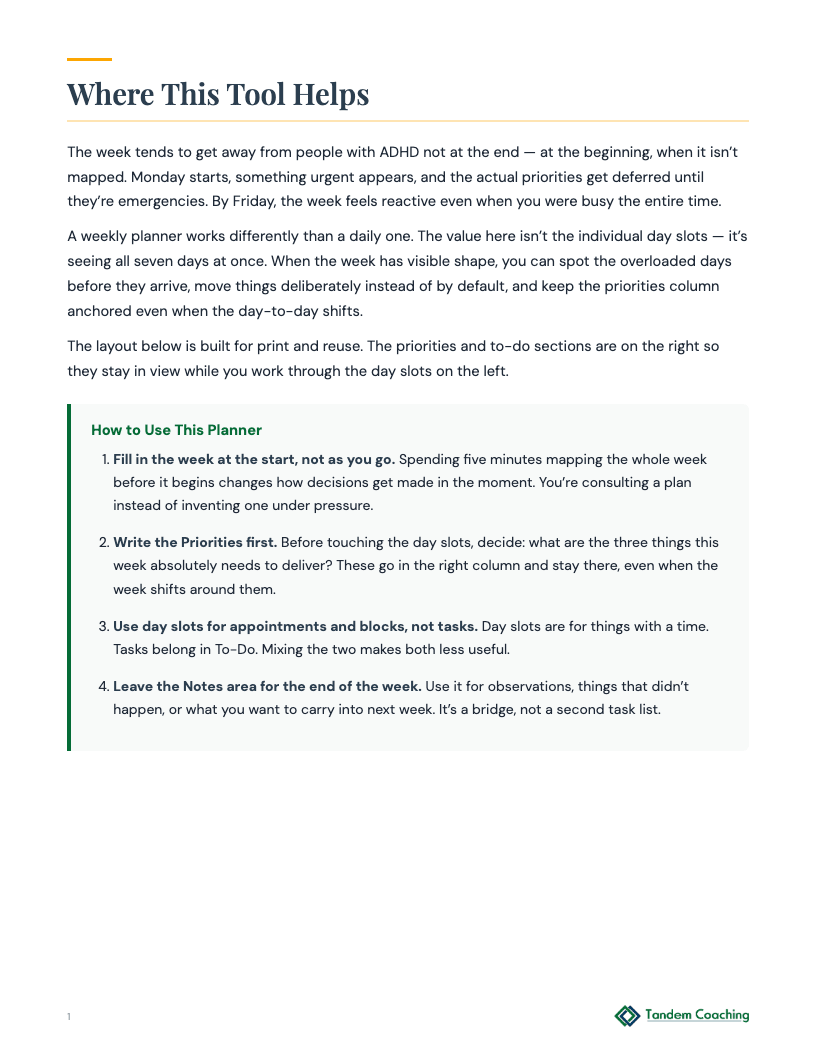
A weekly overview prevents the kind of reactive scheduling that happens when you only plan one day at a time. This planner gives you the full week on one page so you can see everything at once.
Browse All Pages
Tool Classification
Domain
ADHD
Type
Planner
Phase
Action
Details
15 min
Between sessions
Weekly
Topics
Time Management
Executive Function
Accountability
For the Coaching Practitioner
Plus
Coaching Scenarios
Plus
1 Marketing director who fills every day slot but never touches priorities ▶
Context
Marketing director at a mid-size tech company, three months into role. Came to coaching because they feel constantly behind despite working 60-hour weeks. Previous role was individual contributor - now managing team of six while maintaining hands-on project work.
How to Introduce
Frame this as a triage tool before diving into time management systems. 'Let's map one typical week to see where the 60 hours actually go.' Most new managers resist the Priorities section because everything feels urgent. Name this upfront: 'The goal isn't to rank your fires - it's to see which three things move the business forward regardless of what catches fire.'
What to Watch For
Day slots fill quickly with meetings and reactive tasks. Priorities section stays empty or gets filled with urgent items from the day slots. Client may treat To-Do as overflow from day slots rather than distinct category. Watch completion time - if day slots take 15 minutes and Priorities takes 30 seconds, they're avoiding the strategic thinking.
Debrief
Start with what's missing, not what's present. 'Read me your three priorities.' If they're all urgent/reactive, ask: 'Six months from now, what would make this role successful that isn't represented in these day slots?' The question that opens this up: 'What would happen if you spent Tuesday morning on Priority 1 instead of these four meetings?'
Flags
If Priorities section remains empty after multiple attempts or gets filled only with crisis management, the client may lack strategic clarity about their role. Severity: moderate. This suggests role confusion rather than time management issues. Response: explore role expectations and success metrics before returning to planning tools.
2 ADHD consultant who plans perfectly but abandons the plan by Tuesday ▶
Context
Independent consultant, ADHD diagnosis, works with multiple clients on project-based engagements. Seeks coaching because they create detailed weekly plans every Sunday but consistently abandon them when client requests come in. Feels like they're always in reactive mode despite good intentions.
How to Introduce
Position this as a flexibility tool, not a rigid schedule. 'Most ADHD brains reject plans that don't bend. This layout lets you see the whole week so you can move things deliberately instead of just dropping them.' Expect resistance to filling it out completely - they've been burned by over-planning before. Start with just three days and build up.
What to Watch For
Client may over-pack day slots as insurance against forgetting things. Priorities section might be vague or aspirational rather than concrete. Watch for perfectionist completion - if every slot is filled with precise timing, they're setting up for failure. The To-Do section often becomes a dumping ground for everything that doesn't fit elsewhere.
Debrief
Start with the gaps between plan and reality. 'Show me Tuesday - what actually happened versus what you wrote here?' Don't focus on compliance; focus on decision-making. The key question: 'When the client request came in Tuesday morning, how did you decide what to move?' This reveals whether they're making conscious trade-offs or just reacting.
Flags
If client consistently abandons plans within 48 hours across multiple weeks, or if they express shame about not following through, this may indicate deeper executive function challenges beyond planning. Severity: low to moderate. Response: continue coaching but consider referral to ADHD-specialized therapist if shame patterns persist or intensify.
3 Operations manager whose weekly plan reveals they're doing their team's work ▶
Context
Operations manager at manufacturing company, promoted six months ago from floor supervisor. Team of twelve direct reports. Came to coaching because they're working weekends regularly and their manager suggested they need better time management. Client believes the issue is efficiency.
How to Introduce
Frame as a delegation audit disguised as a planning tool. 'Before we optimize your time, let's see where it's actually going.' Don't mention delegation upfront - they'll defend their choices. Instead: 'This shows patterns that aren't visible when you're just moving from task to task.' Most new managers don't realize they're still doing individual contributor work.
What to Watch For
Day slots filled with tasks that could be done by direct reports. Priorities section may focus on operational details rather than management responsibilities. Client might write 'check inventory' instead of 'train Sarah on inventory management.' The To-Do section often contains work that belongs to their team members.
Debrief
Start with the task level, not the delegation concept. 'Walk me through Thursday's schedule. Which of these tasks require your specific expertise?' Then: 'Which ones could someone else do with the right training?' The question that creates movement: 'What would need to be true for you to spend Thursday on manager work instead of floor work?'
Flags
If 80% or more of day slots contain individual contributor tasks, or if client becomes defensive when asked about task ownership, this indicates role transition challenges that may require more support than coaching alone. Severity: moderate. Response: continue coaching but consider involving their manager in role clarity conversations.
4 Project manager who uses weekly planning to avoid difficult conversations ▶
Context
Senior project manager at consulting firm, managing three concurrent client projects. Came to coaching because projects consistently run over timeline and budget. Client attributes this to poor planning and wants better project management tools. Known for being well-liked by both clients and team members.
How to Introduce
Present as a project reality check, not a planning optimization. 'Let's map one week to see where project management time goes versus where it should go.' Many conflict-avoidant managers fill planning tools with tasks that feel productive but avoid the hard conversations. Frame this as diagnostic: 'We're looking for patterns, not solutions yet.'
What to Watch For
Day slots may be filled with research, analysis, and preparation tasks while avoiding client check-ins or team performance discussions. Priorities section might focus on deliverables rather than relationship management. Watch for euphemistic language - 'follow up with John' instead of 'address John's missed deadlines.'
Debrief
Start with what's not scheduled, not what is. 'I see preparation time for the client meeting but not the actual difficult conversation with them about scope creep. What makes the prep feel more urgent than the conversation?' The question that opens this up: 'What conversation are you hoping will happen naturally that you might need to initiate?'
Flags
If planning consistently avoids interpersonal challenges or if client becomes anxious when discussing direct conversations, this may indicate conflict avoidance patterns that impact professional effectiveness. Severity: moderate. Response: continue coaching with focus on communication skills, but monitor whether avoidance extends beyond work relationships.
Tool Flow
Plus
Requires
- identified weekly priorities and fixed commitments
→
Produces
- mapped 7-day schedule with time blocks
- ranked weekly priorities list
- separated task and appointment lists
Pairs Well With
ADHD
Attention Context Log
Use this tracker to notice patterns in executive function and habits over time before drawing conclusions.
Why it pairsRunning this alongside the planner shows whether the time blocks your client committed to on Sunday are actually holding up under real-week distraction pressure.
ADHDADHD Brain Dump
ADHD adult who feels overwhelmed by competing demands and can't prioritize what to work on first
Why it pairsUse this before the planner so your client arrives at the weekly schedule with a sorted task list rather than a cluttered mental queue competing for every slot.
ADHDOptional Digital Context and Cleanup Notes
Use this checklist to review habits and executive function without assuming every item applies.
Why it pairsOnce the week is mapped, this removes the notification noise that would otherwise erode the time blocks your client just committed to.
Related Articles


Remote vs In-Person ADHD Coaching: The Research
Read article →
Executive Function Strategies for ADHD Leaders: Working Memory, Impulse Control & Flexibility
Read article →
Organize Your Success – ADHD Coaching to Master Organizational Skills
Read article →
ADHD and People-Pleasing: Why I Say Yes When I Should Say No
Read article →