Dream Team Mapping

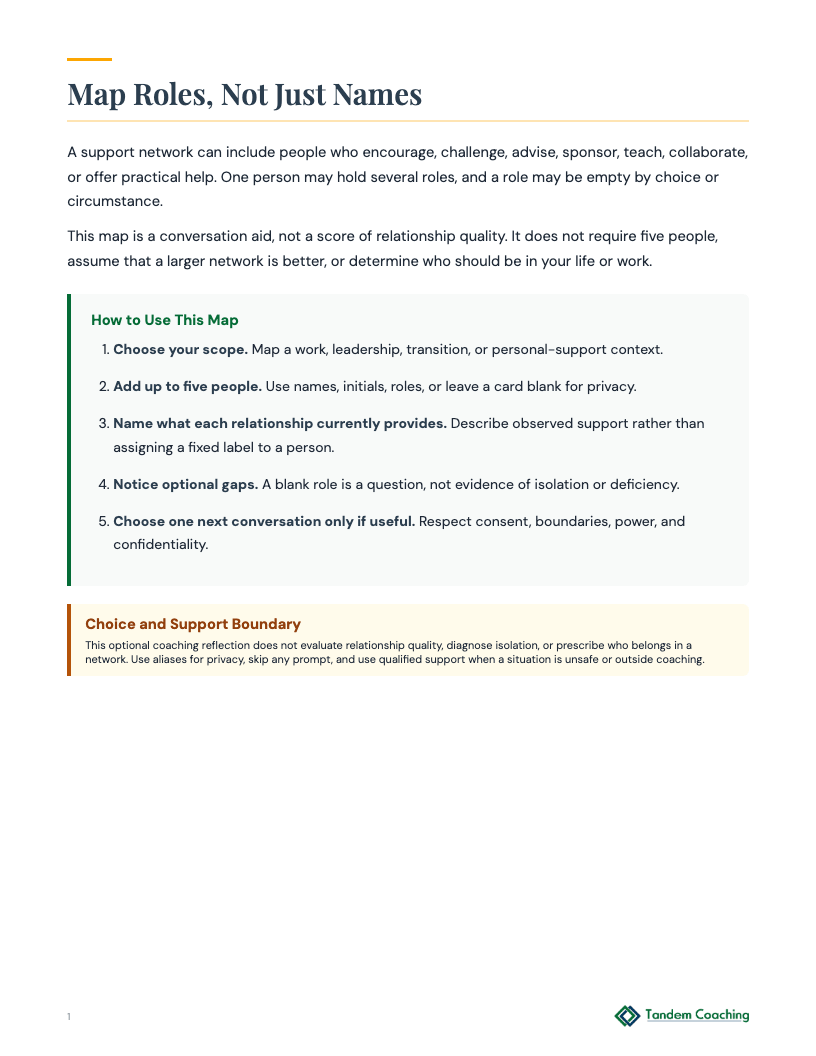
Clarify the roles and strengths already on your team so you can hire and delegate with confidence, using a structured coaching mapping method.

Worksheet · 15 min · Print-ready PDF · Free download

Get This Tool

Free PDF - professionally formatted, ready to print or fill digitally

Preview Worksheet · 15 min
Dream Team Mapping - preview
When to Use This Tool
Client is building a team but has not mapped the roles and strengths already present
Client relies on the same two or three people and cannot see who is missing
Client wants to delegate but has no structured view of who does what
How to Introduce This Tool Plus

This mapping exercise puts your current team on paper by person, role, and what areas are covered or missing - would that kind of visual be useful right now?

Browse All Pages
Interactive Preview Worksheet · 15 min
Tool Classification
Domain
Life Coaching
Type
Worksheet
Phase
Discovery Action
Details
15 min Mid session As-needed
Topics
Identity Leadership Accountability

For the Coaching Practitioner

Plus
Coaching Scenarios Plus
1 New VP discovers their support network didn't transfer with the promotion
Context

A VP of Product who was promoted from Senior Director four months ago. The coaching engagement started because their CEO flagged that they seem isolated in the leadership team. The client believes the problem is that the other VPs are territorial. They have not considered that their own network is still composed entirely of people from their previous level.

How to Introduce

Frame this as a network inventory, not a relationship exercise. 'You mentioned feeling like an outsider on the leadership team. Before we strategize on that, map who you actually turn to right now - for support, for challenge, for honest feedback.' The resistance here is speed: new VPs tend to fill the clouds in two minutes with names they know well, all from their previous role. Slow them down by asking them to note when they last spoke to each person and in what context. This tool works here because it makes the level mismatch visible on paper - five names, all directors or individual contributors, zero peers or mentors at the VP level.

What to Watch For

Count how many of the five people are at the client's current level or above. If all five are former peers or direct reports, the client has not built upward or lateral relationships since the promotion. Also watch for the role labels: if every person is listed as 'encourager' or 'supporter' and nobody is labeled 'challenger' or 'someone who tells me uncomfortable truths,' the client has built a comfort network, not a development network. Genuine engagement looks like pausing on the third or fourth cloud and saying something like 'I actually don't have someone for this.' Performative completion fills all five quickly with confident handwriting.

Debrief

Start with the roles column, not the names. 'Read me the roles you wrote down.' If they cluster around support and encouragement, ask: 'Who on this list would tell you something you don't want to hear?' Then move to what is missing: 'You wrote that challenger and sponsor are missing. Where in your week would you actually encounter someone who could fill those roles?' The question that opens this up is usually: 'If you showed this map to your CEO, what would they notice?'

Flags

If all five names are from the client's previous role and the client cannot name a single person at their current level they turn to for anything, the isolation may be more than a networking gap. Severity: moderate. Explore whether the client is avoiding peer relationships because the promotion feels provisional - they may not yet see themselves as belonging at the VP level. Response: continue coaching, but name the pattern and track whether it shifts over the next two sessions.

2 Senior leader fills every cloud with encouragers and cannot identify a single challenger
Context

A Chief Marketing Officer in a mid-size tech company, two years into the role. Coaching was initiated after a product launch failed and the CMO's post-mortem blamed external factors exclusively. The client is personable and well-liked. They genuinely believe their network is strong because they have many relationships. The gap is that none of those relationships include people who push back on their ideas.

How to Introduce

Position this as mapping what their network is actually built for. 'You mentioned having a strong network - you know a lot of people and they know you. This exercise is different. Instead of listing who you know, map who plays a specific developmental role for you.' Expect the client to fill clouds quickly and confidently - they are socially skilled and have no shortage of names. The resistance will surface in the role-labeling step, not the naming step. When asked to label roles, they will assign 'mentor,' 'encourager,' 'thought partner' but struggle to name anyone as 'challenger' or 'the person who tells me I'm wrong.' Do not point this out during the exercise. Let the pattern emerge in the debrief.

What to Watch For

Look at the role labels across all five clouds. If four or five people serve affirming roles (encourager, supporter, cheerleader, mentor-as-validator) and zero serve confrontational roles (challenger, truth-teller, devil's advocate), the client has built a network that confirms rather than corrects. A second signal: if the client lists the same person in multiple implied roles ('she's my mentor AND my thought partner AND my encourager'), they may be over-relying on one relationship to do the work of three. Genuine engagement shows up when the client notices the pattern themselves before you name it.

Debrief

Start with the missing roles section at the bottom of the worksheet. 'What did you write for roles that are missing?' If the client wrote 'challenger' or something similar, ask: 'When was the last time someone in your professional life disagreed with you directly, to your face, about a decision you'd already made?' The silence after this question is information. Then connect to the presenting issue: 'You mentioned the product launch post-mortem. If someone on this map had played the challenger role six months ago, what might they have said?'

Flags

If the client cannot recall a single instance of professional disagreement in the past year and reacts defensively to the idea that their network lacks challengers ('I don't need people who argue with me - I need people who execute'), the pattern may extend beyond network composition to a feedback-avoidance structure. Severity: moderate. Response: do not push the point in this session. Note it, return to it when debriefing a future tool that surfaces decision-making patterns. If the client's 360 data also shows a gap between self-perception and others' perception of openness to feedback, escalate to a direct conversation about what feedback the client is not receiving.

3 Founder scaling past 50 employees realizes their entire network is internal
Context

A founder-CEO of a SaaS company that grew from 15 to 60 people in 18 months. Coaching started because the board asked the founder to 'develop as a CEO.' The client finds this vague and slightly insulting - they built the company. They think the exercise will confirm they have a strong team around them. They do not distinguish between their organizational team and their personal development network.

How to Introduce

Frame this explicitly as external to the org chart. 'This maps the people in your life who develop YOU - not the people you manage or who report to you. The rule: no one who works at your company.' This constraint will immediately narrow the founder's list. Most founders at this stage have let external relationships atrophy because the company consumed all their relational bandwidth. Name that: 'Most founders in your stage find that their network has collapsed inward. The company became the whole world. This exercise shows what that looks like on paper.' The constraint against listing employees is what makes this tool valuable here - without it, the founder fills five clouds with their leadership team and learns nothing.

What to Watch For

Watch for the pause after the 'no employees' constraint. If the client can fill one or two clouds quickly but stalls on three, four, and five, the network contraction is real. If the client asks 'can I include my co-founder?' or 'does my board chair count?' they are trying to stretch the boundaries because the external network is genuinely thin. Also watch for the age of the relationships listed: if all names are from pre-company life (college roommate, former boss from a previous job), the client has not built new developmental relationships since founding. That is a different problem than having no network at all.

Debrief

Start with how many clouds the client filled. If it is two or three out of five, name the number without judgment. 'You have two people outside the company you turn to for development. When you started the company, how many would you have listed?' Then move to roles: 'Of these two people, which roles do they play? And which roles from this list does no one outside your company play for you right now?' The question that creates movement for founders is: 'Who is coaching you on being a CEO specifically - not on the product, not on fundraising, but on leading an organization of this size?'

Flags

If the client cannot name a single person outside the company and outside their family who plays a developmental role, the isolation is structural. Severity: moderate to high, depending on how long this has been the case. Founders with collapsed external networks make decisions in an echo chamber of their own employees, who have incentive structures that prevent honest upward feedback. Response: this finding should shape the coaching engagement itself. Explore whether the client would benefit from a peer group (YPO, founder cohort) or a mentor relationship, and discuss what has prevented them from building those relationships.

4 Director discovers all five people are subordinates, not peers or mentors
Context

A Director of Engineering at a financial services firm, promoted from tech lead 18 months ago. Coaching engagement was initiated by their VP because the director struggles to influence cross-functionally - they default to solving problems by building things rather than by building relationships. The client believes their team is their greatest strength. They are not wrong, but they have confused team loyalty with a development network.

How to Introduce

Do not pre-frame this as a gap exercise. Say: 'Write down the five people who most help you grow as a leader - anyone, any context.' Deliberately leave the constraint open so the client's natural choices reveal the pattern. If you tell them upfront not to include direct reports, you rob the exercise of its diagnostic value. The resistance pattern here is relabeling: the client will list reports and label them 'thought partner' or 'someone who challenges me.' That relabeling is itself the data point. A direct report who 'challenges' a director is in a structurally different position than a peer who challenges them. The power dynamic changes what honesty is possible.

What to Watch For

Check the organizational relationship between the client and each person named. If three or more of the five are people the client has positional authority over, the client's developmental network runs downhill. Look at the role labels for the subordinates specifically: if a direct report is labeled 'challenger' or 'truth-teller,' note it but do not dismiss it in the moment - the client's perception that this relationship is honest matters. What you are tracking is whether the client has ANY relationship where they are not the most senior person. Also watch for whether the client includes anyone from outside engineering - if all five are technical, the cross-functional influence problem the VP flagged is visible on this single page.

Debrief

Start with a factual observation. 'Three of the five people on your map report to you. Who on this list could tell you that you're wrong about a technical direction and face no consequences for doing so?' Let the client sit with that. Then broaden: 'Your VP mentioned cross-functional influence as a growth area. How many people from outside engineering are on this map?' If the answer is zero, ask: 'Where in your current week do you have a conversation with someone from product, design, or finance that is not about a project deliverable?' The goal is to surface that the client's relational world is both hierarchically narrow and functionally narrow.

Flags

If the client reacts to the observation about subordinates by insisting 'my team really does challenge me' and provides examples, explore whether those challenges are technical (safe for a report to raise) or political/strategic (not safe). If all examples are technical, the client may not be receiving honest feedback about their leadership, only about their engineering decisions. Severity: low to moderate. Response: continue coaching, and consider pairing this tool with a 360 or stakeholder interview process that gathers input from peers and skip-levels.

5 Executive in career transition names people from a role they no longer hold
Context

A former Head of Operations who left a large consumer brand three months ago and is exploring what's next - consulting, a smaller company, possibly a different function. Coaching started to provide structure to the transition. The client is energized about possibilities but has not noticed that every person they turn to for advice is anchored in the identity they left behind. All roads in their network lead back to operations at scale.

How to Introduce

Frame this as mapping who is shaping the transition, not who shaped the last chapter. 'You're making decisions right now about what comes next. Map the five people who are most influencing how you think about that.' Do not mention the risk of backward-looking networks - let the tool reveal it. The resistance here is subtle: the client will list people they trust, which is reasonable. The issue is not trust but perspective. A former colleague who says 'you were amazing at ops, you should find another ops role' is offering affirmation of the past, not guidance for the future. The client will not initially see this as a problem because it feels like support.

What to Watch For

Note the context in which the client knows each person. If four of five are former colleagues from the same company or the same function, the client's sounding board has a single reference point. Also watch for whether anyone on the list has actually made the kind of transition the client is considering. If no one listed has moved from corporate to consulting, or from operations to a different function, then no one on the map has relevant pattern-matching for what the client is facing. Genuine engagement surfaces when the client writes a name and then hesitates: 'Well, they always tell me to go back to what I know.' That hesitation is where the coaching conversation lives.

Debrief

Start with roles rather than names. 'Who on this list is helping you think about options you have NOT considered yet?' If the answer is nobody, that is the finding. Then ask: 'If someone who had successfully moved from ops to consulting were on this map, what role would they play that no one currently plays?' This moves from deficit ('you don't have X') to design ('what would X provide?'). The transitional question is: 'Is this a team that helps you become something new, or a team that reminds you of what you were?'

Flags

If the client becomes emotional or defensive when the backward-looking pattern is named, the attachment to the previous identity may be stronger than the stated openness to change. Severity: low to moderate. Career transitions often involve grief for the professional identity being left behind, and a backward-looking network can be a way of holding onto that identity. Response: do not pathologize this. Name it as normal. 'Most people in transition keep their network anchored in the previous role for longer than they expect. The question is whether that is serving the transition or slowing it.' Track across sessions whether the client begins adding new voices or continues to consult the same people.

Tool Flow Plus
Requires
  • None - standalone tool
Produces
  • named support network with five roles mapped
  • inventory of roles present and roles missing
  • identified gaps to bring to next session

Pairs Well With

Executive

Personal Leadership Assessment

Client is in a leadership role but has not assessed where their actual practice meets or falls short of their standards

30 min Assessment
Executive

Unique Value Proposition

I know my business is different but I struggle to articulate what actually sets us apart

45+ min Worksheet
Life

SWOT Analysis (Guided)

Client is at a decision point and hasn't done a candid inventory of their strengths and gaps

30 min Framework

Related Articles

5 Key Strategies for Building Trust and Effective Communication in Agile Teams

5 Key Strategies for Building Trust and Effective Communication in Agile Teams

Read article →
Transform Your Executive Role for AI | Strategic Guide 2026

Transform Your Executive Role for AI | Strategic Guide 2026

Read article →
Leverage Strengths: How Executive Coaching Helps Leaders

Leverage Strengths: How Executive Coaching Helps Leaders

Read article →
Executive Coaching for IT Leaders: Master People Management

Executive Coaching for IT Leaders: Master People Management

Read article →
The Technology Formation: The Builder Who Cannot Stop Building

The Technology Formation: The Builder Who Cannot Stop Building

Read article →
Unlock Your Agile Coaching Potential: Transform Your Passion into Profit

Unlock Your Agile Coaching Potential: Transform Your Passion into Profit

Read article →