DBT GIVE Skill
Learn how to keep your point without harming the relationship using DBT’s evidence-based GIVE skill for respectful, effective communication.
Get This Tool
Free, print-ready PDF.
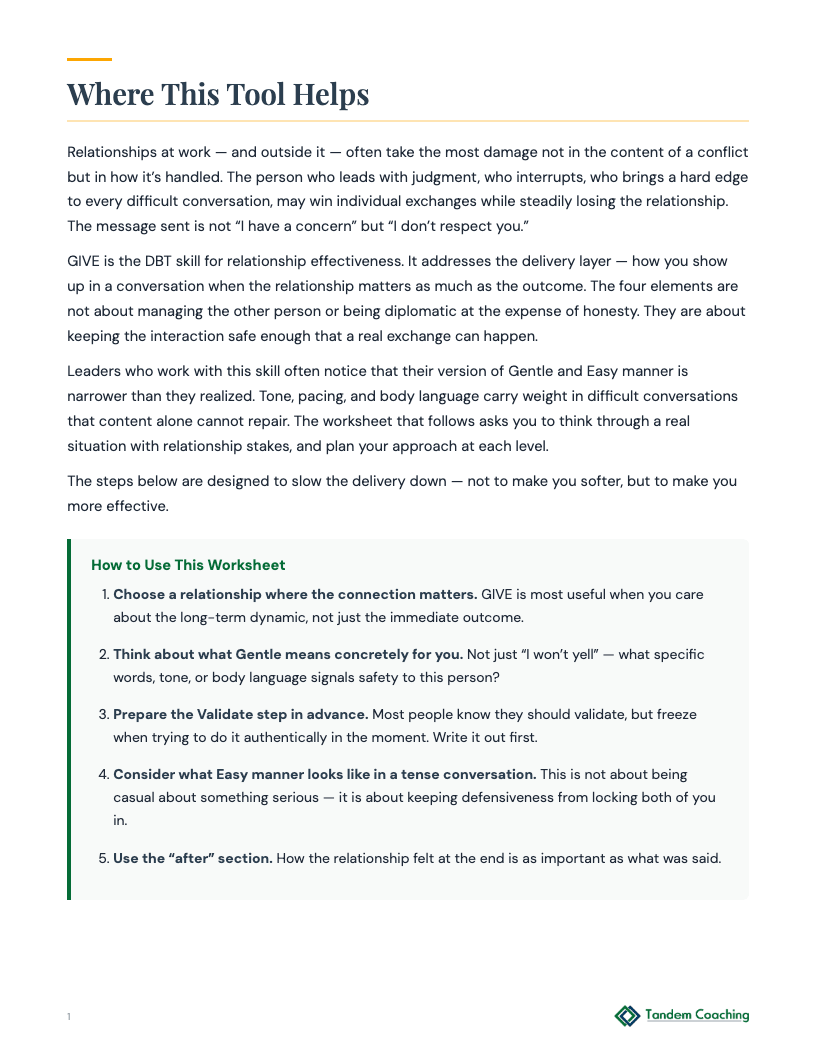
When to Use This Tool
A client tends to win arguments but damage relationships in the process
Someone preparing for a difficult conversation where the relationship matters as much as the outcome
Working on Gentle, Interested, Validate, and Easy manner before a high-stakes interaction
How to Introduce This Tool Plus
When a conversation gets difficult, where do you typically lose the relationship — in your tone, your pace, or somewhere else?
Coaching Tool Disclaimer
This tool is designed for coaching contexts, not clinical use. If you or your client is in crisis, contact the 988 Suicide and Crisis Lifeline (call or text 988) or Crisis Text Line (text HOME to 741741).
Browse All Pages
Tool Classification
Domain
Relationships
Type
Worksheet
Phase
Action
Details
30 min
Between sessions
As-needed
Topics
Communication
For the Coaching Practitioner
Plus
Coaching Scenarios
Plus
1 Senior leader who wins the argument and loses the person ▶
Context
A VP is technically precise and substantively correct in most disagreements but leaves conversations with damaged relationships and defensive peers. He receives consistent feedback that he is hard to disagree with, which means fewer people try. He considers his directness a feature and the relationship damage collateral.
How to Introduce
Lead with the G (Gentle) step and frame it as a strategic tool, not a softening requirement. 'Gentle in GIVE doesn't mean soft or indirect. It means removing the signals that trigger defensiveness before the other person can even hear your point. Your argument is correct. The question is whether the delivery is creating conditions where the other person can receive it.' Clients who identify as direct often hear gentleness as weakness. Hold the distinction: precision of delivery is not the same as precision of content.
What to Watch For
Watch whether the V (Validate) section contains actual validation or a dismissal-shaped-like-validation: 'I understand why you think that, but...' is not a validate step — it is a setup for a counterargument. A complete Validate step requires acknowledging what is true or understandable in the other person's position without immediately pivoting to disagreement. If the written validation is one sentence and the Assert section is four, the tool hasn't changed the ratio.
Debrief
Start with the 'After' section: 'How did the relationship feel at the end of that conversation?' Then ask him to compare that to how it felt at the end of his last three conversations on the same topic. If the relationship tone was different, ask what he did differently in the GIVE steps. If it wasn't different, look specifically at the I (Act Interested) section: 'Did you ask any questions during the conversation? What did you do with the answers?'
Flags
If the E (Easy Manner) section is consistently blank or says 'not applicable' — he doesn't believe this element applies to him — the missing element is likely the one most visible to his team. Severity: low. The E step is often the gap between a conversation that ends in agreement and one that ends in compliance.
2 New manager having first difficult conversations with former peers ▶
Context
A recently promoted team lead needs to address performance issues, workload disputes, and role changes with people who were her peers three months ago. She is highly conflict-avoidant and has been delaying the conversations. When she does attempt them, she over-explains, apologizes, and leaves without a clear outcome.
How to Introduce
Position GIVE as a tool for entering the conversation — not for managing what comes out of it. 'The worksheet helps you prepare the delivery layer before you're in the room. When you're managing people you used to work alongside, the relationship dynamic is already complicated. GIVE gives you a clear approach to your own behavior that doesn't depend on how the other person responds.' Emphasize the I (Act Interested) step specifically: for clients who over-explain, genuine curiosity about the other person's experience redirects energy away from the prepared speech.
What to Watch For
Watch whether the E (Easy Manner) section reads as an instruction to be casual about something serious. Easy manner in a difficult conversation does not mean minimizing the concern — it means keeping the delivery from signaling threat or judgment. If her E section says 'keep it light' for a performance conversation, the guidance is wrong. The correct read is: 'What can I do to keep both of us from locking into a defensive posture?'
Debrief
Start with the 'After' section and ask: 'At the end of the conversation, how did the relationship feel to you — better, worse, or about the same as before you started?' Then ask: 'What, specifically, do you think produced that outcome?' That attribution question matters more than a general debrief, because it tells you whether she is connecting her GIVE choices to the relational result.
Flags
If the worksheet shows that she prepared thoroughly and completed the conversation without a clear outcome — the GIVE steps were followed but the conversation ended without agreement or next steps — GIVE alone may not be the right tool. Severity: low. GIVE addresses relationship effectiveness; DEAR MAN addresses outcome effectiveness. The issue may be a missing Assert step, not a missing relationship approach.
3 Executive whose family reports she brings the same edge home ▶
Context
A chief of staff describes her husband and teenage children noting that she is hard to talk to after difficult days — that she has the same tone at home she uses in hard work conversations. She doesn't recognize it in the moment and is troubled by the feedback.
How to Introduce
Introduce this tool in a personal context, not a professional one. 'GIVE was designed for exactly the situation you're describing: a relationship that matters more than the outcome of any individual conversation. The four steps help you separate how you are in the conversation from what you are saying in it. At work, the edge may be functional. At home, it is registering as a tone that the people you care about are protecting themselves from.' Assign the worksheet to a specific home conversation rather than a work one — the data from a lower-stakes context often produces more honest reflection.
What to Watch For
Watch the V (Validate) section for content that describes validation in the abstract — 'I acknowledged her feelings' — rather than in specific language. Ask her to write the actual sentence she said or would say. The gap between 'I validated them' and the actual words is often where the edge lives. Clients who are skilled communicators at work sometimes have no language for validation in personal contexts.
Debrief
After a conversation she used the worksheet to prepare for at home, start with a simple question: 'How did that person seem at the end of the conversation, compared to the start?' That observational question — not asking her to evaluate herself, but to describe the other person — often produces the most honest account of relational impact.
Flags
If the worksheet is completed only for work situations despite the home pattern being the stated concern, she is avoiding the context where the behavior is most consequential. Severity: low. Name it: 'We've been using this for work conversations. What would it look like to prepare for a specific conversation at home the same way?'
4 Coach working with a client on a specific broken work relationship ▶
Context
A director and a peer have had a deteriorating relationship for eight months. They work closely together on a shared function, the tension is visible to both teams, and both are avoiding a direct conversation. The director wants to repair the relationship without appearing to admit fault.
How to Introduce
Frame the tool around preparation rather than outcome. 'GIVE doesn't guarantee the other person will respond well — it controls your side of the delivery. The preparation you do with this worksheet is about what you want to signal to them: that you are approaching this as a relationship problem worth solving, not a conflict to win.' The 'without admitting fault' concern is worth addressing directly: 'Validating the other person's experience doesn't require agreeing that you were wrong. What does it require is acknowledging what their experience has been.'
What to Watch For
Watch whether the I (Act Interested) section contains questions the director would genuinely ask — questions she doesn't know the answer to — or questions designed to establish her own position. 'Have you felt like I haven't respected your input?' is not an interested question if she already knows the answer she expects. Real interest requires not knowing.
Debrief
Start by asking what she actually learned in the conversation — not what happened, but what she found out about the other person that she didn't know before. That question tests whether the I step produced genuine listening or managed inquiry. If she can't name anything she learned, the conversation may have followed the worksheet structure without the underlying shift in orientation it requires.
Flags
If eight months of avoidance and a single GIVE-prepared conversation do not produce a visible change in relational tone, the intervention may need to move beyond the individual coaching context — a facilitated conversation, a manager conversation, or a structural change to the shared work. Severity: moderate. GIVE is a tool for improving delivery; it is not a conflict resolution process.
Tool Flow
Plus
Requires
- named relationship with specific high-stakes conversation
→
Produces
- planned gentle approach behaviors and tone targets
- prepared validation statement written in actual words
- easy-manner strategy for when conversation goes tense
- post-interaction relationship impact assessment
Pairs Well With
Executive
Message Review Checklist
Use this checklist to review communication and leadership without assuming every item applies.
Why it pairsOnce your client has scripted their validation statement and tone targets, run the checklist to catch gaps between their planned approach and what the actual message delivers.
ExecutiveTeam Engagement Planner
A client is concerned about low morale or disengagement on their team
Why it pairsAfter rehearsing gentle-manner strategies for a high-stakes one-on-one, the planner surfaces whether those same relational habits are missing across the whole team.
ExecutiveShared Information and Feedback Map
Use this framework to structure a conversation about identity and communication while keeping interpretation with the client.
Why it pairsThe blind spots mapped here often explain exactly why your client keeps winning arguments but damaging relationships - use it to name what they cannot yet see in their own conversation style.
This tool is part of a coaching pathway
Step 4 of 6 in A client feels busy all day but doesn't feel productive at the end of it
Use after DBT DEAR MAN Skill. Then continue with Conflict Resolution Planner if that next job fits.
Next: Conflict Resolution Planner → Explore all pathways →Related Articles


Sylvia Hewlett’s Executive Presence Model: What It Gets Right, Where It Falls Short
Read article →
Executive Team Coaching: What It Is, How It Works, and When Your Team Needs It
Read article →
Leadership Team Coaching: Why It’s Different and When Your Team Needs It
Read article →
When NOT to Use Team Coaching: 3 Conditions That Predict Failure
Read article →