DBT FAST Skill
A client tends to apologize, over-explain, or compromise their values to keep the peace
Get This Tool
Free, print-ready PDF.
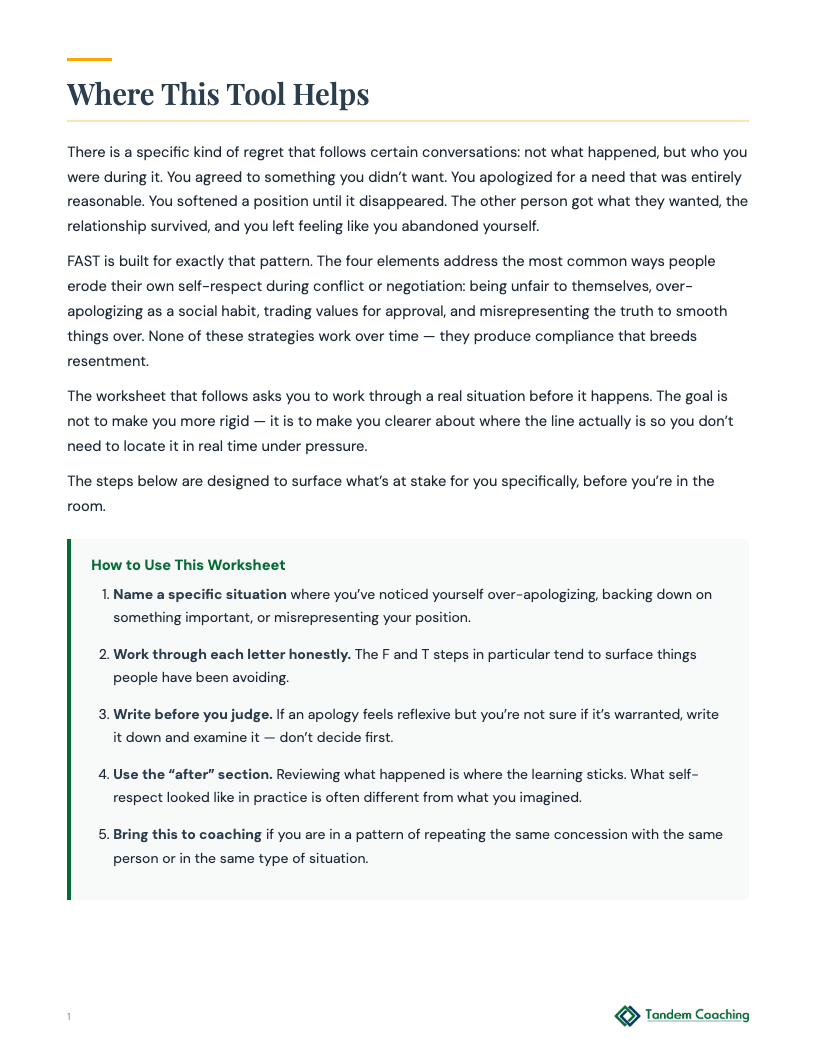
When to Use This Tool
A client tends to apologize, over-explain, or compromise their values to keep the peace
Someone who wants to hold their ground without damaging the relationship
Practicing Fair, No Apologies, Stick to Values, and Truthful in a real situation
How to Introduce This Tool Plus
When you're in a difficult conversation, where do you tend to lose yourself — over-apologizing, abandoning what you actually believe, or shading the truth to smooth things over?
Coaching Tool Disclaimer
This tool is designed for coaching contexts, not clinical use. If you or your client is in crisis, contact the 988 Suicide and Crisis Lifeline (call or text 988) or Crisis Text Line (text HOME to 741741).
Browse All Pages
Tool Classification
Domain
Relationships
Type
Worksheet
Phase
Action
Details
15 min
Mid session
As-needed
Topics
Identity
Communication
For the Coaching Practitioner
Plus
Coaching Scenarios
Plus
1 Manager who apologizes reflexively and then resents having done it ▶
Context
A senior manager opens almost every difficult conversation with an apology — for the request, for the timing, for taking up space. She is aware of it, has tried to stop, and cannot. The apologies are followed within hours by resentment toward the other person for accepting them.
How to Introduce
Position the A (No Apologies) step as the diagnostic, not the goal. 'The worksheet asks you to write down every apology that felt tempting — not to judge whether it was warranted, but to examine it. The question is whether each one is genuine or reflexive. A genuine apology is specific and repairable. A reflexive one is a social habit for managing discomfort. You can't stop the reflexive ones until you can tell them apart.' Some clients in this pattern have been told to 'just stop apologizing' and found it impossible. Normalize that: the worksheet creates the awareness that makes change possible, not the instruction.
What to Watch For
If the A section contains only 'no apologies were needed' after a conversation she described in session as difficult, she may be completing the worksheet retrospectively and editing out the apologies after the fact. Ask her to bring the worksheet to the conversation itself — written preparation before, brief notes after — rather than completing it from memory at the end of the day.
Debrief
Start with the A (No Apologies) section and ask: 'Which apology on this list, when you look at it now, do you think was genuine? Which was reflexive?' Then move to the 'After' section: 'When you read what you wrote about how the interaction felt — what did maintaining self-respect look like, versus losing it?' That contrast question surfaces the felt difference rather than the evaluative one.
Flags
If the worksheet shows a consistent pattern where the T (Be Truthful) section is the least complete — vague entries, sentences that trail off — she may be aware of a truth she needs to say and is not yet ready to examine it. Severity: low. Note the pattern; do not push before the coaching relationship can hold it.
2 VP who compromises values in executive team conversations to maintain standing ▶
Context
A VP consistently agrees with positions in executive team meetings that he does not actually hold, then voices his real view afterward to trusted peers. He describes it as 'playing the room.' The pattern is well-established and he is beginning to feel the identity cost.
How to Introduce
Frame the S (Stick to Your Values) step as the crux. 'Most of the worksheet is about preparation — naming what's actually true for you before you're in the room where the pressure is. The S step asks what you actually believe, and what it costs you when you trade that for agreement. For clients in this pattern, the most valuable thing the worksheet produces is an explicit list of what they've been trading away.' Some clients at this level minimize the values question as idealistic. Hold it: 'What has agreeing with positions you don't hold actually cost you over the past six months? That's not idealism — that's data.'
What to Watch For
Watch the F (Be Fair) section. Clients who over-compromise in groups often write exclusively about fairness to the other party — what the other person deserves, what the relationship requires — without addressing fairness to themselves. If the F section has no self-directed content, point it out: 'What does being fair to yourself look like in this situation? It's supposed to be both directions.'
Debrief
After the conversation, start with the 'After' section: 'What happened? How did the interaction go in terms of self-respect?' Then ask him to compare what he wrote in S before the conversation with what he actually said in the room. The gap between the prepared values statement and the in-room behavior is where the coaching work lives.
Flags
If the worksheet is completed thoroughly before conversations but the 'After' section consistently shows the same erosion — he knew what he valued, went into the room prepared, and still abandoned the position — the issue is not preparation. Severity: moderate. The block is likely relational or contextual: something specific about this group or this power dynamic that the worksheet preparation alone cannot address.
3 Client rebuilding self-respect after a manipulative working relationship ▶
Context
A director left a previous organization after a working relationship that had progressively eroded her self-trust. She second-guesses positions she knows to be correct, apologizes before others have expressed any concern, and describes feeling like she has to earn the right to her own view.
How to Introduce
Introduce this tool slowly and frame it as reconstruction work rather than skill-building. 'The four elements of FAST describe what intact self-respect looks like in a difficult interaction. We're not using this to perform self-respect in front of the other person — we're using it to rebuild your own sense of where the line is. Work through a real situation, but start with one where the stakes are lower. A peer relationship you trust, not the highest-pressure situation you're in.' Some clients in this profile have used tools like this before in a therapeutic context — check in before assigning.
What to Watch For
Watch for entries in the T (Be Truthful) section that describe telling a partial truth rather than the full one — softening language that reveals the truth is still not fully safe to state. If the T section consistently contains a version of the truth that protects the other person's feelings at the client's expense, the pattern from the prior relationship is still present.
Debrief
Start with the F (Be Fair) section and ask: 'What would being fair to yourself look like in this situation — what would that actually require?' Then, after the interaction, ask about the 'After' section: 'When you read what you wrote — were you present for yourself in that conversation? What's the evidence either way?' That framing keeps the debrief from turning into a self-criticism exercise.
Flags
If the client is completing the worksheet and finding it consistently painful — the exercise itself is activating — the coaching context may not be the right container for this particular pattern yet. Severity: moderate. Check whether she has therapeutic support alongside the coaching work. FAST is a coaching-appropriate tool for self-respect skill-building, but the underlying pattern may need more specialized attention.
4 High-achiever who tells partial truths to manage others' expectations ▶
Context
A managing director consistently softens bad news, overpromises timelines, and downplays risks in stakeholder conversations. He does not consider this dishonest — he frames it as communication management. The pattern is producing trust erosion with the board and his own team, which he is beginning to recognize.
How to Introduce
Lead with the T (Be Truthful) step and frame it as a strategic problem rather than an integrity one. 'The worksheet asks you to identify the truth you're tempted to exaggerate, downplay, or avoid. Not to make you uncomfortable about it — to examine what the cost of the managed version has been. The stakeholders who are losing trust aren't responding to your values; they're responding to a pattern of information that doesn't match reality. This is about what truth-telling in the specific situation would actually look and sound like.' Some clients at this level will resist the honesty framing as naive. Stay with the strategic framing — what does telling the truth buy him in the specific situation?
What to Watch For
If the T section describes 'being tactful' or 'framing it constructively' rather than naming the specific truth being softened, the step has not been completed. A completed T step names the exact content he is tempted to avoid: the specific number, the actual risk, the real timeline. Ask him to read it aloud and notice whether it is something he would say out loud to the person.
Debrief
After a conversation he used the worksheet to prepare for, start with the 'After' section: 'What did you actually say — and what truth were you prepared to tell that you held back?' The gap between preparation and delivery is the coaching question. Then ask: 'What would have happened if you had said the full version?'
Flags
If the A (No Apologies) section is the most fully completed in every worksheet — he is good at not apologizing, but the T section consistently shows managed truth — the tool is revealing a specific asymmetry. He maintains personal standing without maintaining honesty. Severity: low to moderate. That asymmetry is worth naming directly as a pattern.
Tool Flow
Plus
Requires
- named specific situation where self-respect eroded
→
Produces
- written fairness assessment for both parties
- map of reflexive versus genuine apologies in the situation
- named values at stake and cost of compromise
- post-interaction self-respect review
Pairs Well With
Executive
Shared Information and Feedback Map
Use this framework to structure a conversation about identity and communication while keeping interpretation with the client.
Why it pairsOnce you've mapped your client's reflexive apologies, this tests whether the relationship threat driving them is real or assumed by others.
ADHDEmotional Vocabulary Reference
A client wants more words for describing a recent emotional experience
Why it pairsUse this after the fairness assessment so your client can name exactly what capitulating feels like, not just which values they're compromising.
ADHDSocial Media Use Reflection
A client uses social media habitually but hasn't examined how it affects their mood and attention
Why it pairsUse this when the keep-the-peace pattern extends online, since social media approval loops may be reinforcing the same capitulation offline.
This tool is part of a coaching pathway
Step 4 of 6 in A client feels busy all day but doesn't feel productive at the end of it
Use after DBT DEAR MAN Skill. Then continue with Conflict Resolution Planner if that next job fits.
Next: Conflict Resolution Planner → Explore all pathways →Related Articles


Leadership Team Coaching: Why It’s Different and When Your Team Needs It
Read article →
When NOT to Use Team Coaching: 3 Conditions That Predict Failure
Read article →
Improving Your Relationships: The Role of a Relationship Coach
Read article →