

Social Media Use Reflection
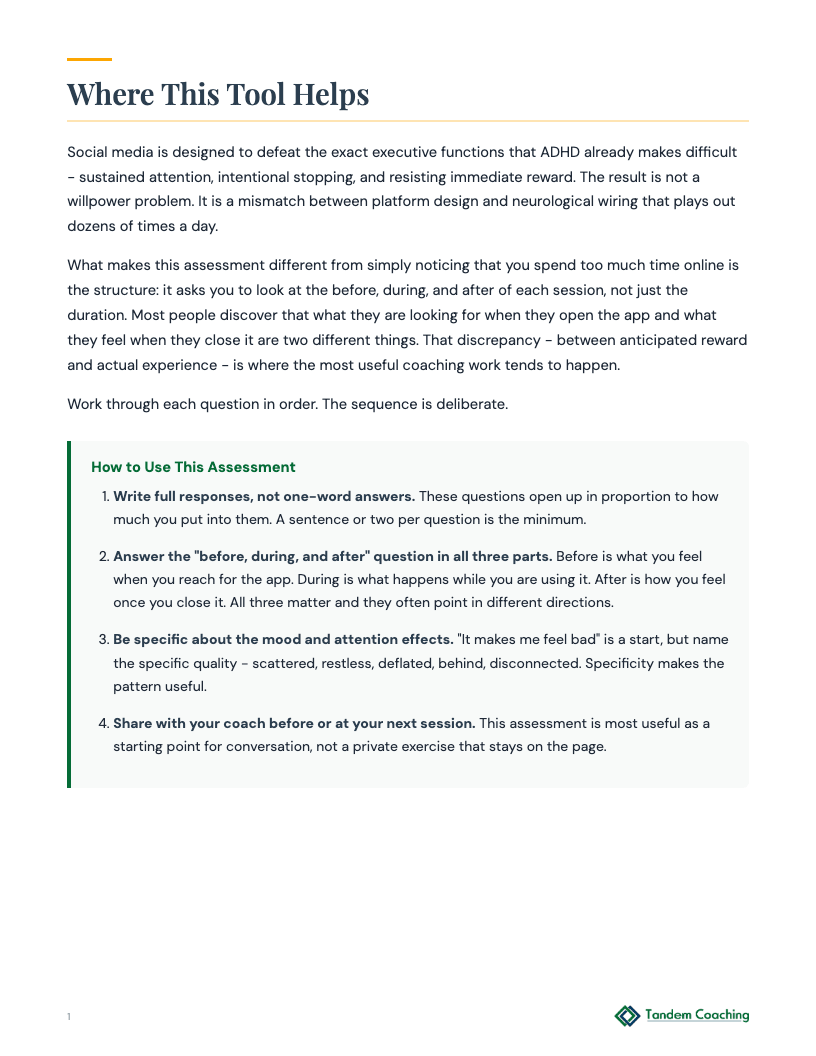
Reflect on what you hope for before social media use, what happens during it, and how you feel afterward.
Get This Tool
Free, print-ready PDF.
When to Use This Tool
A client uses social media habitually but hasn't examined how it affects their mood and attention
A client senses a gap between why they open social apps and how they feel when they close them
A client wants to explore their relationship with social media before deciding on any changes
How to Introduce This Tool Plus
What did you hope for before using social media, what happened during it, and how did you feel afterward?
Coaching Tool Disclaimer
This tool is designed for coaching contexts, not clinical use. If you or your client is in crisis, contact the 988 Suicide and Crisis Lifeline (call or text 988) or Crisis Text Line (text HOME to 741741).
Browse All Pages
Tool Classification
Domain
ADHD
Type
Assessment
Phase
Discovery
Reflection
Details
15 min
Between sessions
Topics
Habits
Identity
Communication
For the Coaching Practitioner
Plus
Coaching Scenarios
Plus
1 Naming the Emotional Function Social Media Serves ▶
Context
A client with ADHD who is a project coordinator uses social media throughout the workday - between tasks, during lunch, and during the first fifteen minutes after clocking out. He describes it as 'just a habit' and has not connected the behavior to any specific emotional state. His coach suspects the usage is functioning as a dopamine reset between cognitively demanding tasks, but the client has no language for that function. The assessment is needed to build enough self-awareness that a different approach to the same need becomes possible.
How to Introduce
Frame the four questions as a reflective, not a judgment: 'Before we decide whether social media is a problem worth solving, I want to know what it's actually doing for you. These questions map the function - what you get from it and what it costs. You don't need to have answers yet; write whatever comes up.' Assign it between sessions rather than in session, because the most honest answers tend to surface when the client has space to reflect without a coach watching.
What to Watch For
Watch for the client answering Question 2 (how do you feel before, during, after) with identical emotional states across all three moments - 'fine, fine, fine.' That flatness usually means the reflection didn't happen or the client is normalizing. Ask about a specific recent session: 'Walk me through the last time you picked up your phone. What had you just been doing?' The behavioral detail recovers what the abstract reflection misses. Also watch for the client using Question 4 (benefits and drawbacks) to produce only the drawbacks, signaling they've already decided social media is bad and are looking for validation rather than data.
Debrief
Start with Question 3 (effects on mood, attention, self-esteem, relationships): 'You listed attention as an effect. What direction - better or worse after a session?' The specific direction matters more than the abstract category. Then move to Question 4: 'What benefits did you write down?' Clients who dismissed the assessment often have a blank benefits column. A blank benefits column means the tool isn't meeting a real need for this client - the behavior might be more habit than function. If real benefits appear (mood regulation, connection, stimulation), the coaching question becomes how to meet those needs with less cost, not how to eliminate the behavior.
Flags
Coaching scope: do not diagnose, interpret symptoms, or recommend treatment. Adapt or stop for distress and use licensed health or emergency support when appropriate.
2 EF-Interaction: Social Media as an ADHD Task-Avoidance Portal ▶
Context
A client with ADHD who is a marketing strategist at a mid-size agency describes losing 45-90 minutes to social media on any day that includes a task she dreads. She knows the pattern intellectually - difficult task triggers avoidance, phone appears - but she cannot interrupt it in the moment. She has tried app timers and phone-free desk rules; both failed. The coach wants to use the assessment to identify which specific emotional state drives the avoidance pull, because 'difficult task' is not specific enough to build an interrupt around.
How to Introduce
Position the assessment as emotional forensics, not usage measurement: 'I don't need to know how many minutes you spend on Instagram. I need to know what you're feeling in the thirty seconds before you pick up your phone. Question 2 is the one I want you to focus on: the before state. Be specific - not just 'stressed' but what kind of stressed, what the physical sensation is, what you were in the middle of doing.' Assign it as a between-session exercise, but add a specific trigger: she should fill in Question 2 immediately after each avoidance episode this week, not at the end of the day.
What to Watch For
Watch for the client returning with Question 2 answers that describe the before state as 'bored' or 'tired' when the actual task pattern suggests anxiety about performance or evaluation. The ADHD avoidance response to challenging tasks is often labeled as boredom because boredom feels more neutral than fear. Ask: 'You wrote bored. What was the task you were avoiding when that happened?' If the avoided tasks are consistently ones with evaluation stakes, the underlying emotion is more likely dread than boredom. That distinction changes the coaching approach entirely. Also watch for her not completing the between-session tracking - avoidance of the avoidance mapping is itself data.
Debrief
Start with the before-state column from Question 2: 'Read me what you wrote for the before feeling.' Then ask: 'What was the task immediately before the phone appeared in each of those moments?' The pattern between task type and before state is the coaching target. Once the specific emotional precursor is named (dread of a certain type of task, anxiety about evaluation, frustration with ambiguity), the coaching conversation shifts to building a specific interrupt for that emotional state rather than a generic phone restriction.
Flags
Coaching scope: do not diagnose, interpret symptoms, or recommend treatment. Adapt or stop for distress and use licensed health or emergency support when appropriate.
3 After a Digital Detox Attempt Reveals the Real Need ▶
Context
A client with ADHD who is a nonprofit communications director attempted a two-week social media break after a coach recommendation and lasted four days before returning. She describes the attempt not as a failure but as revealing: the first two days she felt calm, the third day she felt disconnected and anxious, the fourth day she reinstalled everything. She came back to coaching with new data but no framework to interpret it. The assessment gives the coach a structure to help her make meaning of what the experiment surfaced.
How to Introduce
Frame the assessment as a retrospective on what the detox attempt revealed rather than as a new evaluation: 'You ran an experiment and got data. These four questions will help you read it. You've already lived through Question 2 - you know what before, during, and after felt like when you were off the platforms. Now write it down, and also write what changed on day three. The shift you noticed is the thing we need to understand.' Position the assessment as secondary to the client's own direct experience - she has more insight from the four-day experiment than any questionnaire could generate.
What to Watch For
Watch for the client framing the return to social media as proof she 'can't do it' rather than as information about what need the platforms are meeting. The assessment should redirect from the self-judgment to the question of function: 'You came back on day four. What did you feel in the moment you reinstalled the apps - not what you thought about it afterward, but what you felt?' That immediate emotional state names the need more accurately than any retrospective analysis. Also watch for her moving to action planning before the assessment has been processed - 'okay so I need a better plan for next time.' The coaching value is in understanding the function first.
Debrief
Read Question 1 back to her - why she originally started using each platform: 'Do those reasons still apply? Are they the same reasons you went back on day four, or different?' The gap between original reasons and current function often reveals how the relationship has shifted. Then move to Question 4's benefits column: 'What did you write down?' If 'staying connected' or 'feeling less isolated' appear, the detox attempt removed a genuine social need without replacing it. The coaching conversation becomes: what other channels meet the connection need she identified, and how does that change the approach to the next experiment.
Flags
Coaching scope: do not diagnose, interpret symptoms, or recommend treatment. Adapt or stop for distress and use licensed health or emergency support when appropriate.
Tool Flow
Plus
Requires
- None - standalone tool
→
Produces
- before-during-after social media pattern map
- mood and attention effects inventory
- identified drawback with clearest work impact
Pairs Well With
ADHD
Anger Context and Safety Reflection
Use this worksheet to explore emotions and identity and turn the client’s observations into one optional next step.
Why it pairsOnce a client sees that social media spikes their reactivity, use this to channel that emotional pattern into practiced, constructive anger strategies before it damages relationships.
LifeOptional Accountability Support Agreement
Use this worksheet to explore accountability and communication and turn the client’s observations into one optional next step.
Why it pairsOnce the assessment names the specific work-impact drawback, this agreement gives the client a structured commitment and check-in rhythm to act on that finding.
ADHDEmotional Vocabulary Reference
A client wants more words for describing a recent emotional experience
Why it pairsThe mood inventory from the assessment often surfaces vague labels like 'bad' or 'off' - this reference lets the client name those states precisely enough to track real patterns over time.
This tool is part of a coaching pathway
Step 1 of 6 in A client uses social media habitually but hasn't examined how it affects their mood and attention
Continue with Urge Surfing Weekly Log if that next job fits.
Next: Urge Surfing Weekly Log → Explore all pathways →Related Articles


Why the Best Technical Leaders Struggle When the Room Changes
Read article →
ADKAR Change Management Model: What to Do When You Find the Gap
Read article →
When Your Client Is Already Using AI: Coaching Through the Disruption
Read article →
The Loneliest Seat: What Changes When You Reach the C-Suite
Read article →