Core Values Reflection
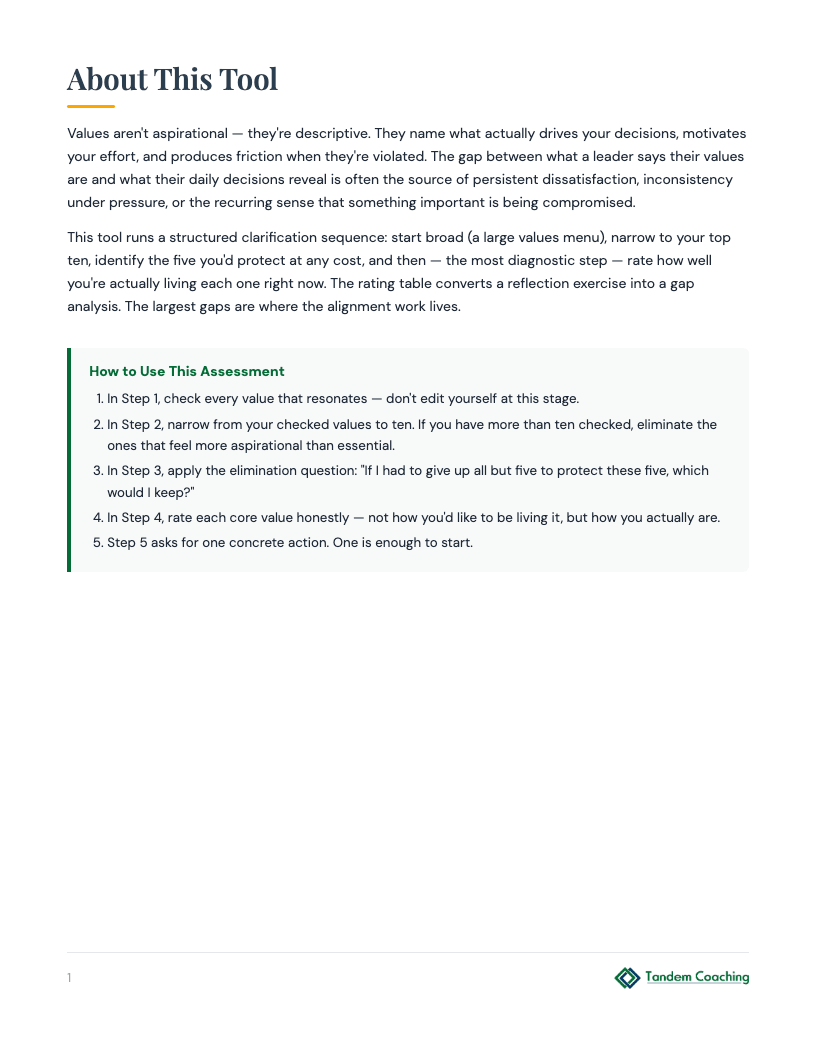
Narrow a broad values list, reflect on how each value appears in practice, and choose one client-owned action.
Get This Tool
Free, print-ready PDF.
When to Use This Tool
A client exploring which value words feel relevant in a changed role
Someone comparing several important considerations before a decision
A professional who wants language for current priorities and constraints
How to Introduce This Tool Plus
Which words felt useful or uncertain, and what specific examples helped you decide?
Browse All Pages
Tool Classification
Domain
Life Coaching
Type
Assessment
Phase
Discovery
Details
30 min
Between sessions
As-needed
Topics
Values
Identity
For the Coaching Practitioner
Plus
Coaching Scenarios
Plus
1 Senior manager promoted to director who feels disconnected from their work ▶
Context
A director who moved from hands-on project management to strategic oversight six months ago. They're performing well but report feeling 'empty' and questioning whether they want to stay in leadership. They think it's about missing the technical work.
How to Introduce
Present the list as optional vocabulary, not a test of hidden or fixed values. Invite the client to add, remove, or redefine words in their own terms.
What to Watch For
Ask for specific examples and current context. Do not infer motives, identity, diagnosis, or a correct decision from selections or ratings.
Debrief
Ask which word feels useful now, what evidence supports that choice, and whether one small action or additional question would help.
Flags
The worksheet is not diagnostic and does not resolve legal, financial, clinical, employment, or family-system decisions. Adapt or stop for distress and involve qualified support when appropriate.
2 Executive who inherited family business and questions staying versus selling ▶
Context
Third-generation CEO of a manufacturing company considering a sale offer. They've run the business successfully for eight years but feel increasingly conflicted about the decision. Family expects them to preserve the legacy, but they're drawn to other opportunities.
How to Introduce
Present the list as optional vocabulary, not a test of hidden or fixed values. Invite the client to add, remove, or redefine words in their own terms.
What to Watch For
Ask for specific examples and current context. Do not infer motives, identity, diagnosis, or a correct decision from selections or ratings.
Debrief
Ask which word feels useful now, what evidence supports that choice, and whether one small action or additional question would help.
Flags
The worksheet is not diagnostic and does not resolve legal, financial, clinical, employment, or family-system decisions. Adapt or stop for distress and involve qualified support when appropriate.
3 High-performing sales leader who consistently burns out their teams ▶
Context
VP of Sales with strong revenue results but high team turnover. They've been told their 'intensity' is the problem and want coaching on leadership style. They believe they need to learn to motivate people differently but don't want to compromise results.
How to Introduce
Present the list as optional vocabulary, not a test of hidden or fixed values. Invite the client to add, remove, or redefine words in their own terms.
What to Watch For
Ask for specific examples and current context. Do not infer motives, identity, diagnosis, or a correct decision from selections or ratings.
Debrief
Ask which word feels useful now, what evidence supports that choice, and whether one small action or additional question would help.
Flags
The worksheet is not diagnostic and does not resolve legal, financial, clinical, employment, or family-system decisions. Adapt or stop for distress and involve qualified support when appropriate.
4 Nonprofit director torn between mission impact and organizational sustainability ▶
Context
Executive director of a social services nonprofit facing budget constraints that require cutting programs. They're paralyzed between maintaining service levels and ensuring long-term organizational health. Board pressure is increasing and they feel like they're betraying their mission either way.
How to Introduce
Present the list as optional vocabulary, not a test of hidden or fixed values. Invite the client to add, remove, or redefine words in their own terms.
What to Watch For
Ask for specific examples and current context. Do not infer motives, identity, diagnosis, or a correct decision from selections or ratings.
Debrief
Ask which word feels useful now, what evidence supports that choice, and whether one small action or additional question would help.
Flags
The worksheet is not diagnostic and does not resolve legal, financial, clinical, employment, or family-system decisions. Adapt or stop for distress and involve qualified support when appropriate.
Tool Flow
Plus
Requires
- None - standalone tool
→
Produces
- up to five value words selected for reflection
- personal support notes for each selected value
- context or constraint notes
- one optional realistic action
Pairs Well With
Life
Optional Vision Context Board
Use this worksheet to explore creativity and identity and turn the client’s observations into one optional next step.
Why it pairsUse the selected words as optional prompts; confirm relevance with the client and avoid treating ratings as diagnostic evidence.
LifeWork-Purpose Context Map
Use this framework to structure a conversation about values and identity while keeping interpretation with the client.
Why it pairsUse the selected words as optional prompts; confirm relevance with the client and avoid treating ratings as diagnostic evidence.
LifeLife Purpose Discovery
A client wants to use Life Purpose Discovery as an optional reflection
Why it pairsUse the selected words as optional prompts; confirm relevance with the client and avoid treating ratings as diagnostic evidence.
Related Articles


Unlocking Your Potential as an Agile Coach: Exploring Different Paths for Professional Development
Read article →
Identity Architecture: How Career Shapes Who Leaders Become
Read article →
Core Coaching Techniques: A Reference Guide for Professional Coaches
Read article →
Evolving Your Coaching Skills: Mastering ICF Competencies for Career Growth
Read article →