Communication Style Assessment

Identify where your communication styles clash and get targeted strategies to reduce conflict, based on a validated communication-style framework.

Assessment · 15 min · Print-ready PDF · Free download

Get This Tool

Free PDF - professionally formatted, ready to print or fill digitally

Preview Assessment · 15 min
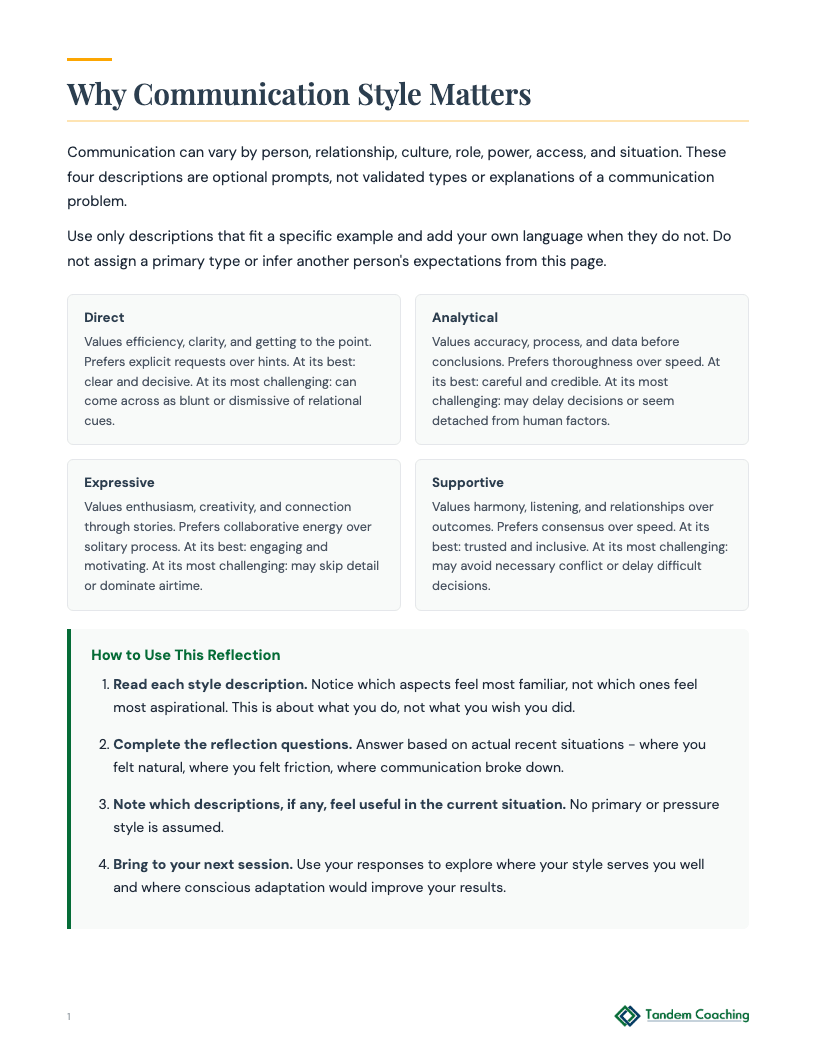
Communication Style Assessment - preview
When to Use This Tool
A client has friction with someone whose communication style differs from theirs
Understanding your own default style before trying to adapt to others
Building self-awareness around how you show up in conversations
How to Introduce This Tool Plus

How do you usually show up in conversations — do you tend to take charge, get analytical, read the room, or focus on people first?

Browse All Pages
Interactive Preview Assessment · 15 min
Tool Classification
Domain
Relationships
Type
Assessment
Phase
Discovery
Details
15 min Mid session
Topics
Communication Identity

For the Coaching Practitioner

Plus
Coaching Scenarios Plus
1 Manager whose direct reports find them intimidating
Context

A director has received 360 feedback that her team finds her 'abrupt,' 'hard to read,' and 'intimidating in one-on-ones.' She describes herself as efficient and direct. She is not hostile - she cares about her team and is confused that they experience her differently than she intends. She's worked with this team for two years and the feedback has been consistent across both cycles.

How to Introduce

Frame the assessment as a gap-mapping exercise, not a personality diagnosis. 'This assessment identifies your default communication style and what happens to that style under pressure. The feedback you're getting from your team probably comes from the pressure version - not from how you show up when things are going well. We need to know the difference between those two to understand what they're experiencing.' The 'style under pressure' field is where the 360 feedback will most likely be explained.

What to Watch For

Watch for a Direct style primary with a significant divergence in the pressure field - clients who lead with Direct style often shift to a more extreme version of that style under pressure (sharper, less context-given, less patient with questions), which reads as intimidating to Supportive or Expressive style team members. If the 'strengths in action' and 'where it creates friction' fields for the Direct style show awareness of the pattern, she has the raw material to work with. If she can name the friction only as 'other people take things personally,' the gap is larger.

Debrief

Start with the style under pressure and ask: 'What does your team see that's different from your default style?' Then move to the style-mismatch relationship: 'Which team member's style is most different from yours, and what specifically creates friction in your one-on-ones with them?' The friction field for her primary style is usually the most productive place to spend time. The session-starter question is worth asking directly: 'When you're in a one-on-one and it starts to go sideways, what's the first signal you get that something is off?'

Flags

If the client's primary style is Direct and her style under pressure description produces words that suggest contempt or impatience with other communication styles - 'I have no patience for people who need hand-holding' or 'people who take everything emotionally slow everything down' - the coaching conversation needs to address the underlying judgment before the behavioral adaptation work will take hold. Severity: moderate. Response: name the judgment pattern directly and explore what it would cost her to assume that the team's styles are adaptive rather than deficient.

2 Client in conflict with a peer whose communication style is opposite to theirs
Context

A product manager and a senior engineer have escalating friction that both describe as 'they just don't communicate the way I do.' The product manager is an Expressive style communicator who builds buy-in through relationship and narrative; the engineer is an Analytical style communicator who leads with data and finds narrative inefficient. Both believe the other is being difficult.

How to Introduce

Introduce this to each person separately before bringing the assessment into a shared conversation. 'We're going to map your default communication style and what happens under pressure. This doesn't explain whether the friction is justified - it explains the mechanism. Once you can see how the other person is probably experiencing your style, you can decide what to do about it.' Avoid framing one style as more or less appropriate for the context - both styles are adaptive, and the friction is about translation, not correctness.

What to Watch For

Watch for how each client describes the relationship field - specifically whether they name the style mismatch as the friction or whether they attribute the friction to the other person's character. 'Their style creates friction when they send a 40-slide deck for a 15-minute meeting' is a style observation. 'They're arrogant and don't care about people' is a character attribution. The coaching work is possible with the first framing and much harder with the second.

Debrief

Start with the friction field for their own primary style. 'What does this say about where your style creates problems for people who communicate differently?' Then move to the relationship they named. 'Based on what you know about your peer's style, which of your default behaviors is most likely to trigger friction for them?' This moves the client from being acted on by the mismatch to being able to observe and choose their response. The session-starter question is useful here: 'How do you usually show up in this specific relationship?'

Flags

If the client identifies the style mismatch accurately but expresses no interest in adapting - 'they need to learn to communicate properly' - the friction will continue regardless of the insight. Severity: low. Response: name the cost of the status quo directly. 'The mismatch is clear. The question is whether the cost of continuing it is worth avoiding the work of adapting.' If the client's answer is yes, that's a legitimate position - but it should be a conscious choice, not a default.

3 Professional who communicates differently with different audiences and wonders if they're being inauthentic
Context

A senior consultant describes adapting his communication style so significantly for different clients and stakeholders that he sometimes feels like a different person in different rooms. He's effective - he gets results and is well-regarded - but he's started to wonder if the adaptation is 'fake' and whether he has an authentic communication style at all. This has surfaced as a question about identity, not just professional skill.

How to Introduce

Separate the self-observation question from the authenticity question. 'What you're describing - adapting your style to different audiences - is a professional skill, not inauthenticity. This assessment is going to help us identify what stays constant across all those adaptations, which is your default style. The question isn't whether you change your style; it's whether you know what you're changing from.' The primary style and style under pressure fields are the anchor points for this conversation.

What to Watch For

Watch for whether the primary style he identifies is consistent with the style he defaults to under pressure. If they're very different, the adaptation skill may be masking uncertainty about his actual default - he may have been adapting for so long that his baseline is harder to access than for most clients. The 'strengths in action' field is particularly useful here: ask him to describe the strengths as they appear in his most natural communication moments, not his most strategic ones.

Debrief

Start with the session-starter question: 'How do you usually show up in conversations?' Then compare his answer to the primary style he identified. If there's a mismatch, that's worth exploring: 'You said you show up [X way] in most conversations, but your primary style assessment points to [Y]. Where does the difference come from?' The style under pressure field is often where his actual default surfaces most clearly - pressure strips away the strategic adaptation and what's left is the baseline.

Flags

If the client's uncertainty about his authentic communication style is connected to broader uncertainty about his professional identity - he can't name who he is when he's not performing for an audience - the question is bigger than communication style. Severity: low. Response: use the assessment findings as a grounding point ('here is what appears consistent across all your adaptations') and note that the identity question may need its own space in the coaching work.

Tool Flow Plus
Requires
  • None - standalone tool
Produces
  • identified primary and secondary communication style
  • style-mismatch relationship named
  • pressure-response communication pattern labeled

Pairs Well With

Relationships

Support Network Map

My client is going through something hard and seems to be handling it completely alone

15 min Worksheet
Relationships

Personal Support Team

I feel like I'm navigating everything alone and I'm not sure who I can turn to

15 min Worksheet
Relationships

Personal User Manual

My team doesn't always know how to work with me effectively and I want to change that

30 min Worksheet

Related Articles

Need a Career Transition Coach? Read This Guide First

Need a Career Transition Coach? Read This Guide First

Read article →
The Room Has No Chaos - And You Can't Figure Out Why That's the Problem

The Room Has No Chaos - And You Can't Figure Out Why That's the Problem

Read article →
Team Coaching Organizational Integration: Building a Lasting Capability

Team Coaching Organizational Integration: Building a Lasting Capability

Read article →
ICF Core Competencies: Managing Client Focus, Session Time, and Relationship Completion

ICF Core Competencies: Managing Client Focus, Session Time, and Relationship Completion

Read article →
ICF Core Competencies: Cultural Awareness

ICF Core Competencies: Cultural Awareness

Read article →
We are hired to give our clients solutions that work. Aren’t we?

We are hired to give our clients solutions that work. Aren’t we?

Read article →