Career Values Assessment

A client is dissatisfied at work but can't pinpoint why when the role looks fine on paper

Assessment · 30 min · Print-ready PDF · Free download

Get This Tool

Free PDF - professionally formatted, ready to print or fill digitally

Preview Assessment · 30 min
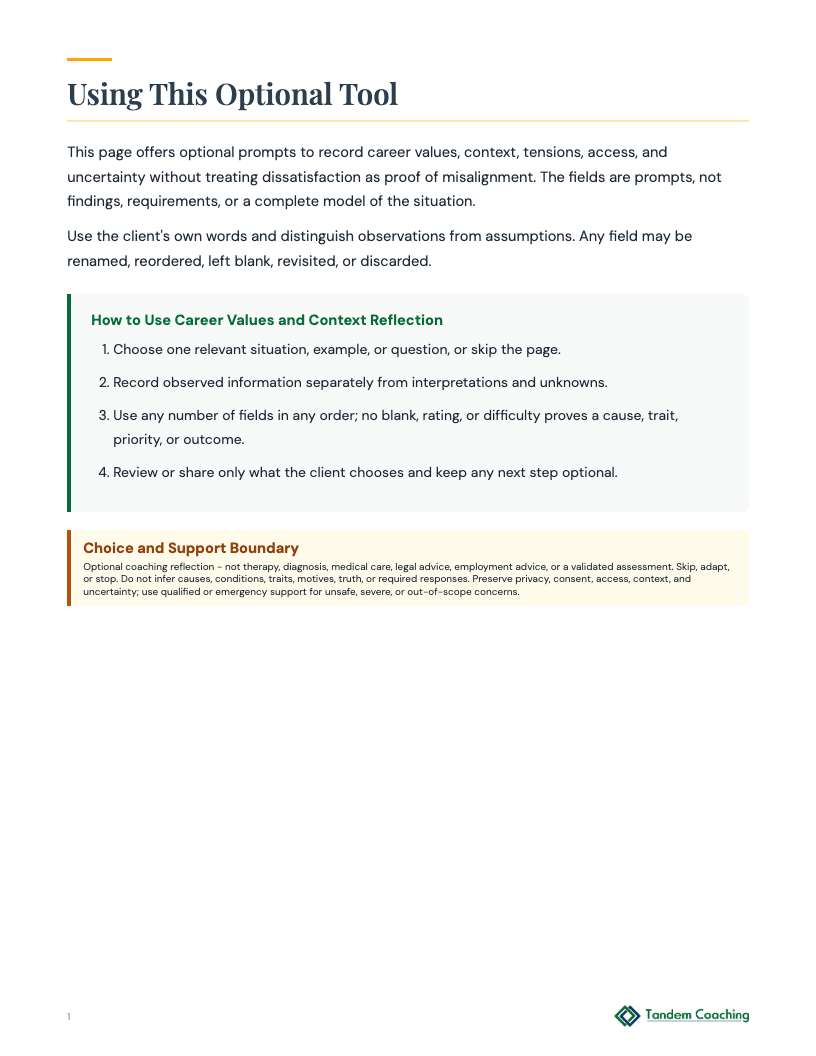
Career Values Assessment - preview
When to Use This Tool
A client is dissatisfied at work but can't pinpoint why when the role looks fine on paper
Someone examining personal values, business values, team values, and their connection to mission
Finding the gap between what they value and what their current environment actually rewards
How to Introduce This Tool Plus

When you compare what you named as most important to you personally with what your current work actually rewards — where is the gap most visible?

Browse All Pages
Interactive Preview Assessment · 30 min
Tool Classification
Domain
Career
Type
Assessment
Phase
Discovery
Details
30 min Between sessions As-needed
Topics
Values Career Transition

For the Coaching Practitioner

Plus
Coaching Scenarios Plus
1 The senior manager who describes the job as good but sits in sessions like someone who hates it
Context

A 39-year-old senior manager of regulatory affairs at a pharmaceutical company came to coaching with a 'general sense that something is off.' The role checks every objective box: compensation, title, stability, respected field. She can articulate no specific complaint. She has a high tolerance for discomfort and a tendency to defer to the evidence of external success when her internal experience contradicts it. The Career Values Assessment separates personal values from professional operating requirements, which is where the mismatch she can't name usually lives. She may be operating inside a culture that rewards precision and compliance when what she actually needs is room to create and influence.

How to Introduce

Frame this as building a diagnostic, not a verdict. 'You've said something feels off but you can't point to it. This assessment separates your personal values, your professional standards, and what you need from the people you work with — and then compares all three to what your current environment actually rewards. The mismatch, if there is one, usually shows up in the comparison.' The four-section structure gives her something concrete to work with: she's not being asked to decide anything, just to describe accurately. The resistance this scenario invites is loyalty to the external evidence — she may want to rate everything as 'somewhat aligned' because the job looks good on paper. Name it: 'I want you to answer based on your actual experience, not the job's resume.'

What to Watch For

Watch for the mission-values alignment section to reveal a significant gap between what she values personally — autonomy, creative input, advocacy — and what the culture rewards — compliance, precision, risk management. That gap often explains low-grade professional dissatisfaction better than any single event. Also watch for the team values section: if she names trust and transparency as requirements but rates her current team environment low on both, the coaching work may be about whether this specific team, manager, or culture can change — or whether the mismatch is structural and won't resolve without a move.

Debrief

Start with the comparison. 'Where is the gap widest — between what you named as important and what your current work actually rewards?' Let her identify it. Then: 'That gap — how long has it been true? Was it different two years ago, or has it always been this way?' Duration matters: a gap that's been growing slowly over years has different implications than a new mismatch following a leadership change. Close with: 'If the gap stayed exactly this wide for the next three years — what does that cost you, specifically?'

Flags

Array

2 The high performer who just received a promotion and immediately started feeling miserable
Context

A 34-year-old team lead at a management consulting firm was promoted to manager six weeks ago. She was the standout candidate. The promotion was celebrated. She now feels worse than she has in years and can't explain why to herself or anyone else, because the promotion was supposed to be the goal. The Career Values Assessment — specifically the section separating personal values from professional identity and the team values section — will help surface whether the work she's been recognized for actually aligns with what she values, or whether she's been optimizing for a career track that was never hers to begin with.

How to Introduce

Frame this as a timing question, not a problem statement. 'Promotions sometimes surface a values question that gets hidden when you're striving toward a goal. Now that you're here, it's worth asking: is this the kind of work you actually want to be doing? This assessment separates what you value personally, what you need professionally, and what you require from your environment — and then looks at what this role actually asks of you.' The personal values section is the key one: most fast-moving high performers have been operating from professional identity for so long that personal values haven't been examined since early career. The promotion disrupts the forward momentum that made this invisible.

What to Watch For

Watch for the professional values section to be well-developed and precise — she knows exactly what she's been rewarded for — while the personal values section is thin or vague. The asymmetry is the signal. Also watch for the team values section: as a new manager, she now has direct reports. If what she requires from the people she works with (intellectual peers, high autonomy, low supervision) is the same thing her reports need from her, she may be experiencing role inversion — she's now the structure she historically needed to escape from.

Debrief

Start with the personal values section. 'Walk me through what you put in personal values — the ones you'd hold regardless of the title.' Then compare to professional: 'Now look at what this manager role actually requires of you, week to week. Where do those two lists point in the same direction, and where do they pull apart?' The gap between personal values and the role's actual demands is usually where the discomfort is living. Close with: 'The promotion was the goal for several years. Now that you're here — is this the right goal, or was it a useful proxy for something else?'

Flags

Array

3 The nonprofit director preparing to move into the private sector who hasn't examined what she's trading
Context

A 46-year-old executive director of a community health nonprofit is seriously considering a move into the healthcare corporate sector. The financial motivation is clear and legitimate — she has been underpaid relative to her skill level for over a decade. She has framed the decision as purely pragmatic. The Career Values Assessment surfaces what the pragmatic framing is obscuring: mission alignment is one of her highest-rated personal values, she has spent twenty years in purpose-driven work, and the private sector role she's considering operates explicitly to serve shareholders. She hasn't examined the trade she's making, only the financial side of it.

How to Introduce

Frame this as due diligence before a major decision. 'You're making a significant move and you've evaluated the financial side carefully. This assessment adds the values side — not to talk you out of anything, but to make sure you're choosing with full information.' The mission-values alignment section is the one to emphasize. 'I want you to complete the mission alignment section honestly — not what you hope the corporate role will feel like, but what you know about how that organization operates and what it's actually optimizing for.' The compare-and-contrast between current role and target role is the output of this tool in this context.

What to Watch For

Watch for her to rate the target role's mission alignment as moderate (not low) because she's found a genuine healthcare mission in the company's framing — clinical impact, access, population health. If the corporate employer does have meaningful mission overlap, that's a real factor. If she's rationalizing, the rating will soften in conversation when she tries to describe it concretely. Also watch for the team values section: she may have strong requirements for team culture that she's never had to name before because her environment has always matched them. A values assessment done for the first time immediately before a move often surfaces requirements the client assumed were universal.

Debrief

Start with the mission alignment section. 'You rated your current role's mission alignment and the target role's mission alignment. Walk me through what you wrote for both.' Then: 'If the salary were identical — same number — which role would you choose, and why?' That question removes the financial variable and tests whether the move is about money or also about something she hasn't named. Close with: 'What's the version of this move where you look back in three years and feel good about it — not just about the outcome, but about who you were when you made it?'

Flags

Array

Tool Flow Plus
Requires
  • None - standalone tool
Produces
  • personal values list separate from work identity
  • professional operating principles and decision standards
  • named requirements from colleagues and team environment
  • written mission-values alignment statement with identified gaps

Pairs Well With

Career

Career Change Exploration Worksheet

A client has been thinking about a career change for months but hasn't committed to a direction

45+ min Worksheet
Life

Ikigai

Client is successful by external measures but cannot articulate why the work feels hollow

30 min Framework
Career

Career Reflection Journal

A client feels stuck in their career but isn't sure what they actually want

45+ min Worksheet

Related Articles

Chief AI Officer Career Path: Is CAIO Right for You?

Chief AI Officer Career Path: Is CAIO Right for You?

Read article →
Executive Psychological Readiness Assessment for Career Change

Executive Psychological Readiness Assessment for Career Change

Read article →
Change Management Certification: Compare Credentials and Choose

Change Management Certification: Compare Credentials and Choose

Read article →
Executive AI Vulnerability Assessment | Know Where You Stand

Executive AI Vulnerability Assessment | Know Where You Stand

Read article →
What Is an Executive Coach? Process, Credentials & Results

What Is an Executive Coach? Process, Credentials & Results

Read article →
Executive Career Reinvention: When Starting Over Makes Sense

Executive Career Reinvention: When Starting Over Makes Sense

Read article →