Assertive Communication Practice
Practice facts, feelings, requests, and boundaries for an ordinary, mutually safe conversation.
Get This Tool
Free, print-ready PDF.
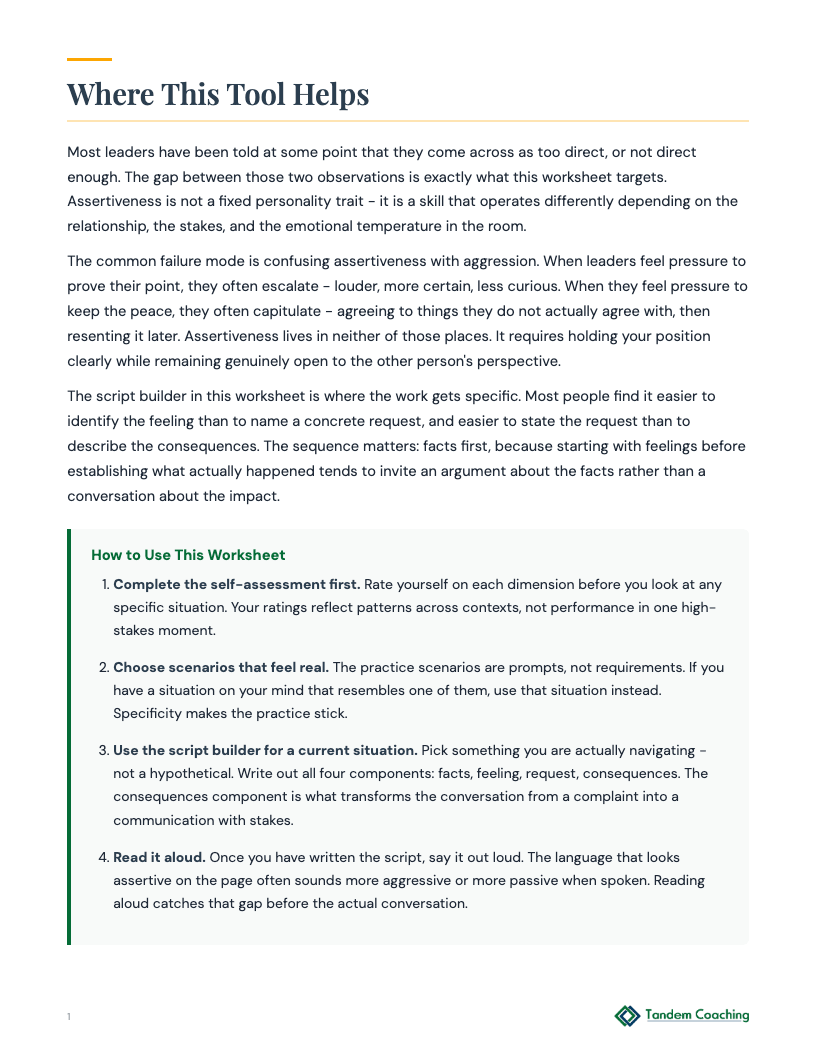
When to Use This Tool
A client says yes when they mean no and struggles to ask for what they actually need
Someone rating their assertiveness across seven dimensions and practicing with a real scenario
Scripting the facts, feeling, request, and consequences before a difficult conversation
How to Introduce This Tool Plus
For an ordinary, mutually safe conversation, what fact, feeling, request, or boundary do you want to state clearly?
Browse All Pages
Tool Classification
Domain
Relationships
Type
Worksheet
Phase
Discovery
Action
Details
30 min
Mid session
As-needed
Topics
Communication
Identity
For the Coaching Practitioner
Plus
Coaching Scenarios
Plus
1 Senior leader who accommodates peers but not direct reports ▶
Context
Your client is a VP who scores themselves high on assertiveness in most contexts but consistently capitulates in peer-level cross-functional meetings. They have no trouble redirecting direct reports or holding positions with subordinates. The pattern is specific: when facing peers with equal or adjacent authority, they fold on positions they believed going into the meeting.
How to Introduce
Frame this as calibration, not development. 'You are clearly capable of assertiveness - the question is what's different in the peer context that changes how you respond.' Use the seven-dimension self-assessment to identify which specific dimensions drop in peer settings versus others. The resistance pattern to watch for: high performers sometimes resist assertiveness framing because they associate it with bluntness or aggression. Name this distinction before starting - assertiveness is position-holding, not confrontation.
What to Watch For
Look at how your client rates 'Expressing Opinions' versus 'Holding a Position Under Pressure' - these two often diverge significantly. If Opinion is high and Position is low, the client can articulate a view but cannot maintain it. The scenario practice section will tell you more: watch whether the script they build in the scenario has escalating language ('I understand your point... and I also think...') or immediate concession language.
Debrief
Start with the dimension ratings, not the scenario. Ask your client to identify the dimension where the gap between what they believe and how they behave is widest. Then move to the SBI script they built. 'Read me the Request line. If someone pushed back on this in the meeting, what would you actually say next?' The answer to that follow-up reveals whether the script is preparation or performance.
Flags
If your client's peer capitulation is longstanding and specifically tied to people with status markers they find threatening (title, credentials, perceived organizational power), explore whether the pattern predates the current role. Severity: low. Response: continue coaching, and note whether self-concept in relation to authority figures may warrant deeper exploration.
2 People-pleaser who experiences physical symptoms before direct conversations ▶
Context
Your client describes their assertiveness deficit in physical terms - racing heart, voice tightening, mind going blank - specifically in moments where they need to decline something or hold a boundary. They have identified this as a problem worth addressing but every attempt to 'just be more direct' has failed. The body response overrides the cognitive intention before the words are out.
How to Introduce
Frame this as building rehearsed language as a workaround for the physiological pattern. 'When the body takes over, the brain needs a script it can execute automatically - because improvising in that state is extremely difficult.' The SBI structure matters here specifically because it is concrete enough to memorize and short enough to complete before anxiety escalates. Name upfront that the goal is not eliminating the physical response but reducing its veto power.
What to Watch For
Watch whether your client avoids the 'Consequences' field in the SBI builder - articulating what happens if the boundary is not respected is where anxiety typically spikes. If that field stays blank or vague ('I'd be disappointed'), the script will not hold under real pressure. Also watch whether the scenario they choose for practice is low-stakes enough to be trivial rather than genuinely representative of the situations they are avoiding.
Debrief
Ask your client to practice saying the SBI script out loud in the session - not read it, but say it. Notice what happens to their pacing and voice quality. The gap between the written script and the spoken version is diagnostic. Then ask: 'Where in this script would your body respond most?' Use that answer to rebuild that specific line until it feels more automatic.
Flags
If the physical symptoms are severe enough to constitute panic - shaking, difficulty breathing, dissociation - this moves beyond assertiveness coaching into territory that warrants physiological support. Severity: moderate. Response: continue the worksheet work for between-session practice, but explore whether the client has support for the somatic component. Consider referral to a somatic practitioner or therapist if the pattern is entrenched.
3 Manager told by their own manager to be 'more direct' without specific guidance ▶
Context
Your client received feedback in their performance review that they need to be 'more assertive and direct.' The feedback was not accompanied by specific examples or behavioral guidance. Your client is unclear whether this is about pace of decision-making, willingness to challenge upward, or how they handle disagreement in team settings. They are trying to address feedback they cannot fully decode.
How to Introduce
Frame the seven dimensions as a way to decode the feedback rather than as a self-improvement tool. 'Before we work on assertiveness, we need to figure out which dimension the feedback was actually pointing to. Not all assertiveness is the same behavior.' Walk through the self-rating as a diagnostic exercise. Then use the scenario practice to test the specific situations where the client suspects the feedback originated.
What to Watch For
Watch whether your client rates themselves uniformly across all seven dimensions - either uniformly low (over-correcting in response to the vague feedback) or uniformly high (defensive and unable to find the signal). Either extreme suggests they are responding to the label 'assertive' rather than examining their actual behavior. The dimensions where they are least certain are usually the most informative.
Debrief
After completing the self-rating, ask: 'Which of these seven areas do you think your manager observed when they gave that feedback?' This forces specificity about the source scenario. Then build an SBI script for that specific type of situation. The closing question: 'What would you need to see from yourself over the next 30 days to know the feedback has been addressed?'
Flags
If the performance review feedback on assertiveness is accompanied by other concerns - or if your client suspects the real issue is about something else being labeled as assertiveness - explore that framing before the tool work. A worksheet designed to build assertiveness behaviors will not address a relationship or credibility issue that is presenting itself as an assertiveness concern. Severity: low. Response: proceed with the tool, but hold the diagnostic question open.
Tool Flow
Plus
Requires
- None - standalone tool
→
Produces
- assertiveness baseline rating across seven dimensions
- scripted assertive response for real situation
- identified assertiveness pattern under pressure
Pairs Well With
Executive
Shared Information and Feedback Map
Use this framework to structure a conversation about identity and communication while keeping interpretation with the client.
Why it pairsAfter mapping their assertiveness pattern, this reveals whether colleagues perceive that same pattern or see something the client hasn't noticed.
ADHDEmotional Vocabulary Reference
A client wants more words for describing a recent emotional experience
Why it pairsIdentifying the exact emotion behind the yes-when-they-mean-no reflex shows why the scripted assertive response breaks down under real pressure.
ADHDSocial Media Use Reflection
A client uses social media habitually but hasn't examined how it affects their mood and attention
Why it pairsAttention and mood dips from habitual scrolling can erode the capacity to hold assertive stances when it matters most.
This tool is part of a coaching pathway
Step 1 of 6 in A client says yes when they mean no and struggles to ask for what they actually need
Continue with DBT FAST Skill if that next job fits.
Next: DBT FAST Skill → Explore all pathways →Related Articles


ADHD and People-Pleasing: Why I Say Yes When I Should Say No
Read article →
Coaching Supervision Models: How They Actually Work in Practice
Read article →
What ICF Actually Says Coaches Can and Can't Do With AI
Read article →
Executive Team Coaching: What It Is, How It Works, and When Your Team Needs It
Read article →