Get a clear baseline of satisfaction across key life areas with an ADHD-informed Wheel of Life used in adult coaching.
Free, print-ready PDF.
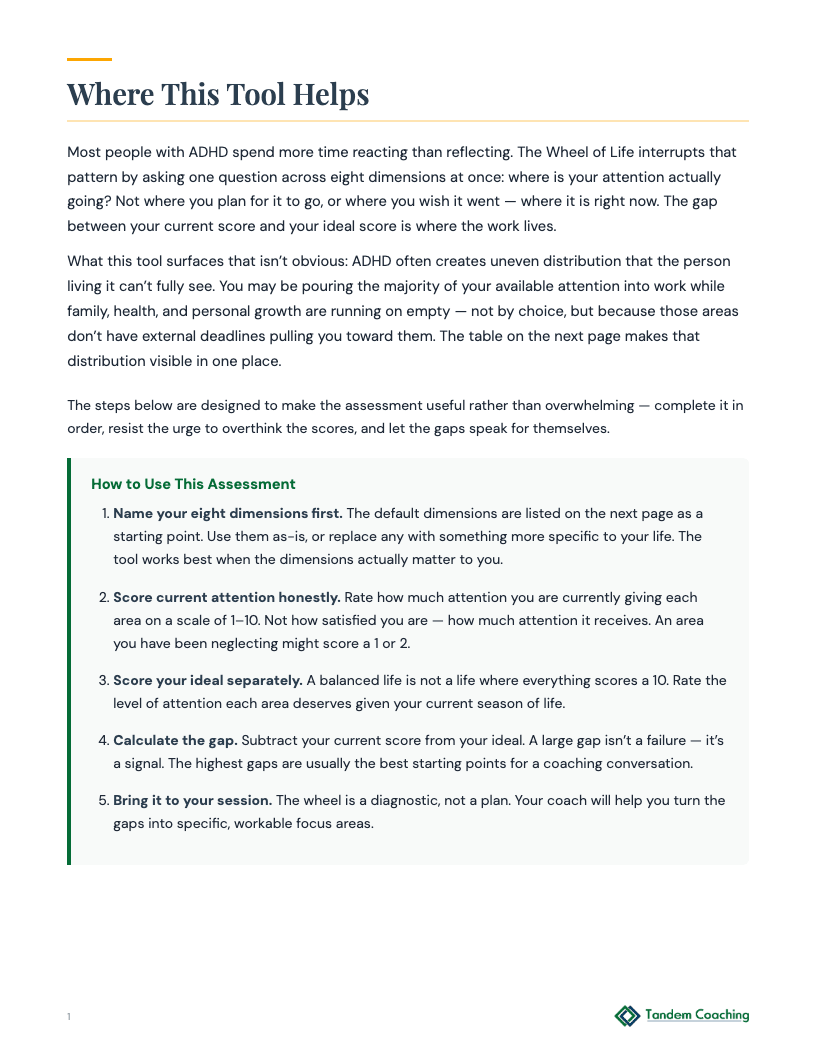
Before we decide where to focus, it helps to see the whole picture. This wheel maps eight areas of your life and shows where you are now versus where you want to be.
Director of Operations at a manufacturing company, recently diagnosed with ADHD at 38. Came to coaching because their partner threatened to leave if work doesn't stop consuming their entire life. Client believes they just need better time management skills.
Frame this as attention tracking, not life balance. 'ADHD brains often pour available attention into whatever has the most urgency or dopamine. Let's map where yours actually goes.' Expect resistance to scoring personal areas low - they'll want to rate based on importance rather than actual attention given.
Work/career will likely score 8-10 current, while health, relationships, and fun score 2-4. Watch for the client trying to inflate personal scores because low numbers feel like admitting failure. The gap calculation is where the real data emerges - they often haven't seen the math.
Start with the highest gap, not the lowest score. 'Your relationship gap is 6 points. What would happen if you gave that area just one more point of attention?' Then explore the work score: 'Work gets a 9. Is that sustainable, or is that where your brain defaults when everything else feels overwhelming?'
If work scores 9-10 and three or more personal areas score below 3, this may indicate ADHD hyperfocus masking as workaholism. Severity: moderate. The partner's ultimatum suggests relationship crisis. Explore whether the work focus is dopamine-driven or avoidance of areas that feel less manageable.
VP of Marketing at a tech startup, three months into role after being laid off from previous company. Keeps saying they need to 'get their life together' but deflects every assessment tool as 'not the right time.' Presents as overwhelmed rather than focused.
Position this as triage, not evaluation. 'This isn't about fixing everything - it's about seeing which area is bleeding the most attention right now.' Name the avoidance directly: 'Most people resist this when everything feels broken. The tool works better when things are messy, not when they're sorted.'
Client may rush through scoring to get it over with, or spend excessive time trying to make scores 'accurate.' Both are avoidance. Look for scores clustered in the middle (5-6 range) across multiple dimensions - this usually means they're not engaging with actual current state.
Ignore the scores initially. Ask: 'Which dimension did you least want to think about while filling this out?' That's where the conversation lives. Then: 'If you could only improve one area in the next month, which would create the most stability for everything else?' Focus on foundation, not balance.
If client scores everything between 4-6 and shows visible distress during completion, they may be in crisis rather than transition. Severity: moderate. Multiple major life changes (job loss, new role, general overwhelm) can indicate need for more support than coaching alone provides.
CFO at a mid-size nonprofit, been in role for six years. Came to coaching for 'executive presence' development but describes their life as already well-balanced. Prides themselves on leaving work at work and maintaining boundaries.
Frame as calibration rather than assessment. 'You describe your life as balanced, which is rare. Let's see what that actually looks like on paper.' Don't challenge the balance claim upfront - let the tool reveal whether it's genuine balance or strategic underinvestment in growth areas.
Look for artificially even scores across dimensions - this often indicates the client is managing to an ideal rather than reporting reality. Career/business may score surprisingly low for someone seeking executive development. Personal growth might also be underscored if they're avoiding challenge.
Start with their lowest gap areas. 'Your scores are remarkably even. Is that intentional management or natural balance?' Then focus on career: 'You rated career attention at 6 but came here for executive presence. What would an 8 in career attention actually require?' The resistance to that question is the coaching work.
If career scores below 6 and personal growth scores below 5, while other areas score 7+, client may be using life balance to avoid professional risk-taking. Severity: low. This is strategic underinvestment rather than crisis, but may limit coaching effectiveness if not addressed.
Regional Operations Manager for a retail chain, supporting elderly parents while paying off student loans. Came to coaching for 'work-life balance' but every conversation returns to money. Claims finances are 'handled' but seems stressed about every decision.
Present as resource allocation mapping. 'You mention balance, but let's see where your mental energy actually goes day to day.' Expect them to score finances higher than reality - financial stress often gets minimized because it feels unsolvable. Focus on attention, not satisfaction.
Finances may get scored as 7-8 (because they're paying bills) when actual attention/worry is 9-10. Look for other dimensions scored artificially low because 'I can't afford to think about that right now.' The ideal scores will reveal what they're postponing until finances improve.
Start with the gap between current and ideal for finances. 'You scored finances 7 current, 8 ideal - only a 1-point gap. But you mention money in every session. What if we rescored based on mental energy spent worrying rather than tasks completed?' Then explore what's on hold.
If client consistently mentions financial pressure but scores finances as adequately attended to, there may be shame or learned helplessness around money management. Severity: moderate. Financial stress can undermine coaching progress if not acknowledged as a legitimate constraint on other life areas.
A client is frequently dysregulated and needs a grounding tool they can use independently
ADHDADHD adult who wants to set intentions across multiple life domains at the start of each month
ADHDADHD adult who feels chronically drained but can't identify what's taking their energy
Step 1 of 6 in ADHD adult who needs a baseline picture of satisfaction across all life areas
Next: Conflict Resolution Planner → Explore all pathways →